


When the legendary fine art photographer David Yarrow calls you answer. Not least when he says he wants to extend his famed art photography of wild things to the animal that most closely resembles the wild ancestor of all modern cattle (Bos taurus), the aurochs (Bos primigenius primigenius.)
David’s up close and personal shots of the beasts of the wilderness, reproduced on the internet ad infinitum, but in actuality produced as vast, wall-sized prints of the highest quality, hair-fine resolution, sell for tens – sometimes hundreds – of thousands of pounds, euros and dollars.

CHARGE by David Yarrow (2013)

Cara Delevingne with lion for Tag Heuer #dontcrackunderpressure campaign by David Yarrow (2018)
The Spanish toro de lidia, aka toro bravo, ‘brave bull’, comes in the top ten genetically for relatedness to the ancestral aurochs, and six of the others in the top ten are its Spanish cousins (including the berrendas who feature later.) However, the toro bravo is the closest in phenotype – anatomy, morphology and behaviour – by far.

The Aurochs from Vig, whose skeleton is in the National Museum of Denmark, weighed almost 1000 kg (2,200 lbs), and its shoulder height was almost 2 metres (6 feet 6 inches.)

You can see the relatedness of the toro de ‘Lidia’ to a British fossil of aurochs, in this summary for Rewilding Europe of the paper ‘Genetic origin, admixture and population history of aurochs (Bos primigenius) and primitive European cattle‘, published in the journal Heredity in 2016.
Having received my brief, I knew exactly where to go: the one breeding ranch, founded in 1847, which is famed for the cattle that most closely match the vast size of the aurochs of all strains of toros bravos and whose extraordinary ‘feral’ (I mean that in the biologist’s sense of the word) aggression most matches the aurochs’ wild character. It is the family name which conjures most fear among matadors. As Ernest Hemingway put it in his 1932 classic, Death In The Afternoon:
There are certain strains of bulls in which the ability to learn rapidly in the ring is highly developed. These bulls must be fought and killed as rapidly as possible with the minimum of exposure by the man, for they learn more rapidly than the fight ordinarily progresses and become exaggeratedly difficult to work with and kill. Bulls of this sort are the old caste of fighting bulls raised by the sons of Don Eduardo Miura of Sevilla… which made them the curse of all bullfighters.
A study by the University of Complutense in Madrid, published as ‘Ancestral matrilineages and mitochondrial DNA diversity of the Lidia cattle breed‘ in the journal Animal Genetics in 2008 showed how among the toros bravos which all show “a certain degree of primitivism”, the Miuras stand alone as a breed-within-a-breed.
That’ primitivism’ is the reason why Ferruccio Lamborghini, formerly a friend and customer of Enzo Ferrari, took the bull as his logo to contrast with the ´prancing pony´, and why the world’s first supercar was launched under the name Lamborghini Miura in 1967.
As you can see below, Ferruccio personally took it to Spain and drove it to show it to old Eduardo Miura, father of the present owners, brothers Eduardo and Antonio. Several more models from that marque also took their name from individual Miura bulls afterward: from the Islero in 1968 to the Murciélago in 2001.

Autumn 1968. Finca Zahariche in Lora del Río, Spain. Standing, in a black suit, Ferruccio Lamborghini, next to Eduardo Miura, patriarch of the famous family of fighting bull breeders. The year before, the legendary car began to be sold, the Lamborghini Miura, the first supercar in history.
The present Don Eduardo Miura – whose son ‘Eduardito’ joined us in the ring – and his brother Don Antonio assembled their team on the ranch, headed by their nephew, matador Eduardo Dávila Miura, my taurine mentor and one of the most remarkable men I know and have the honour to call my friend (if you want to know why I speak in superlatives when I speak of him, read the later chapters in my book Into The Arena: The World Of The Spanish Bullfight.)
Because Mr Yarrow’s primary interest is in the magnificence of the wild, not the ethical and aesthetic complications of the corrida, the bull we selected for photography had never, and will never again, entered a bull ring.
Pañoleto, 10th of that name, is a sire of bulls, a semental, or ‘seed’ bull. Eight years old and untouched, almost three quarters of a ton and so wise he speaks, as they say here, Latin and Greek. However, he still has racehorse-speed and a polo pony-turn, as I was to discover to my detriment.
Since almost no bullfighters speak English, I also assembled a bilingual translation team whom I knew would not flinch when standing behind a slim wooden barrier when confronted with minotaurs. Klarina Pichler is Austria’s number one professional polo player, its best horse breeder and trainer, and my girlfriend. Richard Dunwoody is a professional photographer, but also former three-time British Champion Jockey, and who won the Grand National twice. )I met Richard when he reached out to me many years ago after reading my book The Bulls Of Pamplona – it even has a chapter by my friend John Hemingway, Ernest’s grandson – and we went to run together to run the oldest of all bull-runs, that of Cuéllar, in Old Castille, where they first ran in 1215 AD.
Our team arrived at Finca Zahariche, of Ganaderia Miura, as the sun rose, and crossed under that imposing gateway.

The finca Zahariche of the Spanish fighting bull breeders’ Miura © 2024 Klarina Pichler – All Rights Reserved
After young Eduardito Miura brought the bull in on horseback, using berrenda oxen to guide him as always, for they are only manageable as part of a herd…

Oxen of the red berrenda breed and the toro bravo Pañoleto at the finca Zahariche of the Spanish fighting bull breeders’ Miura © 2024 Richard Dunwoody – All Rights Reserved
…Eduardo Dávila Miura (below left) and I (right) came up with a game strategy which almost perfectly illustrated that great philsopher of war, von Moltke’s famous saying, “No plan of battle survives first contact with the enemy.”
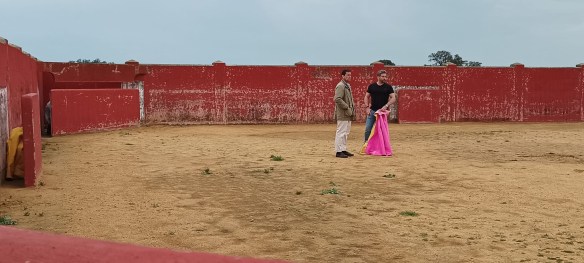
Matador Eduardo Dávila Miura and Alexander Fiske-Harrison in the plaza de tienta of the finca Zahariche of the Spanish fighting bull breeders’ Miura © 2024 Klarina Pichler – All Rights Reserved
What even people who know bulls well in other contexts – aficionados of the corrida or runners of the encierros in the Pamplona manner – may not understand are the parameters of the work which we were doing. This bull had to enter and leave without harming a hair on his hide. He is so valuable as a breeding bull he is untouchable. As a result, he was not worn down as a bull is in the corrida, nor could we risk him cracking a horn on a wall or wooden hide or even twisting an ankle as he might in an encierro.
We humans were not afforded such courtesies. On our side of the equation, there were no surgeons nearby as in a formal corrida, or paramedics as in an encierro, and we were at least an hour’s drive from the nearest hospital. Hence our first attempts were definitely a learning curve.
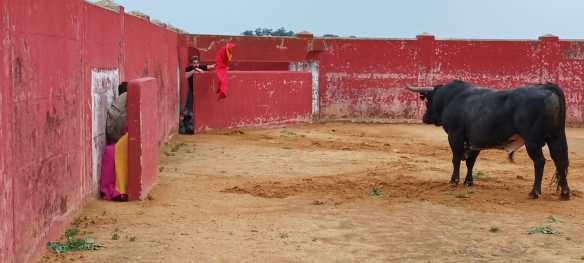
Matador Eduardo Dávila Miura, Alexander Fiske-Harrison and David Yarrow in the plaza de tienta of the finca Zahariche of the Spanish fighting bull breeders’ Miura © 2024 Klarina Pichler – All Rights Reserved
And quickly resulted in a static impasse.
It was to break this stalemate that I made my mistake: I abandoned the techniques of classical toreo, with the two-handed cape and the red muleta, which I had learned in the rings of Andalusia for a decade and a half, and switched to what I had learned after a similar period, but more intensely, running with bulls in the streets of Pamplona, Navarre and Old Castille: I used my body as the lure – as Richard´s photos show.
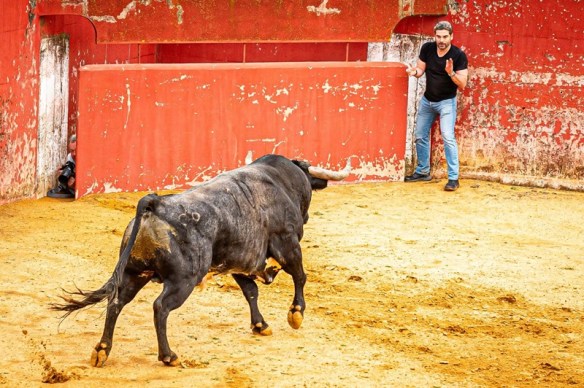
David Yarrow, Alexander Fiske-Harrison and Pañoleto at the finca Zahariche of the Spanish fighting bull breeders’ Miura © 2024 Richard Dunwoody – All Rights Reserved
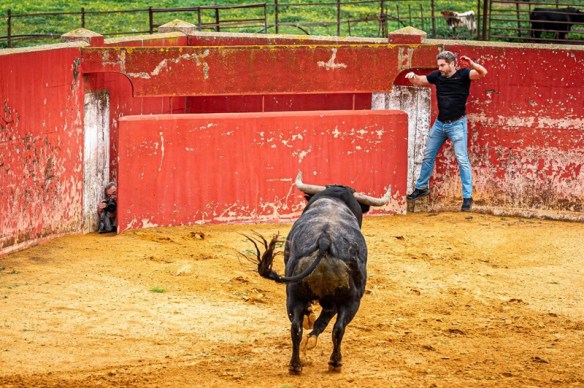
David Yarrow, Alexander Fiske-Harrison and Pañoleto at the finca Zahariche of the Spanish fighting bull breeders’ Miura © 2024 Richard Dunwoody – All Rights Reserved
I commanded the bull’s attention, and to get a strong charge I jumped upwards with my arms above my head in the manner of bull-runners and recortadors (and, indeed, banderilleros.) What I failed to take into account is that the bull was fifteen feet away and charging at thirty feet per second as I was landing with zero horizontal velocity in deep sand in running shoes.
In sand, unlike on the asphalt of Pamplona, hoof-keratin beats running shoe-rubber every time.
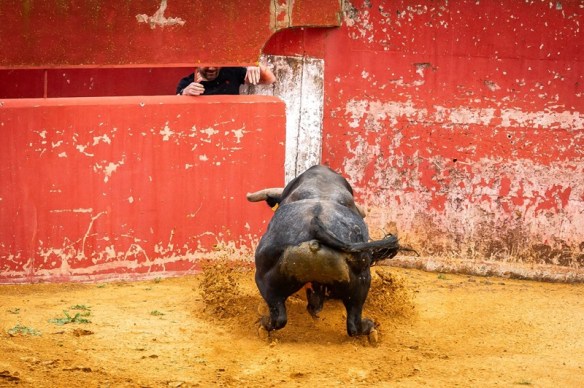
Alexander Fiske-Harrison and Pañoleto at the finca Zahariche of the Spanish fighting bull breeders’ Miura © 2024 Richard Dunwoody – All Rights Reserved
I landed with ankle turning exaclty as the horn struck, and the resulting crunching sound was like an elephant treading on a box of breakfast cereal before I dragged the appendage to safety. That bull came closer than any I have been with since I began working in the world of the Spanish fighting bulls in 2008.
Later, in the hospital, I would find this was the result.

© 2024 Seville Hospital Accident & Emergency Department – All Rights Reserved
Diagnosis: two fractures in the ankle and extensive ligament tears and massive soft tissue damage.
However, there is no time, with a bull in the ring, to take stock. Adrenaline cancels some pain, and the authority and quality of the client takes care of the rest.
I began to improvise a different style, with Eduardo Dávila Miura using his cape and voice to take it away from me so it could charge back. And, notably and heart-stoppingly, my girlfriend Klarina stepping into the ring with her pashmina scarf to turn the bull at the far end, nearly getting caught herself.
Meanwhile Yarrow was constantly having to roll out of the way to prevent him from getting a horn through the lens or through the skull. And very often he couldn’t see where the bull was so had to move on my shouted commands.

David Yarrow, Alexander Fiske-Harrison and Pañoleto at the finca Zahariche of the Spanish fighting bull breeders’ Miura © 2024 Richard Dunwoody – All Rights Reserved
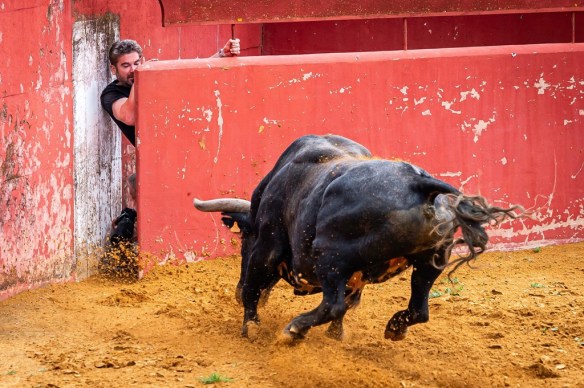
David Yarrow, Alexander Fiske-Harrison and Pañoleto at the finca Zahariche of the Spanish fighting bull breeders’ Miura © 2024 Richard Dunwoody – All Rights Reserved
David Yarrow is a perfectionist, as he should be. For almost an hour I bestrode him in that tiny space, balancing on broken bone, trying to line up the perfect shot, not that he knew what that would be. Yarrow does not approach the wild with an idée fixe, he just has a notion of what is possible – informed by long conversations with myself and Eduardo prior – and a high standard we all wished to match. (I found it interesting that one of his formative influences and friends was also a friend of mine and my family’s, Peter Beard, whose obituary I wrote for The Spectator, online here.)
Finally, the stars began to align. The bull, having dominated the ring and seen off all threats – or rather seen all threats as empty – lowered his actions to a fierce curiosity that allowed that fine focus and subtlety of angle and intent which so define Yarrow’s work.
The bull began to listen.

David Yarrow, Alexander Fiske-Harrison and Pañoleto at the finca Zahariche of the Spanish fighting bull breeders’ Miura © 2024 Richard Dunwoody – All Rights Reserved
The bull came.
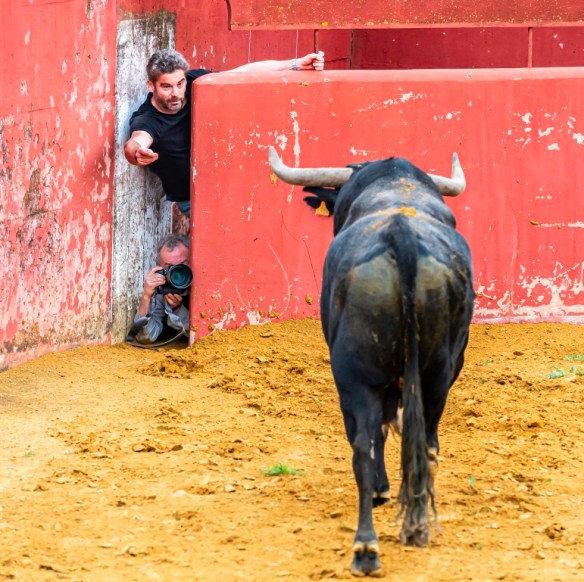
David Yarrow, Alexander Fiske-Harrison and Pañoleto at the finca Zahariche of the Spanish fighting bull breeders’ Miura © 2024 Richard Dunwoody – All Rights Reserved
And the photo was taken.

EL TORO by David Yarrow (2024)
The bull returned to his herd of 30 cows none the worse for wear, perhaps with a story to tell. We returned to the great Casa Morales in Seville for lunch, and told our own. (Even his ever-ready assistant Tom Williams had had his moment, his ‘interview’, as we say here, with the bull.)
Then I went to hospital.
I leave you with David Yarrow’s own words below.
ALEXANDER FISKE-HARRISON
For all enquiries, contact alexander@thelastarena.com
P.S. To read about David’s second photo from that day, below, click here.

BULLISH by David Yarrow (2024)

Raphael Nadal, Abel Lusa, H.M. King Juan Carlos of Spain

El Toro by David Yarrow hanging in Cambio de Tercio (Photo: Abel Lusa – The Proprietor)
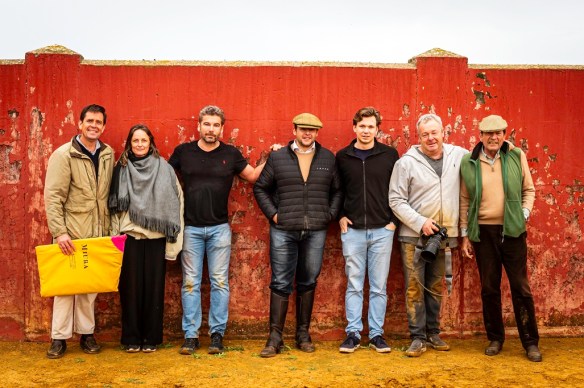
Eduardo Dávila Miura, Klarina Pichler, Alexander Fiske-Harrison, Eduardo Miura, Tom Williams, David Yarrow and Antonio Miura at the finca Zahariche of the Spanish fighting bull breeders’ Miura © 2024 Richard Dunwoody – All Rights Reserved
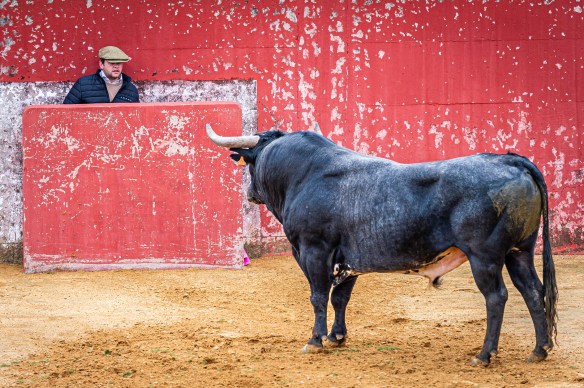
Eduardo Miura and Pañoleto at the finca Zahariche of the Spanish fighting bull breeders’ Miura © 2024 Richard Dunwoody – All Rights Reserved
 The Last Arena