Bullfighting has been intrinsically linked to Spanish culture, but records suggest that its practice dates back to two millennia before Christ.
El Seibo, Dominican Republic – Bullfighting, a centuries-old cultural and artistic event in Europe, was introduced to El Seibo, a province on the eastern part of the Island of Hispaniola, by a Spanish national around 1890. Known locally as “tarde taurina seibana”, ‘Seiban bullfighting afternoon,’ it was incorporated into the festive cycle honouring the Holy Cross.
According to documented data from the records of the Brotherhood of the Devout, an organization linked to the Catholic Church in El Seibo, the event was initiated by a Spaniard who settled in this distinguished and noble eastern city to entertain the residents during the festive period.
The practice of bullfighting in El Seibo traces its roots to Spanish culture, but has evolved in other countries, including the Dominican Republic, where the bull is neither killed nor ridden.
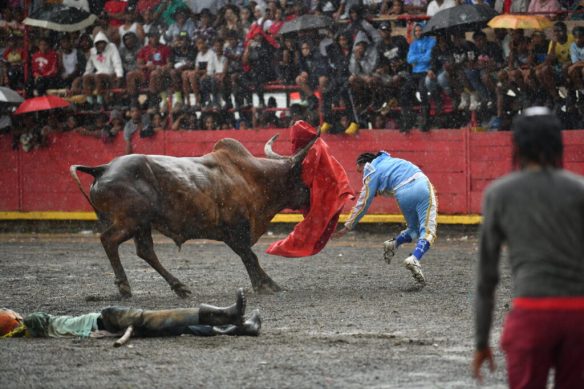
Some experts view bullfighting as a sport, while others see it as a cultural and recreational event. It involves enticing the bull until it begins chasing the matador, a deep-seated tradition that excites the spectators.
Recently, the event in El Seibo has seen innovations that increase the risks to the bullfighter, including the use of wild bulls provided annually by the Central Romana Corporation at the request of the Hermandad de Fervoroso, ‘Brotherhood of the Devout’.
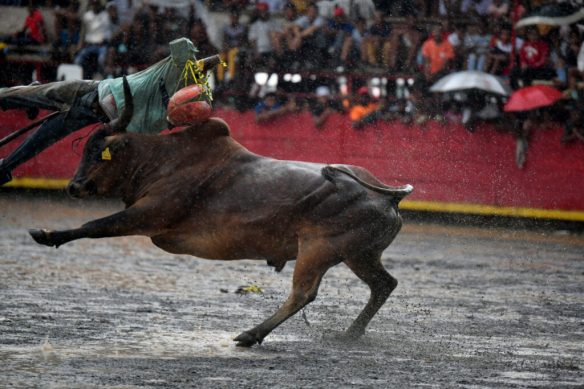
Alexander Fiske-Harrison, an expert on the subject, defends in his studies as a bullfighter the practice of bullfighting, “tauromachy”, and maintains that it is one of the most fascinating on earth, not only for the excitement it provides to the bullfighter but also for its capacity to engage the audience.
Facing the bull is a spectacle that attracts mortals, who gather sitting, standing, or lying down both inside and outside the ring to watch as the bull charges at the ‘torero’ in El Seibo, which heightens the adrenaline of those who have the opportunity to attend the event.
Bullfighting is the most deeply rooted and famous cultural manifestation that not only attracts locals from El Seibo but also the entire Dominican people, who make a pilgrimage every May to El Seibo to witness the spectacle.
The event, especially popular in May each year, attracts not only locals but also crowds from across the Dominican Republic. The term tauromachy originates from the Greek words ταῦρος, (taûros)”, bull, and μάχομαι (máchomai) ‘fight’ and is defined as the art of bullfighting both on foot and on horseback. [I have made one or two changes here due to a misreading of the Classical Greek alphabet and my own views by the journalist – AFH]
The climax of the event occurs when the bull charges at the matador, who traditionally uses a red cloth or cape, believed to enrage the animal further.
The tradition began in the grounds of Estadio La Manicera in the city, where local historian, Ramón Rijo, describes bullfighting as the crown jewel of the festive cycle in El Seibo.
The spectacle, reminiscent of the Seville style, starts with the sound of a bugle, signaling the enraged bull to target its perceived foe, the matador.
The Arena
For decades, the people of El Seibo have been advocating for a dedicated bullfighting arena, a demand renewed every four years, yet remains unfulfilled despite the national recognition of bullfighting as a Cultural Heritage by the National Congress.
On September 13, 2023, the Minister of Tourism, David Collado, initiated the redevelopment of the Bullfighting Plaza in El Seibo with an investment exceeding 300 million pesos. He stated that the venue, set to host bullfights and concerts, would stimulate the local economy.
Collado also promised to bring a renowned artist each year to inaugurate the plaza, a venue long awaited by the locals eager to witness bullfighting up close.
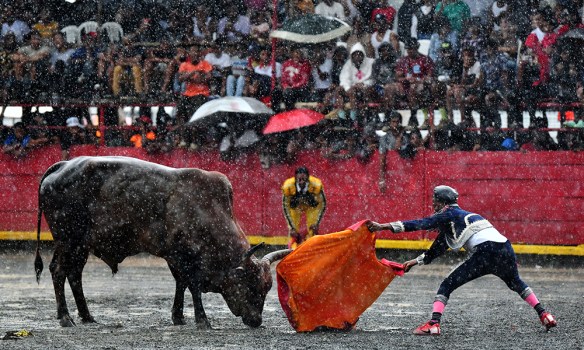
The bulls are born and raised in the pastures of Central Romana
Declared a Cultural Heritage by the Senate
In April 2022, the Senate passed a bill designating the bullfights of El Seibo as an Intangible Cultural Heritage of the Dominican Republic. Introduced by El Seibo senator and vice-president of the Senate, Santiago José Zorrilla, the bill highlights that bullfighting in Santa Cruz de El Seibo dates back to the early 17th century during the colonial period when nobility ceased bullfighting on horseback and the common folk took it up on foot, gradually becoming a leading cultural attraction in the Dominican Republic.
The bill also notes that unlike bullfights elsewhere, those in El Seibo do not harm the animal, making it a true celebration for families and suitable for all audiences.
Expression
“Bullfighting is the most deeply rooted and famous cultural manifestation that attracts not only the people of El Seibo but all Dominicans.”


 The Last Arena