The Last Matador for GQ (unedited)

Padilla at home (Photo Zed Nelson/GQ/Condé Nast 2012)

It was the last bullfight of the Spanish season, held, as it has been for centuries, in the 250-year-old plaza de toros in Zaragoza in north-eastern Spain.

Juan José Padilla, a 38-year-old matador from Andalusia in the south, was fighting the fourth bull of six (he’d also fought the first.)

The bull, ‘Marqués’, was a 508kg (1,120lb) toro bravo born 5 years and 8 months previously on the ranch of Ana Romero, also in Andalusia. Before entering this ring it had lived wild, ranched from horseback, and had never before seen a man on the ground.

Padilla passing a bull with the magenta and gold two-handed capote, ‘cape’ (Photo: Alexander Fiske-Harrison)

Padilla was midway through the second of the three acts of the spectacle. He had already caped the bull with the large, two-handed magenta and gold cape, the capote, then the picador had done his dirty work with the lance from horseback, tiring the bull and damaging its neck muscles to bring its head down.

Now Padilla, rather than delegate to his team as other matadors do, was placing the banderillas himself, the multi-coloured sticks with their barbed steel heads. He had put in two pairs and was on the third. He ran at the bull with a banderilla in either hand, it responded with a charge, Padilla leapt into the air, it reared, he placed his sticks in its shoulders and landed.

Juan José Padilla ‘places’ the banderillas (Credit: WENN US / Alamy Stock Photo)

Running backwards from the charging bull, his eyes were focused on the horns coming at him in an action he had performed tens of thousands of times before. However, this time his right foot came down slightly off centre and in the path of his left, foot hit ankle, and then he was down.

In a breath the bull was on him and its horn took Padilla under his left ear, cracking the skull there, destroying the audial nerve, and then driving into the jaw at its joint. It smashed up through both sets of molars and ripped through muscle and skin before exploding his cheek bone as surely as a rifle bullet, stopping only as it came out through the socket of his left eye – from behind – taking his eyeball out with it, shattering his nose and then ripping clean out of the side of his head.

There is an image I will never lose, much as I wish I could. It is of a man standing with half his face held in his right hand. Cheek, jaw and eyeball, like so much meat, resting in his palm as he walked towards his team uncomprehending, and they, with looks of absolute horror, grabbed his arms and rushed him to the infirmary of the ring.

The second worst image

And yet here, in the amongst the carnage inflicted on a human body by a half ton of enraged animal, is the key to Juan José Padilla. The clue is in the phrase “stood up.”

Soccer players are stretchered off the field from a tap to the ankle. Boxers go down from a padded glove. This was more than half a ton of muscle, focused into a pointed tip that ploughed through his skull like a sword through snow. And the man got up and walked.

Then came coma and intensive care and surgery after surgery. Continue reading
An Essay On Bullfighting


the-last-arena-logo

José Tomás by Carlos Cazalis from his forthcoming book Sangre de Reyes, 'Blood Of

José Tomás by Carlos Cazalis from his forthcoming book Sangre de Reyes, ‘Blood Of Kings’

When I first went to a bullfight 17 years ago, I was 23 and was sure I would hate it. I was a passionate animal lover and had been a keen amateur naturalist since childhood, WWF & Greenpeace member and zoology undergraduate. Not an auspicious CV for a future aficionado de los toros.

As expected, what I saw contained many moments of brutality and blood  but I was surprised also to find I could see beyond them to feel moments of breathlessness thrill as well. What genuinely shocked me, though, was that I could also perceive intermittently, and only with one of the bullfighters present, a kind of beauty that was entirely new to me.

In my moral confusion, I decided to research this alien thing, reading what I could in English – mainly Ernest Hemingway and Barnaby Conrad – and going when possible to see a corrida, a ‘bullfight’, on my irregular visits to Spain. Each time I went with a little more understanding and a little less aversion. Some would argue I became more sensitive to the aesthetics, others that I had become more inured to the ethics (or lack thereof.) I wouldn’t like to say either way.

into-the-arena-coverIn 2008 I was commissioned to write a book on the subject and I moved to Seville for two years and among other researches I trained as a bullfighter to the level of matador de novillos-toros – a novice level matador de toros bravos – ending by killing a single animal in the ring, a novillo, a three-year-old bull weighing around a third of a ton. (Into The Arena: The World Of The Spanish Bullfight was published by Profile Books in 2011 and shortlisted for the William Hill Sports Book Of The Year Award the same year.)

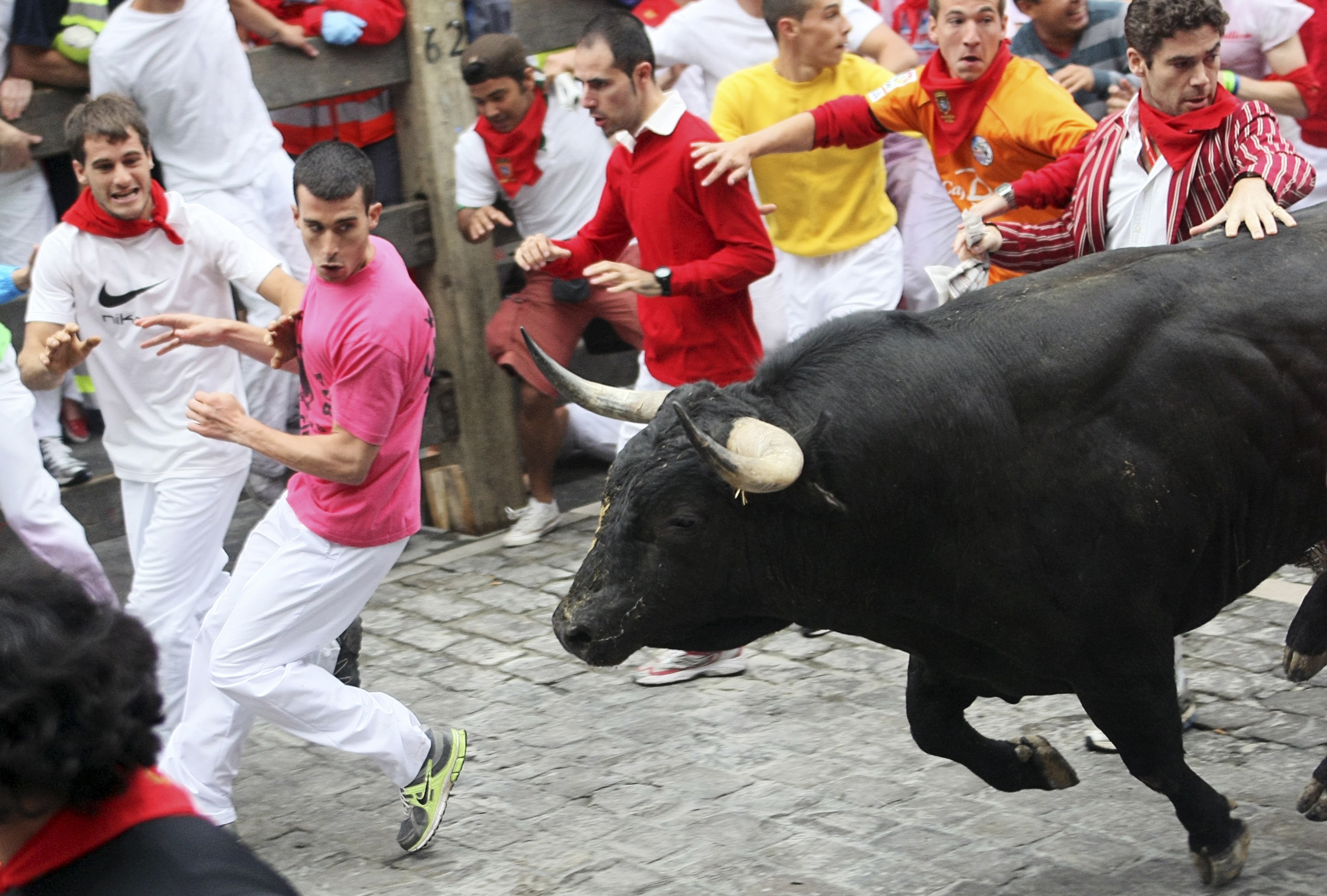
As part of the research, I also attended the encierros, ‘bull-runs’, of Pamplona and ran with fear and ignorance among the masses of drunken foreigners and adrenaline seekers. Unlike those visitors, I returned, and ended up running in towns across Spain, away from the tourist trail and among those born to this bloodless and less formal, more pagan practice. I ran with the bulls from San Sebastián de los Reyes in the suburbs of Madrid, to Falces, where you hurtle pell-mell down a goat-path, bordered by a sheer drop, in the foothills of Navarran Pyrenees. From Tafalla, also in Navarre, which resembles Pamplona in the 1920s to Cuéllar in Old Castille, which hosts the most ancient encierros in Spain.

(The book I edited and co-authored with the Mayor of Pamplona, Ernest Hemingway’s grandson, Orson Welles’s daughter and the finest bull-runners including the late Julen Madina, Jokin Zuasti and Reuters & EPA photographer Jim Hollander, The Bulls Of Pamplona (And Beyond), was published by Mephisto Press in 2017, available online here.)

I may be something of an oddity in my afición in English-speaking countries – although there is a Club Taurino of London as there is of New York – but in Spain (or Portugal, France, Mexico, Colombia, Peru, Ecuador, Venezuela) the picture is very different.

Alexander Fiske-Harrison running with the Torrestrella bulls of Álvaro Domecq - striped jacket - in Pamplona (Photo: Joseba Etxaburu - Reuters)

Alexander Fiske-Harrison running with the Torrestrella bulls of Álvaro Domecq – striped jacket – in Pamplona (Photo: Joseba Etxaburu – Reuters)

According to the annual figures on asuntos taurinos, ‘taurine matters’, published by Spain’s Ministry of Culture, the bulls are on the way back for the first time since the world economy collapsed in 2008.

The number of full-fledged corridas in 2015 stabilised at 394, down only 1% since 2014 compared with that year’s drop of 7% on the year before and 10% before that.

There were even large increases in some regions – Andalusia, Aragon, Murcia, the two Castiles and the Basque Country – and it seems that Madrid was the real fall, perhaps a reflection of the strange political stirrings going on in the capital.

The number of bullfights in the broader sense of the word – including novilladas for novices and rejoneo for horseback toreros etc., – 80% of which occur in Andalusia, Madrid and the two Castiles,  had fallen by 7% to 1,736, but this after a slight increase the year before.

Far more importantly in a country where subsidies distort the market, the number of people actually attending bullfights in 2015 was up to 3.7 million, an increase of more than a third of a million since 2011 when my book came out. Back, in fact, to pre-financial crisis levels.

This is alongside some 6.4 million having watched bullfighting on the television to which it had only returned in 2015 (and half a million more on the internet.) Continue reading

José Tomás: And The Myth Was Made Flesh Once More

When perhaps the greatest matador in history, José Tomás, returned to the ring from his inexplicable five-year retirement in 2007, the Spanish press ran with the headline, “And The Myth Was Made Flesh.” At that time, I had never seen him bullfight, and thought it pure journalistic hyperbole. Since then I have and have chosen this headline myself as a result. The Agence-France Presse released this report on his astonishing re-emergence from near-death and appalling injury:

Jose Tomas makes triumphant comeback to bullring in Spain

VALENCIA, Spain — Acclaimed Spanish bullfighter Jose Tomas made a triumphant comeback to the bullring Saturday, receiving a standing ovation more than a year after a bloody goring in Mexico that almost killed him. The 35-year-old, wearing a purple and gold outfit, offered his first bull of the night, a 502-kilogramme beast, to the doctors who had helped him recover. He was less successful with his second bull, a 556-kilo four-and-a-half-year-old, but delighted the sell-out crowd of 11,000, many of whom had traveled from overseas to see the spectacle in the eastern city of Valencia. Tomas was seriously gored and almost died in a bullfight April 24 last year in Aguasclientes, Mexico. A 470-kilo (1,000-pound) bull named Navegante, his second bull of the evening, thrust its horn into the muscle of Tomas’s left thigh, puncturing the artery and causing the bullfighter to lose about half of his blood. In September he will be able to fight at Barcelona’s Monumental ring in what may be the last La Merced festival before a bullfighting ban in the Catalonia region comes into force next year. Copyright © 2011 AFP. All rights reserved

In celebration of this return, I have put below my description of what I believe to Tomás’s greatest corrida de toros, in Jerez de la Frontera in 2009, where he fought alongside the matadors El Cid, who featured in my Prospect magazine article that led to my becoming a bullfighter (available here), and my great friend Juan José Padilla (whom you can read more about in my The Pamplona Post article here).
Continue reading