The Last Matador for GQ (unedited)

Padilla at home (Photo Zed Nelson/GQ/Condé Nast 2012)

It was the last bullfight of the Spanish season, held, as it has been for centuries, in the 250-year-old plaza de toros in Zaragoza in north-eastern Spain.

Juan José Padilla, a 38-year-old matador from Andalusia in the south, was fighting the fourth bull of six (he’d also fought the first.)

The bull, ‘Marqués’, was a 508kg (1,120lb) toro bravo born 5 years and 8 months previously on the ranch of Ana Romero, also in Andalusia. Before entering this ring it had lived wild, ranched from horseback, and had never before seen a man on the ground.

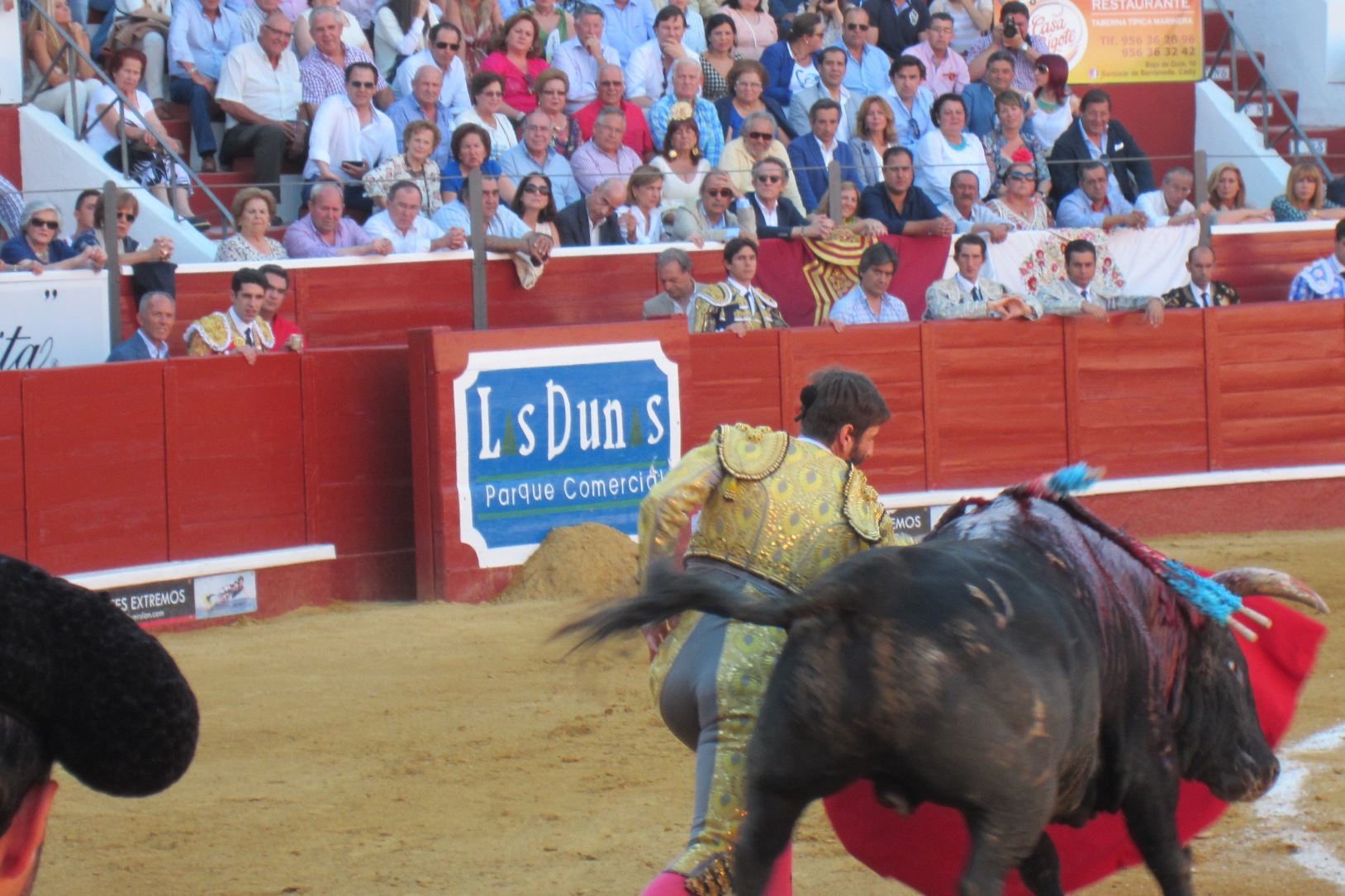
Padilla passing a bull with the magenta and gold two-handed capote, ‘cape’ (Photo: Alexander Fiske-Harrison)

Padilla was midway through the second of the three acts of the spectacle. He had already caped the bull with the large, two-handed magenta and gold cape, the capote, then the picador had done his dirty work with the lance from horseback, tiring the bull and damaging its neck muscles to bring its head down.

Now Padilla, rather than delegate to his team as other matadors do, was placing the banderillas himself, the multi-coloured sticks with their barbed steel heads. He had put in two pairs and was on the third. He ran at the bull with a banderilla in either hand, it responded with a charge, Padilla leapt into the air, it reared, he placed his sticks in its shoulders and landed.

Juan José Padilla ‘places’ the banderillas (Credit: WENN US / Alamy Stock Photo)

Running backwards from the charging bull, his eyes were focused on the horns coming at him in an action he had performed tens of thousands of times before. However, this time his right foot came down slightly off centre and in the path of his left, foot hit ankle, and then he was down.

In a breath the bull was on him and its horn took Padilla under his left ear, cracking the skull there, destroying the audial nerve, and then driving into the jaw at its joint. It smashed up through both sets of molars and ripped through muscle and skin before exploding his cheek bone as surely as a rifle bullet, stopping only as it came out through the socket of his left eye – from behind – taking his eyeball out with it, shattering his nose and then ripping clean out of the side of his head.

There is an image I will never lose, much as I wish I could. It is of a man standing with half his face held in his right hand. Cheek, jaw and eyeball, like so much meat, resting in his palm as he walked towards his team uncomprehending, and they, with looks of absolute horror, grabbed his arms and rushed him to the infirmary of the ring.

The second worst image

And yet here, in the amongst the carnage inflicted on a human body by a half ton of enraged animal, is the key to Juan José Padilla. The clue is in the phrase “stood up.”

Soccer players are stretchered off the field from a tap to the ankle. Boxers go down from a padded glove. This was more than half a ton of muscle, focused into a pointed tip that ploughed through his skull like a sword through snow. And the man got up and walked.

Then came coma and intensive care and surgery after surgery. Continue reading
An Essay On Bullfighting


the-last-arena-logo

José Tomás by Carlos Cazalis from his forthcoming book Sangre de Reyes, 'Blood Of

José Tomás by Carlos Cazalis from his book Sangre de Reyes, ‘Blood Of Kings’

When I first went to my first bullfight 25 years ago, I was 23 and was sure I would hate it. I was a passionate animal lover and had been a keen amateur naturalist since childhood, a member of the WWF (which I remain to this day) & Greenpeace, a former zoology undergraduate student at the University of Oxford, and was at the time a philosophy postgraduate at the London School of Economics and Political Science. (I am currently doing postgraduate work at  King’s College, London, this time in applied neuroscience.)

It should be obvious that this is not an auspicious CV for a future aficionado a los toros.

As expected, what I saw contained many moments of brutality and blood but I was surprised also to find I could see beyond them and feel moments of breathless thrill as well.

What genuinely shocked me, though, was that I could also perceive intermittently, and only with one of the bullfighters present that day, a form of beauty that was entirely novel to me.

In my moral confusion, I decided to research this alien thing, reading what I could in English – Ernest Hemingway, Kenneth Tynan, Barnaby Conrad – and going when possible to see a corrida, a ‘bullfight’, on my annual visits to Spain. Each time I went with a little more understanding and a little less aversion. Some would argue I became more sensitive to the aesthetics, others that I had become more inured to the ethics (or lack thereof.) I wouldn’t like to say either way.

into-the-arena-cover

Into The Arena: The World Of The Spanish Bullfight was published by Profile Books in 2011 and shortlisted for the William Hill Sports Book Of The Year Award – the oldest and richest sports writing prize in the world – the same year.

Following my essay on the subject for Prospect magazine, ‘A Noble Death‘, in 2008 I was commissioned to write a book and moved to Spain for two years. Among other researches, I trained as a bullfighter to the level of matador de novillos-toros, facing endless cattle from old, heavy and wise to young, light and fast. I ended by killing a single animal in the ring, a novillo, a three-year-old bull weighing around a third of a ton.

As part of the research, I also participated in the encierros, ‘bull-runs’, of Pamplona and ran with fear and ignorance among the masses of drunken foreigners and adrenaline seekers who fill those streets.

Unlike those visitors, I returned, and ended up running in towns across Spain, away from the tourist trail and among those born to this bloodless and less ritualised, more pagan practice. This led to my second book on los toros – as editor and primary author – with chapters by the Mayor of Pamplona, along with John Hemingway – grandson of Ernest – Beatrice Welles – daughter of Orson – and many others.

The Bulls Of Pamplona, edited by AFH and co-authored with a foreword by the Mayor of Pamplona and co-authored by John Hemingway, Ernest’s grandson, Beatrice Welles, Orson’s daughter and many others.

This makes me singular in my afición in English-speaking countries but in Spain – or Portugal, France, Mexico, Colombia, Peru, Ecuador, Venezuela – the picture is very different.

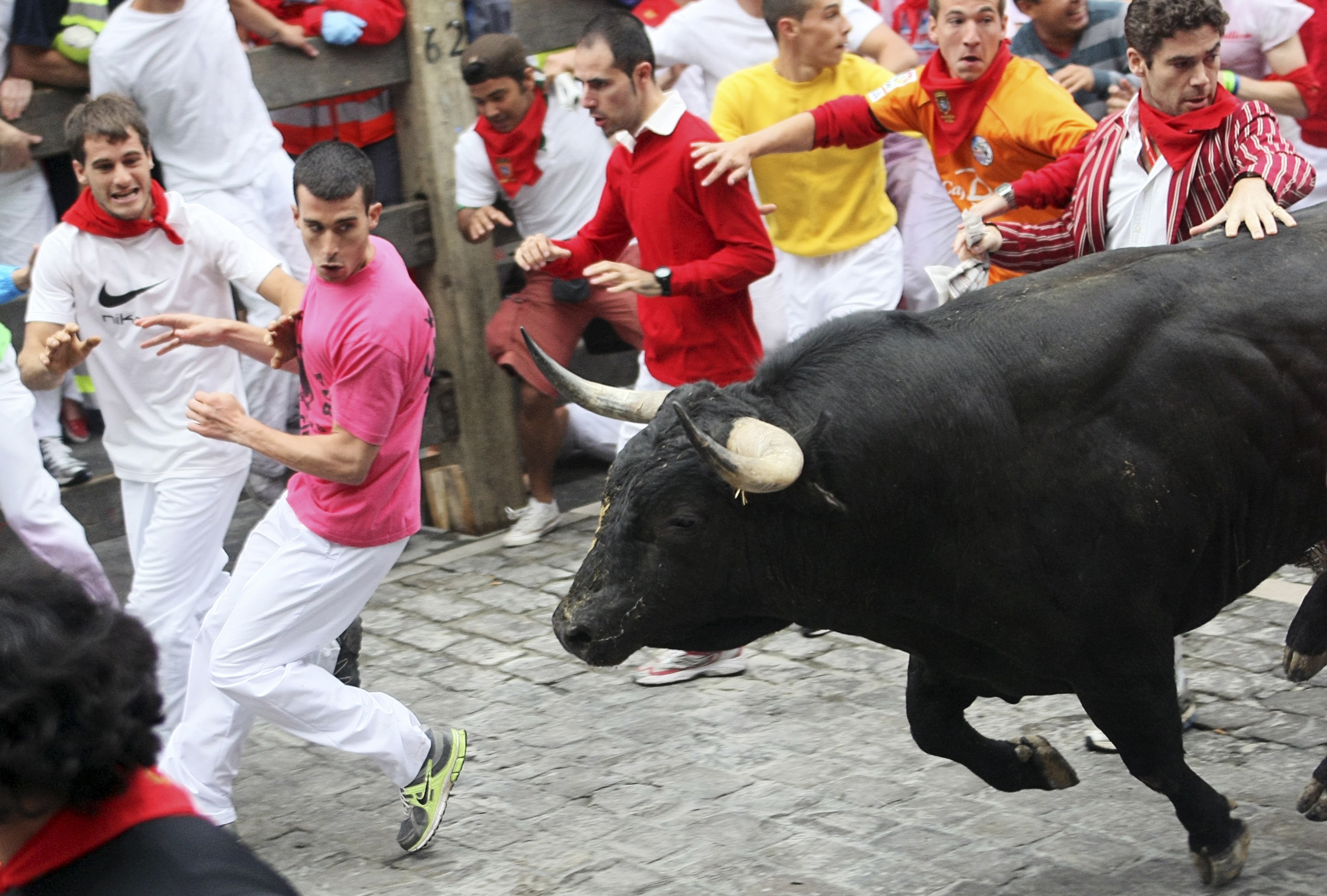
Alexander Fiske-Harrison running with the Torrestrella bulls of Álvaro Domecq - striped jacket - in Pamplona (Photo: Joseba Etxaburu - Reuters)

Alexander Fiske-Harrison running with the Torrestrella bulls of Álvaro Domecq – striped jacket – in Pamplona (Photo: Joseba Etxaburu – Reuters)

According to the annual figures on asuntos taurinos, ‘taurine matters’, published by Spain’s Ministry of Culture, the bulls are on the way back for the first time since the world economy collapsed in 2008.

When I first came to Spain to research in 2007 for Prospect magazine there were 3,691 major public bullfights that year, including corridas, of which there were 953, alongside novilladas with novices, and rejoneo with horseback bullfighters.

Following the financial crisis of historic proportions the next year, there was a precipitous drop in numbers, not only for bullfighting but all expensive live spectacles such as theatre and opera. This drop evened out, averaging at a 6% annual fall until I began researching my second book in 2015, when the fall in corridas was 1% per annum.

However, after COVID-19, the number of bullfights of all kinds in total in 2022 was up 8% on 2019 at 1,546 and the number of full corridas up 18% at 412. Continue reading
The Cult Of The Bull

20130612-010502.jpg

As the 2013 season draws to a close, I have just received my copy of Olé! Capturing the Passion of Bullfighters and Aficionados in the 21st Century, which is filled with chapters and photos by some the foremost among the English-speaking faithful in the Spanish ‘Cult Of The Bull’, brought together and edited by Hal Marcovitz. (Available at Amazon in the US here, and the UK here.)

There are also wonderful photographs, alongside those by Jim (who is responsible for the stunning cover), from my dear friend from Seville, Nicolás Haro, shortlisted contestant for the internationally presitigious Photo España prize.

(Nicolás also took the black and white photos in my own William Hill Sports Book of the Year shortlisted Into The Arena: The World Of The Spanish Bullfight.)

His work on horses is being exhibited in an exhibition in Seville on December 3rd (for which I have literally just filed the ‘foreword’ to the catalogue.)

Photo Espana Nicolas Haro

I should add a mention of my review of the complete letters of Hemingway, from the period 1923-1925, when his interest in bullfighting and Spain first developed, for The Spectator, online here.

However, it is not my own writing I should like to promote in this blog post, but that of the other writers in Olé!, some of whom I have not exactly seen eye-to-eye with over the years.

Continue reading

The Dead Gods With Cold Eyes

image

I submitted this article for my column in Taki’s Magazine. However, I was told by the editor that she’d had quite enough about bulls. Which is ironic, given what it says. Anyway, here it is, for what it’s worth.

Alexander Fiske-Harrison

Alexander Fiske-Harrison waiting for the bulls, Cuéllar 2013 (Photo: Enrique Madroño Arranz)

Alexander Fiske-Harrison waiting for the bulls, Cuéllar 2013 (Photo: Enrique Madroño Arranz)

Dead Gods With Cold Eyes

I nearly died the other day. Not, like the time before when John Hemingway, Ernest’s grandson, pulled me out from a stampede in Pamplona or the time before that when Eduardo Dávila Miura pulled me out of a bull-ring in Palma del Río. This time was for real.

Alexander Fiske-Harrison begins to run with the bulls, Cuéllar 2013 (Photo: Enrique Madroño Arranz)

Alexander Fiske-Harrison begins to run with the bulls, Cuéllar 2013 (Photo: Enrique Madroño Arranz)

I was running with the bulls of Cuéllar, which is a much like running with the bulls of Pamplona, only the town is smaller, the encierro – ‘bull-run’ – more ancient (the most ancient, in fact, as I wrote in the Financial Times) less crowded, and those that do turn up are mainly local, all Spanish, with not a drunk or first-timer among them.

Cuellar photo 3 blogDespite this I still managed to bump into someone as I passed a lone, stationary bull in a narrow stretch of street. Being lighter than me, he was knocked to safety, but I dropped where I was and the commotion drew the bull’s eyes – black, bovine, lifeless and colour-blind, following only movement – and it charged across the street, skittering to a halt on its hooves as I similarly fought for grip in my new, untested running shoes.

With my back against the wall, its horns either side of my chest – literally – and, unlike in Pamplona or an official plaza de toros, no surgeon within a forty-five minute drive, I saw my own death ahead of me. However, for some reason the bull decided today was not my day and moved on, most likely because I had the presence of mind to freeze, making myself invisible to the clockwork brain behind the horns. Continue reading

An English farewell – ‘Una despedida Inglés’

20130612-010611.jpg

A portrait of me by Nicolás Haro

I wrote on this blog just before the April Fair that I first came to Seville on the back of a broken relationship ten years before. My dates were wrong: it was in June. This June, I found myself back again.

Seeing things through different eyes, a realisation came over me, which I have expressed in my column in today’s issue of Taki’s Magazine, centring as it does on the saddest story in cinema, Orson Welles. Even the title is a quotation from the great man: ‘The Second-Hand Men’. As I write there,

Welles either couldn’t admit to himself or couldn’t say out loud that the more pressing issue is not just becoming audience rather than artist, but in being fêted for just sitting in the stands and reveling in that. At this point one has slid from the morally and aesthetically questionable world of the voyeur to the far more reprehensible one of poseur.
(To read the column in full click here.)

Cf., the photo above…

At the same time, fate conspired me to spend a little time with all the people who helped me make, and themselves made up, my book on this beautiful and strange land, Into The Arena: The World Of The Spanish Bullfight.

As I describe in the column, I stood in front of the last lot of Saltillos ever to exit the gates of Félix and Enrique Moreno de la Cova’s ranch ‘Miravalles’, alongside my former Maestro, the ex-matador Eduardo Dávila Miura. And given what I used to be able to do…

20130612-085020.jpg

Me with a Saltillo bull in 2010 (Photo Nicolás Haro)

… what remained of my bullfighting technique was a rather poor thing…

20130612-005915.jpg

Me with a Saltillo becerra in 2013 (Photo: Miguel Santos)

20130612-005804.jpg

Me with a Saltillo becerra in 2013 (Photo: Miguel Santos)

However, it was still an emotional day with a large audience, many toritos and vaquillas, young bulls and cows, for the toreros practicós, ‘amateur bullfighters’, and a beautiful long lunch at the former Saltillo finca ‘La Vega’ afterwards, even if I was not in any condition to enjoy it as much as I should.

20130612-010357.jpg

The last capea of Saltillo at Miravalles (Photo: Miguel Santos)

Having realised that I was now just a torero on paper – a second-hand guy on the sand – I decided to quit while I was still ahead. (The bulls gave me a great deal, and I gave a great deal back, but they took something as well.)

20130612-084928.jpg

A portrait of me by Nicolás Haro

First, I paid a visit to my old friend and frequent collaborator, the photographer Nicolás Haro, who took these portrait shots while I could still fit into my traje corto. Hopefully, Nicolás and I will soon be collaborating once more on a book about the psychological link between horses and men, a centaur project to balance our minotaur one (Nicolás took the black and white photos for Into The Arena.) The initial collection of Nicolás’s photos for this project have already been nominated for one of the most prestigious international photographic contests held in Spain: PhotoEspaña.)

I will, once I have completed my new novel, finished the task of washing the blood from my hands with a book on what Teddy Roosevelt called “the beast of waste and desolation” and Man’s Best Friend: wolves and dogs.

That said, as you can see from the cover of this new book, Olé! Capturing the Passion of Bullfighters and Aficionados in the 21st Century, due to be published in the United States in the next few weeks, I have been writing on the bulls up to the very last minute (my chapter also contains great photos by Nicolás.)

20130612-010502.jpg

Before I left, I even got to say farewell to that one-eyed gladiator, my first teacher, Juan José Padilla, when he fought in the feria de manzanilla in his home town of Sanlúcar de Barrameda. (These photos are by me.)

???????????????????????????????

???????????????????????????????

JJ 4

20130612-011107.jpgAnd then a last adíos to that matador de arte from the greatest of the taurine dynasties, my dear friend Cayetano Rivera Ordóñez, who was my chauffeur from Seville to Ronda so I could talk about Orson Welles, whose ashes are interred at his family home.

So, all that remains for me to do is say farewell to the streets of Pamplona in July with a couple of runs among their bulls, and those of that other, and more ancient, bull-running town Cuéllar in August (I wrote comparing and contrasting them in the Financial Times last weekend, linked to here.) I even have an invitation from Cayetano to join him in the ring (on a ranch in Ronda) one last time for “amusement” on the morning of the Feria Goyesca. We will see…

However, such amusements and formalities to one side, I’m done here. “There’s a world elsewhere.”

Alexander Fiske-Harrison

To read my Takimag column in full click here.

P.S. In a neat and final symmetry, having reached my highest point on talking about the bulls – the speech I gave to the Reform Club at the request of, and beside, the Spanish Ambassador – I have now gone full circle and been invited to talk about the bulls at my old school, Eton. I wonder if they know I’ll be running my last runs in my Eton College Athletic Club Colours blazer (400m). It’s the striped one on the right – I have my hand on the bull for balance – in this Reuters photo in 2011.

20130612-085052.jpg

“He came to Seville, and he is called Manzanares”

Matador José Mari Manzanares dances a ‘chicuelina’ with the 510kg, 4-year, 10-month-old J P Domecq bull ‘Rasguero’ (Photo: Alexander Fiske-Harrison)

Gregorio Corrochano, the bullfighter critic of the influential newspaper, A. B. C., in Madrid, said of him, “Es de Ronda y se llama Cayetano.” He is from Ronda, the cradle of bullfighting, and they call him Cayetano, a great bullfighter’s name; the first name of Cayetano Sanz, the greatest old-time stylist. The phrase went all over Spain.

from Ernest Hemingway’s Death In The Afternoon (1932)

In this year’s Feria de San Miguel in Seville I watched the new hero of that city return to the sand to confirm yet again his supremacy in a mano a mano with another very skilled young matador named Alejandro Talavante.

* * *
Note

From here on in, I shall refer to what we English call a ‘bullfight’ as a corrida de toros (literally ‘coursing of bulls’) or just a corrida, and bullfighters as toreros (lit. ‘those who deal with bulls’). All activities involving bulls in Spain come under the blanket term fiesta de los toros, aka the fiesta brava or fiesta nacional or just the Fiesta, the activity of bullfighting is called tauromaquia – we have the old word tauromachy in English – and the art, technique and style of bullfighthing is called toreo.

Continue reading

The text of my speech at the University of Seville on ‘Into The Arena’

(In the original Spanish here.)

Last Friday, before the opening of the Feria de Abril here in Seville, I gave a conference on my two perspectives on bullfighting: from far away – England – and far too close – the sand of the bullring.

It was a great honour to talk in the main lecture theatre in the antique Royal Tobacco Factory of Seville, the setting for Bizet’s Carmen among other things (which was in turn based on the novella of that name by Prosper Mérimée.)

The speech was particularly well-received. Rafael Peralta, a poet, author and amateur bullfighter from a great family of bull-breeders and rejoneadors – horseback bullfighters – had the following to say about it in the newspaper La Razón, ‘The Reason’ (my translation):

An Englishman in the arena; by Rafael Peralta Revuelta

This past Easter Sunday, a British diplomat, Lord Tristan Garel-Jones, made a defense of bullfighting from the lectern of the Lope de Vega theatre in the classic Pregón Taurino, ‘Taurine Proclamation’, of the Royal Maestranza of Seville. Bullfighting has always appealed in one way or another to the English. For some, it is a show that, far from their Anglo-Saxon culture, they describe as barbaric. For others it may mean something curious, full of mystery and romance. Such was the case of Joseph William Forbes, a boxing manager who every summer went to Spain for his own particular taurine “tournament”. As do the members of the Club Taurino of London, who every year visit our city to attend the bullfights of the April Fair. Alexander Fiske-Harrison is an English writer and actor, whom we find at the entrance of the Plaza de Toros. Several years ago now, he began to have contact with the world of bullfighting, with the help of family and close friends. Little by little, he went deeper into the secrets of the world of the bulls. He became an amateur bullfighter, fighting on the ranch “Zahariche” of the Miuras, and arrived at the point of killing a Saltillo bull on the ranch of the Moreno de la Cova family. He became friends with bull-breeders, with bullfighters like Juan José Padilla and Adolfo Suárez Illana. His experiences are contained in the book Into The Arena: The World Of The Spanish Bullfight. As a philosopher and writer specializing in analyzing the behavior of animals, he recognized in England that there is a lot of hypocrisy about bullfighting. Last week gave a lecture at the University of Seville, explaining his vision of bullfighting. Fiske-Harrison opens a new door, fundamental and necessary, to the Fiesta Brava in Anglo-Saxon culture.

I enclose the text of my speech below. The text of Lord Garel-Jones’s Pregón Taurino, which he has kindly provided to me in English (his speech, like mine, was delivered in Spanish), is viewable as a PDF by clicking here: El Pregón Taurino de Lord Tristan Garel-Jones – English. I will finish by saying how happy I am that after leaving a lecture like this, the entire audience went to the Seville bullring, La Plaza de Toros de la Real Maestranza de Caballería de Sevilla (in whose 250-year-old library, Into The Arena is the only book in English). There we saw the very essence of what I was talking about in terms of beauty in the toreo of José Mari Manzanares who cut four ears and left on the shoulders of the crowd through the Gate of the Prince. (We met in the training ring a month ago.) I must also mention the astonishing valour of the now one-eyed Juan José Padilla.

In the photo below, by the historian and author Guy Walters who was sitting with my mother and my girlfriend, you can see Manzanares embracing his father, a former matador of great note. Circled left are myself and my own father, in seats generously provided by Enrique Moreno de la Cova and Cristina Ybarra. Leaning on the planks in the foreground is Padilla.

“Into The Arena”: The bullfight as lived by an Englishman

Ladies and Gentleman,

You will forgive me but in the eighteen months since I completed the research for my book I have forgotten as much of my Spanish as I have of my bullfighting – as a little bull of Astolfi discovered to his delight a week ago. However, I hope that more language remains than my technique of tauromachy and that I walk away with fewer bruises!

First, I would like to thank the University of Seville – and especially Jose Luis and Antonio and their Forum of Analysis for inviting me, an Englishman, to speak about my perspective on the bulls. I was going to say that this is a rare honour indeed, until I read in the newspaper that my fellow Briton, Lord Tristan Garel-Jones, was doing just that two weeks ago. I would like to say it doesn’t count, because he is Welsh and not English, but then I might offend my dear friend and deep aficionado Noel Chandler who is here today. Also, since Lord Garel-Jones’s talk was the annual Pregón Taurino of La Maestranza, and it was delivered with such eloquence, I must doff my cap, and have provided a copy of it courtesy of its author.

So I am now faced with the problem many matadors have in facing a bull immediately after a colleague has taken two ears. Continue reading