Mad Bulls and Englishmen by Giles Coren in The Times

This article of Giles Coren’s was originally published in The Times magazine on Boxing Day ’09 where it is still available along with Dominic Elliot’s film of our day bullfighting here. All photos are by Nicolás Haro.

Alexander Fiske-Harrison, the English bullfighter, takes on a ‘vaquilla’ of the Saltillo breed. Inset: with Giles Coren, attending a bullfight in Seville.

Writers and travellers have long been drawn to the drama and romance of the bullfight. Giles Coren is no exception, so when he was contacted out of the blue by the younger brother of his dead best friend, now training to be a bullfighter in Spain, Giles was intrigued. Here he describes his journey into a unique culture of noblemen, peasants and swindlers, all driven by deadly serious dreams of death and glory

I am in a bullring. Not in the seats, in the ring. On the sand. From the relative safety of a wooden barrier with a small room behind it, built into the stone wall, I have seen four vaquillas, young cows, “caped” by one of Spain’s most famous matadors, the son of the first post-Franco prime minister of Spain, Adolfo Suárez Illana, and by Alexander Fiske-Harrison, the younger brother of my best friend at school, who died in an accident the year we left, three months before his 19th birthday. Continue reading


Ted Hughes and Sylvia Plath on Bullfighting

Hughes & Plath

On Tuesday, the poet Ted Hughes was commemorated with a monument in Poet’s Corner in Westminster Abbey, among the remains of Chaucer and Wordsworth, Dickens and Hardy (I have not visited myself since my brother’s memorial service there in ’88).

In the summer of 1956 Hughes married the poet Sylvia Plath and for their honeymoon they went to Spain and watched a bullfight. As she wrote in a letter to her mother:

I’d imagined that the matador danced around with the dangerous bull, then killed him instantly. Not so… The killing isn’t even neat, and with all the chances against it, we felt disgusted and sickened by such brutality.

I feel I would have had exactly the same response were it not for the fact that the first corrida I saw was headed by El Fandi, four days before his alternativa, in the Maestranza of Seville. Sheer chance.

Plath wrote a poem about her bullfight experience, in which a picador was injured by the bull. Continue reading

I didn’t win the Bookie Prize but as the latest Sunday Telegraph says, it’s “pure theatre” anyway…

FINALIST

Sadly, my book did not win the ‘Bookie Prize’ this year. That honour went to Ronald Reng’s A Life Too Short about the tragic suicide of his friend, Robert Enke, the German goalkeeper. Ronald gave a deeply moving impromptu speech, and then he, the champion cyclist David Millar (whose book Racing Through The Dark was also shortlisted) and I went for dinner. I would like to thank William Hill, Waterstones of Piccadilly, and all the other contestants (and my agent, publisher and girlfriend who were all present) for a great day. As I argued in my article in the Daily Telegraph on Saturday, I shouldn’t have won anyway. Here is the review their sister newspaper the Sunday Telegraph gave me the following day.

Alexander Fiske-Harrison

27.11.11

Books for Christmas

Sport books

Oliver Brown

INTO THE ARENA: The World of the Spanish Bullfight BY ALEXANDER FISKE-HARRISON Profile Books, £15.99

Bullfighting was banned in Catalonia last year and yet has continued to capture both the quintessence of Spain and the extremes of sporting heroism. It exerted a fascination early upon Alexander Fiske-Harrison, who watched his first bullfight as a 23-year-old philosophy student in Seville and embarked soon after on a quest to understand the spectacle in all its cultural complexity. This is no passive work, however: he undertakes months of training with one of the top matadors, Eduardo Dávila Miura, to steel himself for the final act of his own corrida de toros. Uneasy ethical dilemmas abound, not least how much suffering the animals are put through. But this remains a compelling read, unusual for its genre, exalting the bullfight as pure theatre.

My interview about Into The Arena on Sports Tonight Live

Below is a link to the podcast of the interview I gave about my view of bullfighting, from the stands and from the sand, to Neil Cole on Sports Tonight Live.

Sports Tonight Live: The Book Club with Alexander Fiske-Harrison

The matador Juan José Padilla, in his own words – #fuerzapadilla

Juan José Padilla with a Miura bull, Feria de Abril, Seville 2010 (Photo: Alexander Fiske-Harrison)

For those that missed the news story (here) Spain’s bravest matador, Juan José Padilla – a friend of mine and major character in my recent book Into The Arena – was terribly gored a fortnight ago. In this interview he speaks of his recovery. A translation of some of his words is below…

Alexander Fiske-Harrison

They know that this is my life and they know that this is my profession, and they know that I am going to fight, I will give my utmost to be able to face bulls again, because that is what makes me happy.

And because the bull has given me everything. The bull has given me magnificent triumphs, I have been the victor of the greatest fairs in Spain, and the fact that a bull is going to give me injuries does not meant that I am going to feel any bitterness towards him. I will return to face the bulls.

In the words of Adolfo Suárez Illana this morning, who is with him, “He is getting better little by little. But he is getting there…”

#fuerzapadilla

Juan José Padilla and I in the ring together in March ’09 (Photo: Paloma de Gaytan Ayala)

My “literary spat” with Mark Rowlands in the TLS (as reported in the Evening Standard)


Monday 24 October 2011

It’s wolf v bull as philosophers bare their teeth

Warring in blogland: Mark Rowlands and Alexander Fiske-Harrison

It’s the latest literary spat. Mark Rowlands, a British philosophy professor who spent a decade living with a wolf, gave a savage review to Alexander Fiske-Harrison’s book Into The Arena on the art of the matador in the Times Literary Supplement in September. Now Fiske-Harrison is as wounded as a bull lanced by a picador — and the men are locked in a battle of letters and blog posts against each other. Fiske-Harrison’s complaint is that Rowlands, who concerns himself with animal welfare, would be naturally indisposed to his love of bull-fighting, not to mention that Fiske-Harrison has previously given him a bad review. “Mark Rowlands is a proponent of vegetarianism and once tried to make his pet wolf into one, as described in The Philosopher and the Wolf,” says Fiske-Harrison. Professor Rowlands, who teaches at the University of Miami, had described Fiske-Harrison’s writing as being infected with “vainglory” and “startling arrogance” in his love of bull-fighting.The red rag in this feud was first waved two years when Fiske-Harrison reviewed Mark Rowlands’s wolf book for Prospect magazine. “If you combine misanthropy and lycophilia,” he wrote, “the resulting hybrid, lycanthropy, is indeed interesting but philosophically quite sterile.” Over to Rowlands. “I felt rather guilty that I was dispensing such a negative review,” he tells me. “I did, of course, inform the TLS of the fact that he had previously reviewed a book of mine. I resent the suggestion that my negative review was the result of personal animus … [it] was the result of the book not being very good.” Rowlands has also called Fiske-Harrison “thin-skinned”. The blog argument now runs to several thousands words, with still no victor in sight.

P.S. I suspect that Rowlands’ loathing of the book is more about my having fought a bull – see photo from my book above – than my ‘love’ of watching it. My aficion, or ‘love’, is actually what is in question throughout the book, something every other reviewer noted. As for the idea that a review could wound me – well, that’s just nice journalism I guess. My actual issues with Rowlands are quite clearly pointed out in our exchange in the letters’ page of the TLS here.

Alexander Fiske-Harrison

EVENING STANDARD: Clive’s 50 Not Out In The City

It makes me particularly proud to see that my father’s 50th anniversary in the City of London is makes headlines courtesy of the City Editor of the capital’s great newspaper.

Evening Standard

CLIVE’S 50 NOT OUT IN THE CITY

Anthony Hilton
26th September 2012
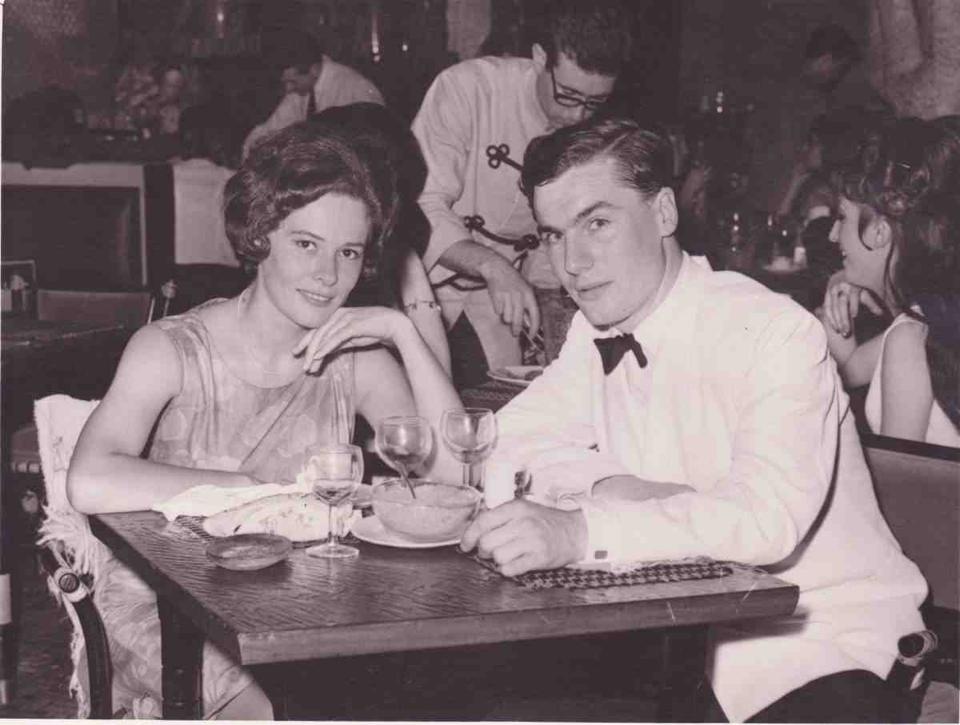
Clive Fiske Harrison, with his then fiancée, now wife, Barbara Gail Horne, at The May Fair Hotel in London during his first year in the City, 1963, after his return from New York

Clive Fiske Harrison, with his then fiancée – now wife – the sculptor Barbara Gail Horne, at The May Fair Hotel in London during his first year in the City, 1963, after his return from New York (Photo: family archive placed in public domain)

Today saw the annual general meeting of Fiske & Co, the stockbroker and investment bank.

It also marks the day 50 years ago when Fiske’s chairman, Clive Fiske Harrison, joined Panmure Gordon, then one of the leading brokers. A fellow junior colleague in Panmure at that time was David Mayhew. He, like Fiske Harrison, has survived the intervening years of change rather better than has Panmure. (Mayhew stood down as chairman of J. P. Morgan Cazenove at the end of last year.)

In those relaxed days, the market opened at 9.30am, the partners drank gin or whisky (starting often not much later) and the office workers beer. Hardly anybody drank wine. This was of course before the 1970s market collapse, 1980s Big Bang and 1990s explosion of regulation.

But some things haven’t changed, Fiske Harrison told his shareholders. When he started in 1962, Greek bonds traded at the equivalent of 30p in the pound!

Well done, Clive! I doubt there are many of the current City take who will match your half century.