Oxford Mail: Bullfighting author’s talk called off

News

Bullfighting author’s talk called off

9:30am Thursday 9th February 2012

A TALK tonight by Oxford bullfighter Alexander Fiske-Harrison has been cancelled.

Mr Fiske-Harrison mounted a fierce attack on Blackwell’s for cancelling the event, rescheduled to today after the Broad Street bookshop postponed the original talk because of security fears.

Mr Fiske-Harrison, 35, angered animal rights extremists after training to become a bullfighter and killing a bull in a ring in Spain, later describing his experiences in a book. The writer said the original lunchtime meeting two weeks ago was postponed after Blackwell’s informed him that they had received “a credible threat.”

But he has now accused Blackwell’s of overstating the threat, scaring people away from tonight’s rearranged talk.

Tony Cooper, manager of Blackwell’s, said: “After several conversations with Alexander Fiske-Harrison we decided to cancel the event due to the small number of tickets taken up. Despite initial interest in the lunchtime talk this did not carry forward into a full evening talk by the author.

“We are obviously disappointed that this is the case as we never like to cancel an event unless absolutely necessary.”

Mr Fiske-Harrison, 35, spent two years in Spain’s heartland of bullfighting with matadors and breeders, talking with fans and training to fight bulls himself.


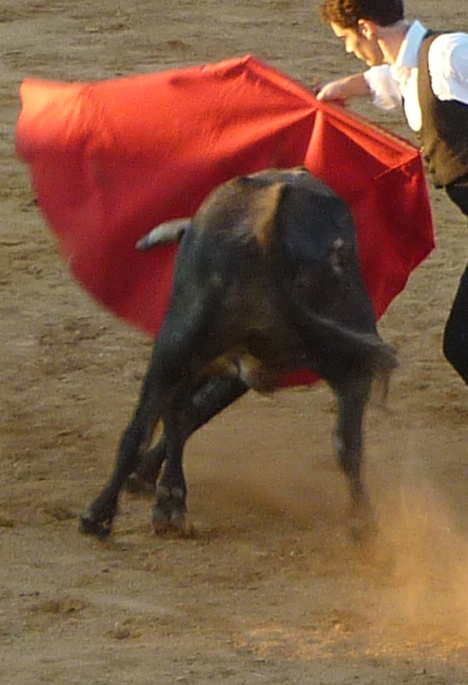
Alexander Fiske-Harrison with a 3-year-old Saltillo bull.

Photo: Paloma Gaytán de Ayala (Santa Coloma)

My talk on Into The Arena: The World Of The Spanish Bullfight at Blackwell’s of Oxford on Thursday at 7pm

On Thursday, February 9th, at 7pm I will be giving a talk on my book, Into The Arena: The World Of The Spanish Bullfight at Blackwell’s Bookshop on Broad Street, Oxford. Tickets are free and are available by calling 01865 333623.

Putting to one side the articles in the Oxford Times and Oxford Mail, which discuss an apparently needless postponement of the talk – Blackwell’s effectively caved into complaints and then misrepresented them to me as messages of a threatening nature so I would agree – it is still worth clarifying one point of fundamental importance. Into The Arena is not a piece of pro-bullfighting propaganda. And it’s not just me saying that. Here’s what the press said:

Shortlisted for

*****

Fiske-Harrison’s argument that the interplay between man and bull, when done with the highest skill, merits the tragedy will not convince many readers. But his descriptions of the fights are compelling and lyrical, and his explanation of different uses of the matador’s capes is illuminating. One begins to understand what has captivated Spaniards for centuries. This complex and ambitious book examines not only life in the bullring but also Spain’s cultural identity and modern ideas of masculinity. Fiske-Harrison admits that with each of his fights he knows more, not less fear. When he kills his first and only bull he feels not triumph but overwhelming sadness for a life take.

Provides an engrossing introduction to Spain’s “great feast of art and danger”…brilliantly capturing a fascinating, intoxicating culture.

Uneasy ethical dilemmas abound, not least the recurring question of how much suffering the animals are put through. But this remains a compelling read, unusual for its genre, exalting the bullfight as pure theatre.

Fiske-Harrison did not expect to fall in love with bullfighting when he saw it for the first time in 2000. A philosophy student and member of the World Wildlife Fund and Greenpeace, he would argue with his brother about animal cruelty. But then he travelled to Seville and had his eyes opened by the beauty, dignity and art of the sport. Fiske-Harrison recounts his year spent studying the matadors, breeders, fans and the bulls themselves, set against the backdrop of the campaign to ban bullfighting in Catalonia.

Others have been there before, not least Ernest Hemingway, the 50th anniversary of whose death neatly coincides with this travelogue. Hemingway concluded that bullfighting was ‘moral’ as it gave him a ‘feeling of life, death and mortality’. Fiske-Harrison comes to much the same conclusion, albeit after considerable soul-searching… He develops a taste for the whole gruesome spectacle, but what makes the book work is that he never loses his disgust for it…

This is an informed piece of work on a subject about which we are all expected to have a view. But what I really enjoyed about Into The Arena is that after nearly 300 pages I still couldn’t quite decide whether bullfighting should be banned or allowed to flourish.”

It’s to Fiske-Harrison’s credit that he never quite gets over his moral qualms about bullfighting; the book is at its strongest when he uses his degree in biology to investigate the cruelty question… Into the Arena is full of intriguing detail… an engrossing introduction to bullfighting. Continue reading

The unedited version of my article for the Daily Telegraph on why I shouldn’t win the Bookie Prize

My article about bullfighting and my book, Into The Arena, appeared in the Daily Telegraph yesterday (online here). However, it was edited to two-thirds of its original length, mainly to save money on photos it would seem. Here is the original.

Alexander Fiske-Harrison

Why I shouldn’t win the ‘Bookie’ Prize

Alexander Fiske-Harrison, on why his shortlisted book Into The Arena: The World Of The Spanish Bullfight should not win the William Hill Sports Book Of The Year Award 2011

A life and death matter: Alexander Fiske-Harrison (far right) running with the bulls in Pamplona, Spain Photo: Reuters /Joseba Etxaburu

When my publisher told me that my book was longlisted for a sports writing prize sponsored by William Hill – the Bookie Prize as it is known – I smiled a cynical smile. Controversy equals publicity, I thought, and this little gambit had a timely ring to it, given that it came less than a week after the Barcelona bullring had its last ever fight before a Catalonia wide ban on the activity came into force. Something often reported here as “Bullfighting Dies In Spain”, even though of the thousand bullfights a year, less than a dozen were held there.

In Spain itself bullfighting is written about in the cultural pages of the newspapers, not their sporting section and 2011 not only saw its regulation transferred from the Ministry of the Interior to that of Culture, but over the border in France it was placed on the list of the “cultural patrimonies” making it effectively unbannable. (French bullfights are mainly in the south, most notably in the restored Roman colisea of Arles and Nîmes.) Even Ernest Hemingway, the most famous writer on the subject in English wrote in Death In The Afternoon: “The bullfight is not a sport.”

Ernest Hemingway and the matador Antonio Ordóñez

So, whilst grateful for the nod, I didn’t think any more of it. However, when I found myself on the shortlist of just seven books, I wondered to myself what I would say if I received the prize and was then asked the inevitable question, “is it even a sport?” Continue reading

The Uses of Cruelty and the “Gentling Effect”

“The question of whether a modern society should endorse animal suffering as entertainment is bound to cross the mind of any casual visitor to a bullfight. Alexander Fiske-Harrison first tussled with the issue in his early twenties and, as a student of both philosophy and biology, has perhaps tussled with it more lengthily and cogently than most of us.”
Literary Review, August 1st, 2011

“It’s to Fiske-Harrison’s credit that he never quite gets over his moral qualms about bullfighting.”
Financial Times, June 4th, 2011

“He develops a taste for the whole gruesome spectacle, but what makes the book work is that he never loses his disgust for it.”
Daily Mail, May 26th, 2011

As I got on the plane to the Roman coliseum at Nîmes in France to see the greatest living bullfighter, José Tomás, on Sunday, September 18th, the idea of cruelty was foremost on my mind for obvious reasons. The gladiatorial arena is the birth place of the bullfight, whatever other historical traditions may have partly inspired it or later imposed themselves and moulded it – Minoan bull-dancers, Carthaginian marriage rituals, Mithraic initiation rites, the knightly joust, the circus, flamenco, ballet and the theatre. The gladiator is he who wields the gladius, the ‘sword’. The old name for a matador, ‘killer’, is espada or sword.

(All photos are mine from that day unless otherwise marked.)

Continue reading

The League of Cruel Sports

At the same time as the Sunday Telegraph joined the Sunday Times in listing my book Into The Arena as “essential summer reading”, and I was doing what you see in the photo below (more photos here), the animal rights lobby groups have broken their silence and ‘The League Against Cruel Sports’ has put up a review of my book which even contains a complimentary paragraph:

To his credit, Fiske-Harrison does at least acknowledge the morally questionable nature of the bullfight. And the book does contain some interesting explorations of concepts such as fear, bravery and drive.

Alexander Fiske Harrison, far right – red and white jacket – with Torrestrella bull in Pamplona, July 7th 2011 (Photo: REUTERS/Joseba Etxaburu)

Despite this, the rest of their review is riddled with errors from the first sentence:

Alexander Fiske-Harrison spent a year immersing himself in the bullfighting culture of Spain, with the seemingly noble aim of trying to gain a greater understanding of it.

I spent two years in Spain with the bulls. To the last: Continue reading

Moving blog for Pamplona

Running in Pamplona ’09 – me circled right

For the festivities of Pamplona 2011, I will be moving blog to The Pamplona Post, an informal, constantly updated multimedia avalanche on the madness of bullrunning, bullfighting, drinking and everything else one gets up to in the streets of the capital of Navarre…
Join me there by clicking on the masthead below:

The run up to Pamplona…

Me, right, running with the bulls in Pamplona. (Look for the horn behind the head of the man falling to my right.)

As I dig out my running clothes for the 320th annual running of the bulls in Pamplona, Spain, I am pleased to see the chapter where I described running there in 2009 in my book, Into The Arena: The World Of The Spanish Bullfight, serialised in The Independent On Sunday today. This year, on the 50th anniverary of Ernest Hemingway’s death, I go to meet with John Hemingway, grandson of the man who made the town the by-word for “grace under pressure” and drunken revelry with bulls attached.

Alexander Fiske-Harrison: ‘How I risked my life in the Pamplona bull run’

Ernest Hemingway made the Pamplona bull run famous. To mark the 50th anniversary of his death, the acclaimed British writer Alexander Fiske-Harrison relives the day he ran with Pamplona’s bulls…

Read on here..

http://www.independent.co.uk/arts-entertainment/books/features/alexander-fiskeharrison-how-i-risked-my-life-in-the-pamplona-bull-run-2301797.html

Or just buy the book here…

http://www.amazon.co.uk/Into-Arena-World-Spanish-Bullfight/dp/1846683351/ref=sr_1_1?ie=UTF8&qid=1302790004&sr=8-1

Is bullfighting an art?

Cayetano Rivera Ordóñez in Sanlucar de Barrameda in 2009 by Nicolás Haro

In last weekend’s Sunday Times there is a review of my book, Into The Arena: The World Of The Spanish Bullfight (which can be purchased at Amazon by clicking here) which, although largely positive, has two main criticisms.

The first, a minor one, is that the author is too self-regarding. I can’t really protest against this on pain of self-contradiction, and my only response is to say that the bullfight is, as I argue below, all about the emotion it inspires in both bullfighter and the audience. Since I play both of those roles at different points in the book, I have no choice but to describe who I am so the reader can try to triangulate what sort of emotions it might inspire in them.

His second, more serious criticism is two-pronged: he finds my apparent conversion from journalist to aficionado, and then beyond that to practioner, repellent, and this is made worse by the fact that he finds my justifications given in defence of bullfighting fatuous. The funny thing is, the review in the usually much more sentimental and emotional Daily Mail says that what makes my book readable is that I manage to maintain my “disgust “for the bullfight throughout the book.

So what is the truth? Am I in love with the bullfight, or in hate? The answer is both, at different times, and sometimes with such a quick turnaround between them that they seem to overlap. However, there is one thing I am not, and that is someone who would unprotestingly allow any law to be passed to ban it. The primary reason is because politically I am a liberal. The secondary one is that I believe bullfighting can be justified, even if the justification will not convince everyone all of the time (and that includes me.) The justification I phrased best in the Prospect magazine article which led to the book:

Whether or not the artistic quality of the bullfight outweighs the moral question of the animals’ suffering is something that each person must decide for themselves – as they must decide whether the taste of a steak justifies the death of a cow. But if we ignore the possibility that one does outweigh the other, we fall foul of the charge of self-deceit and incoherence in our dealings with animals.

This is what has given me the title of this blog post. I believe that the bullfight does have an artistic quality, in fact, that can be an art in its own right. Now, I am aware that a large number of people, including the Sunday Times reviewer, think that even if it is an art-form, it could not possibly be justified on that basis. In fact, one journalist for the BBC – our national television network that has a state-enforced monopoly largely to guarantee the impartiality of its journalism – whom I approached on the subject, put his views even more strongly in an email to me.

Dear Xander,

Thanks so much for the invitation. I do have a passing interest in the subject – nothing quite cheers up my morning like reading in the paper that some matador or another has been gored to death by one of the bulls he was proposing to kill. It’s sort of like a man-bites-dog story, but with an added moral twist. But most of the time, I’m more interested in sports stories where both participants have volunteered to take part, and where one of the parties hasn’t been deliberately hobbled by minions sticking spears in them beforehand. Come to think of it, I guess you could see it as appreciating the rules of fair-play they instill at Eton.

Ole… Continue reading

An Englishman in Miura country


Author with a Miura (Photo: Pepe Sánchez)

As I train with my Maestro, to kill a single bull so I can write the most complete book on bullfighting possible (although abandoning my reputation for neutrality as a writer by getting into the arena) remarkable things happen. It is well known in the bullfighting world that no photography is allowed in the unique rectangular ‘plaza’ of Zahariche, the ranch where the world famous Miura bulls are bred, but that rule was broken for a demonstration for a select group of guests – including my friend Enrique Moreno de la Cova who breeds the equally historic Saltillo bulls. This piece of picture reportage by the photographer Pepe Sánchez can be found in the article ‘An Englishman in Zahariche’ on the website of Spain’s most popular bullfighting programme, Toros para Todos, ‘Bulls for All’, to see it click here. The first images are of Pepe Luis Vázquez, a notable former matador and son of an even greater one. Then comes my Maestro, Eduardo Dávila Miura, a recently retired matador and nephew of the house of Miura. Then the aficionado práctico Pepe González Barba. Followed by myself.

Here is what Hemingway had to say about Miura back in the 1930s.

“These bulls must be fought and killed as rapidly as possible with the minimum of exposure by the man, for they learn more rapidly than the fight ordinarily progresses and become exaggeratedly difficult to work with and kill.

Bulls of this sort are the old caste of fighting bulls raised by the sons of Don Eduardo Miura of Sevilla”

Two of the sons of those sons are below, and their daughter’s son as well…

Miuras – Eduardo Miura, AFH, Antonio Miura, and the matador Eduardo Dávila Miura in the finca ‘Zahariche’ in 2010 (Photo: Lucy Gould)