An English farewell – ‘Una despedida Inglés’

20130612-010611.jpg

A portrait of me by Nicolás Haro

I wrote on this blog just before the April Fair that I first came to Seville on the back of a broken relationship ten years before. My dates were wrong: it was in June. This June, I found myself back again.

Seeing things through different eyes, a realisation came over me, which I have expressed in my column in today’s issue of Taki’s Magazine, centring as it does on the saddest story in cinema, Orson Welles. Even the title is a quotation from the great man: ‘The Second-Hand Men’. As I write there,

Welles either couldn’t admit to himself or couldn’t say out loud that the more pressing issue is not just becoming audience rather than artist, but in being fêted for just sitting in the stands and reveling in that. At this point one has slid from the morally and aesthetically questionable world of the voyeur to the far more reprehensible one of poseur.
(To read the column in full click here.)

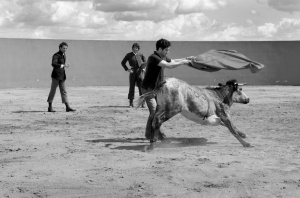
Cf., the photo above…

At the same time, fate conspired me to spend a little time with all the people who helped me make, and themselves made up, my book on this beautiful and strange land, Into The Arena: The World Of The Spanish Bullfight.

As I describe in the column, I stood in front of the last lot of Saltillos ever to exit the gates of Félix and Enrique Moreno de la Cova’s ranch ‘Miravalles’, alongside my former Maestro, the ex-matador Eduardo Dávila Miura. And given what I used to be able to do…

20130612-085020.jpg

Me with a Saltillo bull in 2010 (Photo Nicolás Haro)

… what remained of my bullfighting technique was a rather poor thing…

20130612-005915.jpg

Me with a Saltillo becerra in 2013 (Photo: Miguel Santos)

20130612-005804.jpg

Me with a Saltillo becerra in 2013 (Photo: Miguel Santos)

However, it was still an emotional day with a large audience, many toritos and vaquillas, young bulls and cows, for the toreros practicós, ‘amateur bullfighters’, and a beautiful long lunch at the former Saltillo finca ‘La Vega’ afterwards, even if I was not in any condition to enjoy it as much as I should.

20130612-010357.jpg

The last capea of Saltillo at Miravalles (Photo: Miguel Santos)

Having realised that I was now just a torero on paper – a second-hand guy on the sand – I decided to quit while I was still ahead. (The bulls gave me a great deal, and I gave a great deal back, but they took something as well.)

20130612-084928.jpg

A portrait of me by Nicolás Haro

First, I paid a visit to my old friend and frequent collaborator, the photographer Nicolás Haro, who took these portrait shots while I could still fit into my traje corto. Hopefully, Nicolás and I will soon be collaborating once more on a book about the psychological link between horses and men, a centaur project to balance our minotaur one (Nicolás took the black and white photos for Into The Arena.) The initial collection of Nicolás’s photos for this project have already been nominated for one of the most prestigious international photographic contests held in Spain: PhotoEspaña.)

I will, once I have completed my new novel, finished the task of washing the blood from my hands with a book on what Teddy Roosevelt called “the beast of waste and desolation” and Man’s Best Friend: wolves and dogs.

That said, as you can see from the cover of this new book, Olé! Capturing the Passion of Bullfighters and Aficionados in the 21st Century, due to be published in the United States in the next few weeks, I have been writing on the bulls up to the very last minute (my chapter also contains great photos by Nicolás.)

20130612-010502.jpg

Before I left, I even got to say farewell to that one-eyed gladiator, my first teacher, Juan José Padilla, when he fought in the feria de manzanilla in his home town of Sanlúcar de Barrameda. (These photos are by me.)

???????????????????????????????

???????????????????????????????

JJ 4

20130612-011107.jpgAnd then a last adíos to that matador de arte from the greatest of the taurine dynasties, my dear friend Cayetano Rivera Ordóñez, who was my chauffeur from Seville to Ronda so I could talk about Orson Welles, whose ashes are interred at his family home.

So, all that remains for me to do is say farewell to the streets of Pamplona in July with a couple of runs among their bulls, and those of that other, and more ancient, bull-running town Cuéllar in August (I wrote comparing and contrasting them in the Financial Times last weekend, linked to here.) I even have an invitation from Cayetano to join him in the ring (on a ranch in Ronda) one last time for “amusement” on the morning of the Feria Goyesca. We will see…

However, such amusements and formalities to one side, I’m done here. “There’s a world elsewhere.”

Alexander Fiske-Harrison

To read my Takimag column in full click here.

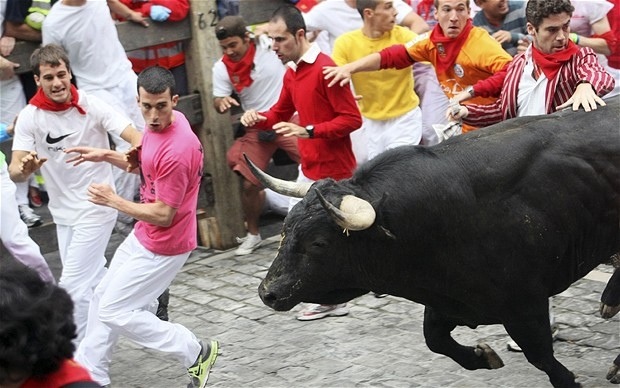
P.S. In a neat and final symmetry, having reached my highest point on talking about the bulls – the speech I gave to the Reform Club at the request of, and beside, the Spanish Ambassador – I have now gone full circle and been invited to talk about the bulls at my old school, Eton. I wonder if they know I’ll be running my last runs in my Eton College Athletic Club Colours blazer (400m). It’s the striped one on the right – I have my hand on the bull for balance – in this Reuters photo in 2011.

20130612-085052.jpg

My Speech on the bulls before the Spanish Ambassador at the Reform Club

Microsoft Word - Logo-1.docx

A Celebration of

The Reform Club and Spain

Thursday 16th May 2013 at 7pm

The evening will commence with a Reception at 7pm, to take place on the Gallery, when members will be invited to enjoy acorn-fed Iberian ham and Gazpacho, served with Gonzalez Byass’s Palo Cortado Leonor sherry. Dinner will be served at 7.30 pm in the Smoking Room, prior to which Father Jorge Boronat will offer Bendecir la mesa.

Musical entertainment will be provided between courses when Isabel Maria Martinez Garrido, guitarist, and Ricard Rovirosa, pianist, will perform some memorable Spanish pieces by, among others, the composers Manuel de Falla and Enrique Granados.
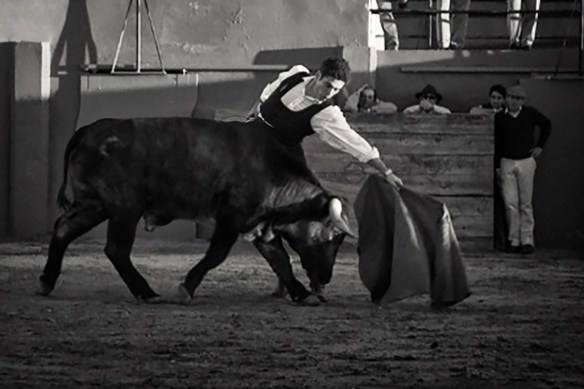
The evening will be further enhanced with an address by Alexander Rupert Fiske-Harrison, renowned academic, writer, broadcaster, and conservationist, who will speak on ‘The British and the Bulls: A History of Love and Hate from Charles I to Churchill and beyond’.  Alexander, pictured in the photo, is a sought after speaker whose topic is guaranteed to provide much food for thought.

The Club is honoured that the Spanish Ambassador to London, His Excellency Frederico Trillo-Figueroa, and former Minister of Defence for the Kingdom of Spain, will be present. His Excellency will be accompanied by Mr. Fidel López Álvarez, Minister for Cultural and Scientific Affairs.

Government of Spain logo

Embajada de España en Londres

Oficina de Asuntos Culturales y Científicos

INTRODUCTION OF THE SPEAKER ALEXANDER FISKE-HARRISON

(Reform Club May 16th 2013)

Mr. Chairman,

Ambassador,

My Lords, Ladies and Gentlemen,

The Reform Club asked the Spanish Embassy to present its best to the assembled guests who include your members of parliament, ministers of cabinet and secretaries of state, and we have. Thanks to their initiative and the support of certain others we all are here tonight enjoying a delicious Spanish dinner, listening to the finest music, and now preparing to listen to our guest speaker.

When the Chairman invited me to look for a speaker I was thinking of someone knowledgeable of both Spanish and British cultures. The task seemed easy, since I had nearly a million Britons living in Spain to choose from, but I finally decided, given the subject in question – bullfighting – on the one person I would call in this tradition truly Anglo-Spanish.

Tonight’s speaker, Alexander Fiske Harrison, is, first of all, son of a Reform Club member and very appropriate for tonight’s speech, because he not only loves his country and Spain too but he’s an Oxford graduate in biology, a London postgraduate in philosophy, a New York trained method actor, a writer and a journalist, a runner before Pamplona’s bulls and even a torero!

In the summer of 2008 Alexander Fiske Harrison was acting in a play two streets from this very club, in the West End, which he had also written. In his own words, that play went so “well” that he decided to give up the stage for the sand of the bullring and moved to Spain to write about the – for him – alien world of the Spanish fighting bulls.

By the spring of 2010, the London Times was calling him “the bullfighter-philosopher”, even though he had not by that point even fought a bull, only their daughters and their mothers, las vacas!

In 2011, his book Into The Arena was published and was shortlisted for the William Hill Sports Book of the Year Award, even though he wrote in the book, and in the Daily Telegraph on the eve of the prize-giving, that bullfighting is definitely not a sport.

No wonder he did not win.

Tonight we have the opportunity of listening to a real Anglo/Spaniard on his personal experiences in Spain.

The title of his speech is “The British and the Bulls: a history of love and hate from Charles I to Churchill and beyond”.

With you, Don Señor Alexander Fiske Harrison.

Thank you.
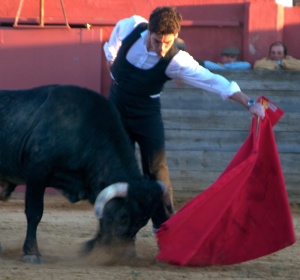
Alexander Fiske-Harrison, Palma del Río, Spain, 2010 (Photo: Nicolás Haro)

Alexander Fiske-Harrison, Palma del Río, Spain, 2010 (Photo: Nicolás Haro)

Su excelencia, my lords, ladies and learnéd gentleman,

When I originally came up with this title, I was told I would be speaking for somewhat longer, so forgive me if this speech seems a little more abrupt and anecdotal than you might have hoped.

Beginning with the most concise and anecdotal description of the views of the British on the bulls I have ever heard, I offer you this: on the day after I published my book Into The Arena: The World Of The Spanish Bullfight, I was in a taxi on my way to be interviewed on the BBC. The driver, on hearing destination, asked what I was going there for. I said I was being interviewed about bullfighting.

“Oh, I can’t be having with that…” said the driver.

“…I know,” I reolied, “it can seem terribly cruel…”

“…no, it’s not that.” He countered.

“What then?” I asked

“My mother always told me never to play with my food.”


This anecdote is the very real frame to all our talk about bullfighting in Britain, but it is so often forgotten.

The debate is not about “animals”, a word which we always associate with our pets, but what we do to things which we kill for food, before we do the killing. The toro bravo, the distinct breed that is the Spanish fighting bull, enters the food chain, although nowadays most of it is not for human consumption. It is too tough. The fighting bull is reared in natural forests and meadows until the age of five, running and combating with his herd mates, building hard muscle.

The 3 million or so cattle we kill in the UK die at eighteen months after largely corralled lives. Of the 35 million they kill in the US, 78% are factory farmed. And the fact is we don’t need to eat meat – vegetarians live longer – we eat it for the flavour, for the pleasure of our palates: these millions are killed for entertainment, just like the six thousand fighting bulls in the rings of Spain last year.

Here you have the first problem with after dinner speaking about bullfighting… it is hard to deal with it lightly. It is a serious thing. The Spanish poet Federico García Lorca, in words paraphrased by Pablo Picasso, went so far as to call it “the last serious thing left in the world today.”

I think it is statements like that which often rouse British scepticism. There is a certain Latin poetic temperament, an operatic emotionality, which thrills to seriousness, to drama, to ritual. And this is found in spades in the world of the bulls. The man who taught me most about bullfighting, the former matador Eduardo Dávila Miura, whose uncles breed the so-called ‘Bulls of Death’, the Miuras, once said to me – “fighting with bulls is like talking to God.”

The British find this sort of talk hyperbole, melodrama. We like our courage discrete, our stiff upper lipped-service to be discharged with a wry smile and a raised eyebrow.

In contrast, the opening sequence of the bullfight is a man, wearing silk and gold, standing erect and still in front of a half ton of charging bull, and bringing the bull past him with the capote, the large cape, in a move called the veronica, named after Saint Veronica, who wiped the face of Christ with a cloth on his way to Golgotha as the bullfighter wipes the face of the bull.

No wonder the British and Spanish can’t see eye to eye on this!

Which brings me to me neatly to my first little historical aside, and a sentence I dared myself to say in this august company: following the unfortunate events of the Spanish Armada…


… and the often forgotten, and equally disastrous, English Armada the following year…


…our two kings, James the First and Philip the Third, agreed on a peace, and as part of that came to a deal by which James’s then second living son, Charles, would marry Philip’s second daughter, Maria Anna.
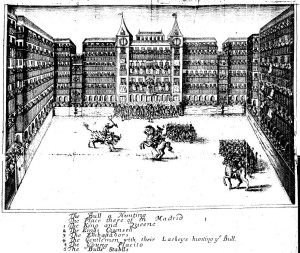
Plaza Mayor, Madrid

Plaza Mayor, Madrid

To be brief, Charles’s elder brother died, he became Prince of Wales, and negotiations stalled. So Charles visited Spain incognito in 1623 with his friend the Duke of Buckingham, travelling under the names of Thomas and John Smith, and arriving unannounced, anonymous and in the middle of the night at the door of the house of the British Ambassador, Lord Bristol, in Madrid – rather to his surprise.

The Spanish King was duly informed and so, in the way of Spain, immediately arranged a bullfight in the Plaza Mayor. Here is a near-contemporary account. I begin halfway through.

Therefore, after the three bulls had been killed, and the fourth a coming forth, there appeared four gentlemen in good equipage; not long after a brisk lady, in most gorgeous apparel, attended with persons of quality, and some three or four grooms, walked all along, the square a foot. Astonishment seized upon the beholders, that one of the female sex could assume the unheard boldness of exposing herself to the violence of the most furious beast yet seen, which had overcome, yea, almost killed, two men of great strength, courage, and dexterity. Incontinently the bull rushed towards the corner where the lady and her attendants stood; she, after all had fled, drew forth her dagger very unconcernedly, and thrust it most dexterously into the bull’s neck, having catched hold of his horn; by which stroke, without any more trouble, her design was brought to perfection; after which turning about towards the king’s balcony, she made her obeysance, and withdrew herself in suitable state and gravity.


Sir, did you ever see, or hear, any example to parallel this? Wonderful indeed! that a faint-hearted feeble woman, one would think, should stand in the fields undauntedly, after her attendants had quickly made their escape, yea, and have overcome such a furious creature as that bull was.


I will not conceal the mystery of the matter from you. This person was a man, though in the habit of a woman, of great experience, agility, and resolution, who had been well inured to this hard labour at several other occasions, whom they appointed to be disguised so much the rather, that the Prince of Wales might be the more taken with the thing.


(James Salgado, 1683)

Now, no record exists of Charles’s immediate reaction, but I think we can deduce from the fact that he not only returned to England and demanded we declare war on Spain, but also married a Frenchwoman, that perhaps this bloody show, the climax of which was the revelation that the woman was actually a man all along – a transvestite torero – hadn’t had the desired effect on the Royal guests.

It is hard to see when during the evolution of the bullfight this scene is set. There has been a transition in that history from a knightly jousting of bulls, after which the bull was finished off by a servant of the knight – a man known as the ‘killer’, the matador – to the servant’s metaphorical ascendance over his master, who became his picador.

This climax of this usually located in the 18th century, with Pedro Romero of Ronda, the first matador to bring art to the arena as well as risk.

What does one mean by art? Well, by this point, the corrida de toros had its present structure of three acts. Opening with the matador with the large cape, then the testing of the bulls fortitude and ferocity against the lancer on horseback, the picador, then the display of athleticism which is the placing of the barbed banderilla-sticks, and then finally the dance with the matador ending in the kill, the moment of truth, and the moment of greatest risk to the matador.

That there is risk is undeniable, although courtesy of antibiotics and surgery’s astonishing advances, no bullfighter has died in some years. That said 533 noted matadors, banderilleros, and picadors have died in the past three centuries – and that’s just the noted professionals.

It is during an early phase of the evolution in this deadly “art” – I always think of it as a tragic play with a ritual sacrifice at its heart – that my next character appears, George Gordon Noel, Lord Byron.
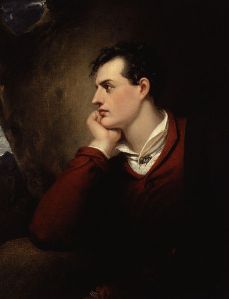
Lord Byron by Richard Westall (Wikipedia)

In the Childe Harold Pilgrimage, Byron describes a bullfight he’d seen in Cadiz during his Grand Tour in 1809 thus:

Thrice sounds the Clarion; lo! the signal falls,

The den expands, and Expectation mute

Gapes round the silent circle’s peopled walls.

Bounds with one lashing spring the mighty brute,

And, wildly staring, spurns, with sounding foot,

The sand, nor blindly rushes on his foe:

Here, there, he points his threatening front, to suit

His first attack, wide-waving to and fro

His angry tail; red rolls his eye’s dilated glow.

But by the end:

Foil’d, bleeding, breathless, furious to the last,

Full in the centre stands the bull at bay,

Mid wounds, and clinging darts, and lances brast,

And foes disabled in the brutal fray:

And now the Matadores around him play,

Shake the red cloak, and poise the ready brand:

Once more through all he bursts his thundering way —

Vain rage! the mantle quits the cunning hand,

Wraps his fierce eye — ’tis past — he sinks upon the sand!

And Byron’s conclusion ?

Such the ungentle sport that oft invites

The Spanish maid, and cheers the Spanish swain.

Nurtured in blood betimes, his heart delights

In vengeance, gloating on another’s pain.


Now, there is no denying that the bullfight was much bloodier then – 200 years ago exactly – than now, not least with the injury and death of the horses, which has not occurred since the introduction of the peto armoured covering in the 1920s.

However, the heart of the matter is that Lord Byron, was that most British of things – and I include myself as one too – an animal lover. He famously wrote a four verse epitaph to his late dog, Boatswain.

So, having called myself an animal lover, what was my first response to a bullfight? Similar it seems to a member of your club, the novelist Henry James, who wrote two hundred years before I was born:

I ashamed to say I took more kindly to the bullfight than virtue, or even decency, allows. It is beastly, of course, but it is redeemed by an extreme picturesqueness and by a good deal of gallantry and grace on the part of the espada [matador].

I was very lucky in the first bullfight I saw – in 2000 in Seville – as the first matador, in fact a novice, a novillero, called El Fandi, was very good.

This nineteen-year-old Spaniard walked across the ring before the bull had entered, right up to the toril, known as ‘the gates of fear’, and knelt down before them, laying his cape delicately out over his knees. When the gates opened, this was how I described it in my book:

From within the darkness, came a rearing, jolting black head, eyes focused, nostrils flaring, ears forward, a foot and a half of horns tapering to fine points above it. And behind it came a half-ton of pulsing muscle propelling it at a steady twenty-five miles an hour.


Fandi pulled the cape up in a single long smooth movement so it swung out in front of the speeding animal’s eyes, catching their attention, and then spun out to the side of his head, the bull following, finding only empty air with its questing horns.


Fandi smiled. Then he stood up.
Into The Arena portada

Of course, this is a dramatic description of a bravura move and is more about thrill than art, but it had its effect.

Fandi, although popular to this day, has little Art. The real artist on the sand is called José Tomás. This is man who once commanded a million Euros for a single afternoon in Barcelona in 2009, the year before bullfighting was banned there, where he faced six bulls solo. However, it was not the contest that was interesting. It was what he did with them: it was his style.

Within the three acts of this drama, the one the modern Spanish audience reveres most is the last (as, by the way, do the French, and Mexican and South American audiences.) Vivemos en la epocha de la muleta. We live in the epoch of the muleta: the smaller red cape – more a cloth than a cape – which is draped over a wooden stick, and offered to the bull as a lure.

It is by the slow solemn execution of the centuries old dance-book of passes with this cloth that the matador performs his art. By his unmoving rigidity, his tranquillity and the elegance of his gesture, contrasted with the surging, pulsing darkness of horn and muscle that brushes against the fabric of his ‘suit of lights’, he transmits emotion to the audience.
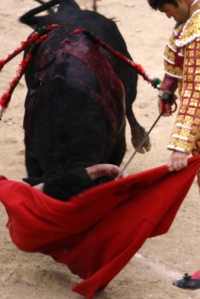
José Tomás in Nîmes, France in 2011 (Photo: Alexander Fiske-Harrison)

José Tomás in Nîmes, France in 2011 (Photo: Alexander Fiske-Harrison)

Transmission and emotion are the key concepts here, and you will find them endlessly bandied about by the critics in the toros section of the Spanish newspapers among the theatre and opera reviews.

Ernest Hemingway was the probably the first to really come to grips with these ideas, partly because they only came into being the year before he first went to Spain in 1923. They were the invention of the Golden Age of bullfighting, the age of Belmonte and Joselito, until the latter was killed in the ring in 1920.

However, I promised myself that I wouldn’t talk about Hemingway, as he is not British, nor that other great American aficionado Orson Welles, whose ashes lie interred at a matador’s house near Ronda.

Which is fine as my early period of learning about bullfighting was as much influenced by Kenneth Tynan as Hemingway. Tynan, Britain’s greatest theatre critic, and co-founder of the National Theatre with Laurence Olivier, was the first to really make me see what he called “the slow, sad fury of the perfect bullfight.”

It was he who put it so neatly in his book Bull Fever in 1955 when he said,

By profession, I am a drama critic; by conviction, a believer in the abolition of capital punishment; by birth, English. The reader may find it odd that a lover of the mimic deaths of stage tragedy, an enemy of judicial killing, and a native of a country which has immemorially detested those blood sports which involve personal hazard should have succumbed to bull fever, joined the afición, become a friend and apologist of the Spanish bullfight. And indeed it is odd. Or so I thought for many weeks after I saw my first corrida in 1950. But now the bullfight seems to me a logical extension of all the impulses my temperament holds – love of grace and valor, of poise and pride; and, beyond these, the capacity to be exhilarated by mastery of technique. No public spectacle in the world is more technical, offers less to the untaught observer, than a bullfight.

So, after these brief glances at this quintessentially Spanish thing, through different sets of British eyes over the centuries, I thought I’d better end with a man voted Greatest Briton of all time, although how he is viewed in this club, where he was once a member, before resigning exactly a hundred years ago, I do not know.

The story goes like this: a stuffed bull’s head, solid black but with a white v on its forehead, arrived at No. 10 Downing Street in July 1945 with the following inscription.

This bull ‘Perdigon’, which came from my stud, was fought at Valencia by Manolete on the day of Victory. It was most noble in its ferocity and was born with the sign of victory on its brow. I present it to the great Mr. Winston Churchill, who with exemplary valour, nobility and humanity, wrought the victory which will save the world.

José Escobar

And this letter that was sent to Manolete in response that December:

My Dear Sir Manolete:

I have received some time ago the head of a magnificent toro, that was sent to me by the breeder Don José María Escobar. The toro had a distinct letter V in it’s forehead. They say that you killed this bull in Valencia on Victory Day.

I would like to thank you and for the generous act & expression of the friendship from Spain. I beg you to accept my best wishes for the happy ending for what must have been a difficult struggle.

Winston Churchill

One could pass it off as an amusing courtesy, were it not for the fact that when Manolete was killed by a Miura bull two years later, Churchill wrote a letter of condolence to his mother, containing the sentence:

I was moved when I received the noble trophy of your son’s superb skill in the bullring.

[To The Ambassador]

One wonders where, and if His Excellency could find out where, that bull head is today?

Thank you.

P.S. After His Excellency delivered his thanks as a response, The Right Honourable Nick Herbert, M.P. and Minister of State for Police and Criminal Justice, informed me that the bull’s head and letter were both at Chartwell, Churchill’s home.

A Dedication To Seville

Camille Natta in 1998 (Photo: Alexander Fiske-Harrison)

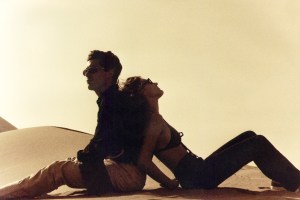
I discovered the city of Seville fifteen years ago on the way back from travelling with the Sahara desert with my then girlfriend, Camille Natta, the French actress-director (although then a fellow philosophy student at Oxford) and the following year we returned and I saw my first corrida de toros, the spectacke that we English wrongly call bullfights, as though it were a sporting contest rather than what it is, a scripted drama culminating in a ritual sacrifice. The Spanish word for the activity, toreo is as well translated by the word ‘bullfighting’ as flamenco would be by ‘heel-dancing’.

(We had the word bullfight and its cognates sitting idle in our vocabulary since we banned our own grim ‘sport’ of bull-baiting with dogs, which gave us our national symbol, the bull-dog, as Spain was given its, the toro bravo by the corrida, hence it is also called the fiesta nacional. For discussion of its current popularity and the oft-quoted ‘Gallup’ polls, see this post. On the ethics of the corrida, see this one.)

The corridas confused and fascinated me – when done well, they were beautiful, when badly a sin: they appeared to exist on a moral precipice – while the atmosphere of Seville – the buildings and people so clearly European when seen on my way back from Africa, yet somehow alien when arrived at from London – had a similar effect. And underneath both was the soul-twisting lament of the flamenco voice with its dark rhythms that pulse like the inevitable approach of death.

Author, Algerian border, 1998 (Photo: Camille Natta)

Author, Algerian border, 1998

Lorca dedicaciónHemingway dedicaciónSo I came back to Seville in 2003, staying at the Hotel Alfonso XII according to my copy of that poet of flamenco, toreo and Andalusia, Federico García Lorca. My copy of the aficionado’s bible, Ernest Hemingway’s Death In The Afternoon, charts my progress through the town to what was the bullfighter’s hotel in those days, the Colón, and on east to Cordoba.

Now, ten years later, I am coming back to a different Seville as a different person. Spain’s economy, like a bull stumbling after a bad wound from the picador’s lance, is being watched by the world to see if it will get up to charge again – something even the bull does not know – or will have to be replaced with something different. I, however, have moved from my seat in the audience to the callejón, the alleyway around the ring where the toreros stand.

After that first visit in 2003, I came back a few times, most notably for the feria de abril, the ‘April Fair’, of ’07, when I saw the matador El Cid torear a bull of Victorino Martín so well that I based an entire essay for Prospect magazine on it. As a result of that, I was sent back to Seville to write a book on toreo, and it was then that first met a series of people who would both populate my book and change my life.

This history of a taurine tribe

This history of a taurine tribe

The Dedication of a Friend

The Dedication of a Friend

Among the most important of these are the family that bred the only bull I have ever killed with a sword.

I first met Enrique Moreno de la Cova in the Spring of 2009, as I described in chapter five of my book Into The Arena: The World Of The Spanish Bullfight, and he invited me to come and face his cattle along with the now one-eyed – and world famous – matador Juan José Padilla. Enrique and his elder brother Félix had inherited the ‘mark’ (literally a ‘brand’) of cattle called Saltillo, now more famous as an encaste, a ‘strain’ of the breed that is the toro bravo. The original Saltillos still exist, though. (They are named after their first owner, the Marquess of Saltillo, from whom Enrique’s grandfather, Félix Moreno Ardanuy purchased them in 1918.) However, their decline was noted as long ago as 1937, when the matador and father of modern toreo, Juan Belmonte remarked in his memoirs, “What has happened to the breeds of Parladé, Saltillo and so many others?”

When I faced the Saltillos, I had only been in the ring once before – with the far simpler and smoother cattle of Fuente Ymbro with Padilla and our friend Adolfo Suárez Illana, son of the founding Prime Minister of Spanish Democracy – and the account of my injuries on their horns is fully recorded in chapter six of the book.

Finito de Córdoba, Juan José Padilla, author & vaquilla (Photo: Nicolás Haro)

Matadors Finito de Córdoba & Juan José Padilla give a lesson(Photo: Nicolas Haro)

For me the Saltillos are Seville, and so I was sad to hear from Enrique that he and his brother no longer had them. However, they remain within the family, having moved to a cousin, José Joaquín Moreno Silva. One of my greatest memories of my two years living in Spain is an afternoon spent with the Saltillos at their ranch Miravalles under the tutelage of my friend, the former matador Eduardo Dávila Miura (whose grandfather bred the most famous bulls of all, including the one that killed Manolete). We then returned to the former ranch of the Saltillos, La Vega, with all three grandsons of Don Félix, who, along with Maestro Dávila Miura, inscribed a copy of their forebear’s philosophical musings on the bulls.

Filosofía taurina portadaFilosofía taurina dedicaciónNow, I must pack for my return to Seville, where I shall be watching corridas with Enrique, drinking at La Fresquita with him, his wife the artist Cristina Ybarra (who has an excellent blog here) her brother Tristán and his aficionada pura wife Maria O’Neill, joking with Adolfo and Padilla as he dresses before going to torear in the Maestranza, and returning to the ring myself with Eduardo.


Spring is here, and Seville, she has not abandoned me .

(The heraldic motto ‘NO8DO’ is to be found all over Seville, from the drain covers to the police cars. The skein of wool in its centre represented by an ‘8’ is called a madeja in Spanish, so it reads, “no madeja do”, a play on the words no me ha dejado, ‘she has not abandoned me.” These were reputedly said by King Alfonso X when the city remained loyal to him against his son, Sancho IV of Castile.)

Alexander Fiske-Harrison

P.S. Obviously, I never became an investment banker, although in a strange twist of fate and friendship Enrique and Cristina’s eldest son did come and work for a summer with my father in the City doing exactly that, exchanging Saltillo for Fiske & Co PLC.

Enrique Moreno de la Cova and the author en route to the bullring of his Saltillos (Photo: Nicolás Haro)

“He came to Seville, and he is called Manzanares”

Matador José Mari Manzanares dances a ‘chicuelina’ with the 510kg, 4-year, 10-month-old J P Domecq bull ‘Rasguero’ (Photo: Alexander Fiske-Harrison)

Gregorio Corrochano, the bullfighter critic of the influential newspaper, A. B. C., in Madrid, said of him, “Es de Ronda y se llama Cayetano.” He is from Ronda, the cradle of bullfighting, and they call him Cayetano, a great bullfighter’s name; the first name of Cayetano Sanz, the greatest old-time stylist. The phrase went all over Spain.

from Ernest Hemingway’s Death In The Afternoon (1932)

In this year’s Feria de San Miguel in Seville I watched the new hero of that city return to the sand to confirm yet again his supremacy in a mano a mano with another very skilled young matador named Alejandro Talavante.

* * *
Note

From here on in, I shall refer to what we English call a ‘bullfight’ as a corrida de toros (literally ‘coursing of bulls’) or just a corrida, and bullfighters as toreros (lit. ‘those who deal with bulls’). All activities involving bulls in Spain come under the blanket term fiesta de los toros, aka the fiesta brava or fiesta nacional or just the Fiesta, the activity of bullfighting is called tauromaquia – we have the old word tauromachy in English – and the art, technique and style of bullfighthing is called toreo.

Continue reading

Vocento: “A Gentleman In The Ring”

(Versión original en español aquí.)

A couple of weeks ago the eleven newspapers of the Vocento Group in Spain – El Correo, El Diario Vasco, El Diario Montañés, La Verdad, Ideal, Hoy, Sur, La Rioja, El Norte de Castilla, El Comercio, La Voz de Cádiz, Las Provincias – ran the following interview with me. The only exception was ABC which ran this one a few weeks before.

Alexander Fiske-Harrison

A Gentleman In The Ring

by Francisco Apaolaza

Having crossed through a dimensional portal, suddenly he appears in the bull-run of Cuéllar (Segovia), in an out-and-out race with Spanish fighting bulls, a copy of the Financial Times rolled up in his hand. With each stride, Alexander Fiske-Harrison, English gentleman, writer, actor and reporter for the British press spans the huge distance between his world of the cultural and economic elite of London and the bull-run of Cuéllar with its dust, hooves, horns and shoe leather. This is the story of how one man crossed through the door of these parallel universes and then relayed it in the first person to the most anciest newspaper in the City.

Now, perhaps, the Financial Times will give a respite to the workhorse of Spanish debt and point instead to Spain’s oldest bull-run. Perhaps the best part of the story is the signature on the article. Fiske-Harrison is not the type of tourist who cannot distinguish a cart-ox from a fighting bull, but is an amateur bullfighter whose curious journey began many years ago while search of new cultures and strong sensations. What he found was very far from his life in a grand English family – a line of bankers – with its studies at Oxford, its games of rugby, horses, shooting and the exclusive red and white athletics blazer of Eton College, where Prince William and David Cameron also studied. Continue reading

The text of my speech at the University of Seville on ‘Into The Arena’

(In the original Spanish here.)

Last Friday, before the opening of the Feria de Abril here in Seville, I gave a conference on my two perspectives on bullfighting: from far away – England – and far too close – the sand of the bullring.

It was a great honour to talk in the main lecture theatre in the antique Royal Tobacco Factory of Seville, the setting for Bizet’s Carmen among other things (which was in turn based on the novella of that name by Prosper Mérimée.)

The speech was particularly well-received. Rafael Peralta, a poet, author and amateur bullfighter from a great family of bull-breeders and rejoneadors – horseback bullfighters – had the following to say about it in the newspaper La Razón, ‘The Reason’ (my translation):

An Englishman in the arena; by Rafael Peralta Revuelta

This past Easter Sunday, a British diplomat, Lord Tristan Garel-Jones, made a defense of bullfighting from the lectern of the Lope de Vega theatre in the classic Pregón Taurino, ‘Taurine Proclamation’, of the Royal Maestranza of Seville. Bullfighting has always appealed in one way or another to the English. For some, it is a show that, far from their Anglo-Saxon culture, they describe as barbaric. For others it may mean something curious, full of mystery and romance. Such was the case of Joseph William Forbes, a boxing manager who every summer went to Spain for his own particular taurine “tournament”. As do the members of the Club Taurino of London, who every year visit our city to attend the bullfights of the April Fair. Alexander Fiske-Harrison is an English writer and actor, whom we find at the entrance of the Plaza de Toros. Several years ago now, he began to have contact with the world of bullfighting, with the help of family and close friends. Little by little, he went deeper into the secrets of the world of the bulls. He became an amateur bullfighter, fighting on the ranch “Zahariche” of the Miuras, and arrived at the point of killing a Saltillo bull on the ranch of the Moreno de la Cova family. He became friends with bull-breeders, with bullfighters like Juan José Padilla and Adolfo Suárez Illana. His experiences are contained in the book Into The Arena: The World Of The Spanish Bullfight. As a philosopher and writer specializing in analyzing the behavior of animals, he recognized in England that there is a lot of hypocrisy about bullfighting. Last week gave a lecture at the University of Seville, explaining his vision of bullfighting. Fiske-Harrison opens a new door, fundamental and necessary, to the Fiesta Brava in Anglo-Saxon culture.

I enclose the text of my speech below. The text of Lord Garel-Jones’s Pregón Taurino, which he has kindly provided to me in English (his speech, like mine, was delivered in Spanish), is viewable as a PDF by clicking here: El Pregón Taurino de Lord Tristan Garel-Jones – English. I will finish by saying how happy I am that after leaving a lecture like this, the entire audience went to the Seville bullring, La Plaza de Toros de la Real Maestranza de Caballería de Sevilla (in whose 250-year-old library, Into The Arena is the only book in English). There we saw the very essence of what I was talking about in terms of beauty in the toreo of José Mari Manzanares who cut four ears and left on the shoulders of the crowd through the Gate of the Prince. (We met in the training ring a month ago.) I must also mention the astonishing valour of the now one-eyed Juan José Padilla.

In the photo below, by the historian and author Guy Walters who was sitting with my mother and my girlfriend, you can see Manzanares embracing his father, a former matador of great note. Circled left are myself and my own father, in seats generously provided by Enrique Moreno de la Cova and Cristina Ybarra. Leaning on the planks in the foreground is Padilla.

“Into The Arena”: The bullfight as lived by an Englishman

Ladies and Gentleman,

You will forgive me but in the eighteen months since I completed the research for my book I have forgotten as much of my Spanish as I have of my bullfighting – as a little bull of Astolfi discovered to his delight a week ago. However, I hope that more language remains than my technique of tauromachy and that I walk away with fewer bruises!

First, I would like to thank the University of Seville – and especially Jose Luis and Antonio and their Forum of Analysis for inviting me, an Englishman, to speak about my perspective on the bulls. I was going to say that this is a rare honour indeed, until I read in the newspaper that my fellow Briton, Lord Tristan Garel-Jones, was doing just that two weeks ago. I would like to say it doesn’t count, because he is Welsh and not English, but then I might offend my dear friend and deep aficionado Noel Chandler who is here today. Also, since Lord Garel-Jones’s talk was the annual Pregón Taurino of La Maestranza, and it was delivered with such eloquence, I must doff my cap, and have provided a copy of it courtesy of its author.

So I am now faced with the problem many matadors have in facing a bull immediately after a colleague has taken two ears. Continue reading

Mad Bulls and Englishmen by Giles Coren in The Times

This article of Giles Coren’s was originally published in The Times magazine on Boxing Day ’09 where it is still available along with Dominic Elliot’s film of our day bullfighting here. All photos are by Nicolás Haro.

Alexander Fiske-Harrison, the English bullfighter, takes on a ‘vaquilla’ of the Saltillo breed. Inset: with Giles Coren, attending a bullfight in Seville.

Writers and travellers have long been drawn to the drama and romance of the bullfight. Giles Coren is no exception, so when he was contacted out of the blue by the younger brother of his dead best friend, now training to be a bullfighter in Spain, Giles was intrigued. Here he describes his journey into a unique culture of noblemen, peasants and swindlers, all driven by deadly serious dreams of death and glory

I am in a bullring. Not in the seats, in the ring. On the sand. From the relative safety of a wooden barrier with a small room behind it, built into the stone wall, I have seen four vaquillas, young cows, “caped” by one of Spain’s most famous matadors, the son of the first post-Franco prime minister of Spain, Adolfo Suárez Illana, and by Alexander Fiske-Harrison, the younger brother of my best friend at school, who died in an accident the year we left, three months before his 19th birthday. Continue reading

An Englishman in Miura country


Author with a Miura (Photo: Pepe Sánchez)

As I train with my Maestro, to kill a single bull so I can write the most complete book on bullfighting possible (although abandoning my reputation for neutrality as a writer by getting into the arena) remarkable things happen. It is well known in the bullfighting world that no photography is allowed in the unique rectangular ‘plaza’ of Zahariche, the ranch where the world famous Miura bulls are bred, but that rule was broken for a demonstration for a select group of guests – including my friend Enrique Moreno de la Cova who breeds the equally historic Saltillo bulls. This piece of picture reportage by the photographer Pepe Sánchez can be found in the article ‘An Englishman in Zahariche’ on the website of Spain’s most popular bullfighting programme, Toros para Todos, ‘Bulls for All’, to see it click here. The first images are of Pepe Luis Vázquez, a notable former matador and son of an even greater one. Then comes my Maestro, Eduardo Dávila Miura, a recently retired matador and nephew of the house of Miura. Then the aficionado práctico Pepe González Barba. Followed by myself.

Here is what Hemingway had to say about Miura back in the 1930s.

“These bulls must be fought and killed as rapidly as possible with the minimum of exposure by the man, for they learn more rapidly than the fight ordinarily progresses and become exaggeratedly difficult to work with and kill.

Bulls of this sort are the old caste of fighting bulls raised by the sons of Don Eduardo Miura of Sevilla”

Two of the sons of those sons are below, and their daughter’s son as well…

Miuras – Eduardo Miura, AFH, Antonio Miura, and the matador Eduardo Dávila Miura in the finca ‘Zahariche’ in 2010 (Photo: Lucy Gould)