Capote y Toros, 157 Old Brompton Road, London, SW5

Back when my book, Into The Arena, was published last year the Reuter’s editor Angus MacSwan decided to interview me at a new, bullfighting-themed tapas bar in South Kensington called Capote y Toros (‘cape and bulls’).

All the food was excellent, especially the gambas al ajillo – sizzling prawns in garlic. It also has the largest selection of sherries in London: not only the standard finos, olorosos and amontillados of Jerez de la Frontera and Puerto de Santa María, but also the manzanillas of Sanlucar de Barrameda. CyT is also the only place I have found in London with proper jamón ibérico de bellota – the pata negra name you sometimes hear refers to the distinctive black hooves of the ibérico breed. They import the 5J from the town synonymous with jamón: Jabugo.

So when a production company asked for a good venue in which to talk about bulls, this is where we ended up, under the photos of all the great matadors alive today from Curro Romero to Morante de la Puebla (its name is capote after all.)

While I was there, the restauranteuraficionado Abel Lusa came along to say hello. He recently opened CyT and also owns the more formal tapas restaurant Tendido Cero across the road, and the justly famed Cambio de Tercio a few doors down, a favourite of the likes of Rafa Nadal when he’s in town and most recently graced by the Duchess of Cambridge.

Abel Lusa

(I was meant to eat there with Giles Coren so he could review it along with my book as as follow up to his piece on my training as a bullfighter, but they don’t do lunch, so we went to 34 instead.)

Alexander Fiske-Harrison

For those that missed it: The return of Juan José Padilla to the bullring in Olivenza.


YouTube video below:

Alexander Fiske-Harrison

The matador Juan José Padilla triumphs

Juan José Padilla tours the ring in triumph on the shoulders of our friend Adolfo Suárez Illana (click to enlarge)

Juan José Padilla is a Spanish matador whose generosity of time, spirit and courage allowed much of my book, Into The Arena: The World Of The Spanish Bullfight, to exist (click here to purchase at Amazon UK, and here for Amazon US). And, without him, as many critics pointed out, it certainly have been as widely praised as it was (nor shortlisted for Sports Book Of The Year 2011, I suspect.)

Juan José was the first matador I met in Spain. It was he who took me to my first training session with cattle at the ranch of Álvaro Domecq, ‘Los Alburejos’ (and then onto his own nightclub ‘La Lola’ in Jerez de la Frontera afterwards). This – including the club – forms chapter three of the book. He was also with my when I first entered the ring myself at the ranch of Fuente Ymbro (chapter four), and much, much more besides.

So, when I heard about his horrific goring, detailed in the post here, in which he lost his left eye I knew that I had to be present when he inevitably returned to the ring.

However, no amount of confidence inspired by Juan José’s words when I visited him at home two days before the fight, nor seeing the calm beauty of the bulls in their natural wilderness the day before that, could prepare me for his triumph in the ring, ending with him being carried out on the shoulders not of the crowd as is usual with a great success in the plaza, but on the shoulders of the top matadors of today – who had gathered to watch – and now jockeyed to carry the Maestro themselves.

However, should you wish to know more of Juan José, read Into The Arena, and then go and see him in Valencia on March 16th alongside the No.1 matador in Spain, José María Manzanares or they will both be fighting at my own favourite ring, in Seville at the April Fair, on the 20th and again, with his old friend Fandi (the technical no .1 in Spain) and El Cordobés on the 28th (you can buy tickets here). I would suggest that in Seville those on a budget stay at the Hotel Adriano (website here) next to the bullring, those who want old beauty stay with my friends at the Hotel Las Casas de la Juderia (website here), and those who prefer the boutique, with my friends at the Hotel Corral del Rey (website here). Direct flights from London are by Ryanair and Easyjet.

Alexander Fiske-Harrison

Juan José Padilla with his capote (Photo: Daniel Ochoa de Olza / APMore Photos)

My interview on BBC Radio Oxford

As the Oxford Mail reported, my talk at Blackwell’s bookshop in Oxford on my book Into The Arena: The World Of The Spanish Bullfight was finally cancelled following a debacle involving purported death-threats and postponements for security reasons which all seemed deeply dubious.

However, as a result, I was invited to talk instead on Bille Heine’s Sunday morning show on BBC Radio Oxford. The other guests were a hunt saboteur, a representative of People for the Ethical Treatment of Animals – PETA – and the secretary of the Club Taurino of London – CTL.

You can find the interview by clicking here. It begins one hour into the show and lasts for an hour.
Alexander Fiske-Harrison

The Man of the Moment: Juan José Padilla

Screen capture of interview (videos embedded below)

I have embedded below, in two parts, Canal Sur’s Jesús Quintero interviewing the matador Juan José Padilla – and his wife Lidia at the end of the second part – about his forthcoming return to the ring in Olivenza on March 4th, following his horrific injuries I posted about here. Not for nothing did Continue reading

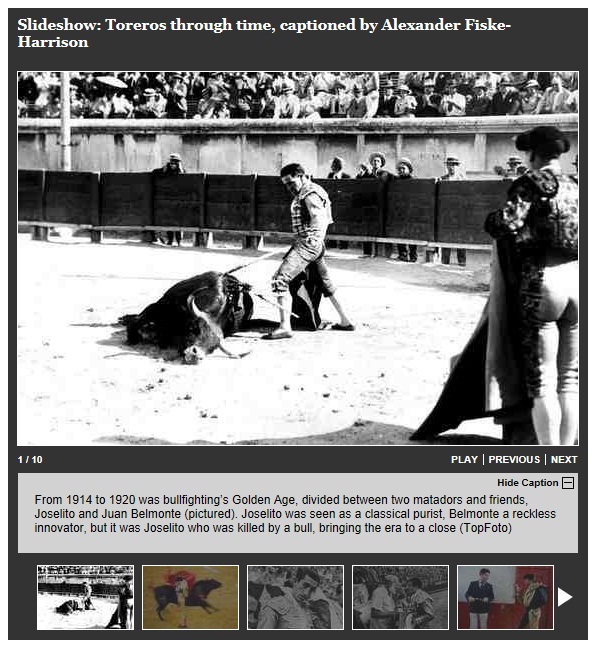
The Times: Toreros Through Time, captioned by Alexander Fiske-Harrison

 

Continue reading

Matador Juan José Padilla returns to the ring… and so do I

My friend, the legendary matador Juan José Padilla who is the first four chapters of my book Into The Arena, whose terrible goring last year cost him an eye as detailed here, is confirmed to return to the professional arena in Olivenza, Spain, on the final day of the feria there on Sunday, March 4th.

The matadors who are to accompany him are two of greatest working today. Morante de la Puebla, the Divine Cape, is an artistic genius and a childhood friend of Padillas. The second is José María Manzanares, son of the great matador of the same name, who put in a performace last year which stunned Spain and elevated him to “man of the moment”. Only Julián López – El Juli – and José Tomás also fight at this level.

They will be facing the best bulls in Spain, Núñez del Cuvillo, whose cattle are known for their ferocity and courage (as I have experienced myself). It was one of their bulls, fought by Manzanares, who was pardoned for bravery in Seville last year – the first pardon in that discerning ring in half a century.

I will be at Padilla’s side in training on the ranch – my own return to the ring with cattle – and in the callejón – the bullfighter’s alley – at the plaza de toros itself.

Alexander Fiske-Harrison

Juan José Padilla with a Miura bull, Pamplona 2011 (Photo: AFH personal collection)

Oxford Mail: Bullfighting author’s talk called off

News

Bullfighting author’s talk called off

9:30am Thursday 9th February 2012

A TALK tonight by Oxford bullfighter Alexander Fiske-Harrison has been cancelled.

Mr Fiske-Harrison mounted a fierce attack on Blackwell’s for cancelling the event, rescheduled to today after the Broad Street bookshop postponed the original talk because of security fears.

Mr Fiske-Harrison, 35, angered animal rights extremists after training to become a bullfighter and killing a bull in a ring in Spain, later describing his experiences in a book. The writer said the original lunchtime meeting two weeks ago was postponed after Blackwell’s informed him that they had received “a credible threat.”

But he has now accused Blackwell’s of overstating the threat, scaring people away from tonight’s rearranged talk.

Tony Cooper, manager of Blackwell’s, said: “After several conversations with Alexander Fiske-Harrison we decided to cancel the event due to the small number of tickets taken up. Despite initial interest in the lunchtime talk this did not carry forward into a full evening talk by the author.
“We are obviously disappointed that this is the case as we never like to cancel an event unless absolutely necessary.”

Mr Fiske-Harrison, 35, spent two years in Spain’s heartland of bullfighting with matadors and breeders, talking with fans and training to fight bulls himself.


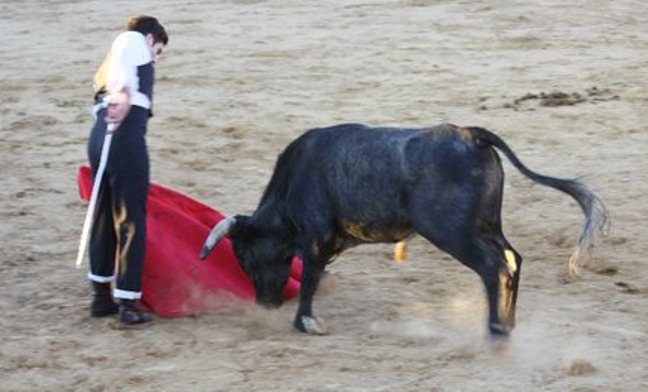
Alexander Fiske-Harrison with a 3-year-old Saltillo bull.

Photo: Paloma Gaytán de Ayala (Santa Coloma)

My talk on Into The Arena: The World Of The Spanish Bullfight at Blackwell’s of Oxford on Thursday at 7pm

On Thursday, February 9th, at 7pm I will be giving a talk on my book, Into The Arena: The World Of The Spanish Bullfight at Blackwell’s Bookshop on Broad Street, Oxford. Tickets are free and are available by calling 01865 333623.

Putting to one side the articles in the Oxford Times and Oxford Mail, which discuss an apparently needless postponement of the talk – Blackwell’s effectively caved into complaints and then misrepresented them to me as messages of a threatening nature so I would agree – it is still worth clarifying one point of fundamental importance. Into The Arena is not a piece of pro-bullfighting propaganda. And it’s not just me saying that. Here’s what the press said:

Shortlisted for

*****

Fiske-Harrison’s argument that the interplay between man and bull, when done with the highest skill, merits the tragedy will not convince many readers. But his descriptions of the fights are compelling and lyrical, and his explanation of different uses of the matador’s capes is illuminating. One begins to understand what has captivated Spaniards for centuries. This complex and ambitious book examines not only life in the bullring but also Spain’s cultural identity and modern ideas of masculinity. Fiske-Harrison admits that with each of his fights he knows more, not less fear. When he kills his first and only bull he feels not triumph but overwhelming sadness for a life take.

Provides an engrossing introduction to Spain’s “great feast of art and danger”…brilliantly capturing a fascinating, intoxicating culture.

Uneasy ethical dilemmas abound, not least the recurring question of how much suffering the animals are put through. But this remains a compelling read, unusual for its genre, exalting the bullfight as pure theatre.

Fiske-Harrison did not expect to fall in love with bullfighting when he saw it for the first time in 2000. A philosophy student and member of the World Wildlife Fund and Greenpeace, he would argue with his brother about animal cruelty. But then he travelled to Seville and had his eyes opened by the beauty, dignity and art of the sport. Fiske-Harrison recounts his year spent studying the matadors, breeders, fans and the bulls themselves, set against the backdrop of the campaign to ban bullfighting in Catalonia.

Others have been there before, not least Ernest Hemingway, the 50th anniversary of whose death neatly coincides with this travelogue. Hemingway concluded that bullfighting was ‘moral’ as it gave him a ‘feeling of life, death and mortality’. Fiske-Harrison comes to much the same conclusion, albeit after considerable soul-searching… He develops a taste for the whole gruesome spectacle, but what makes the book work is that he never loses his disgust for it…

This is an informed piece of work on a subject about which we are all expected to have a view. But what I really enjoyed about Into The Arena is that after nearly 300 pages I still couldn’t quite decide whether bullfighting should be banned or allowed to flourish.”

It’s to Fiske-Harrison’s credit that he never quite gets over his moral qualms about bullfighting; the book is at its strongest when he uses his degree in biology to investigate the cruelty question… Into the Arena is full of intriguing detail… an engrossing introduction to bullfighting. Continue reading

The Australian reviews my book: Death in the afternoon revisited by a beginner bullfighter

As an Australian citizen (dual-nationality with my British citizenship), I am very pleased to see that their best-selling national newspaper, The Australian has reviewed my book Into The Arena: The World Of The Spanish Bullfight in this weekend’s edition (online here: Death in the afternoon revisited by a beginner bullfighter | The …).

I think that the author, Matthew Clayfield, who refers heavily to Ernest Hemingway’s Death In The Afternoon as a strongancestral influence to my book has got it largely right – including in his criticisms.) Especially in his line on my ethical misgivings about bullfighting in the book:

While Fiske-Harrison eventually dismisses his qualms, it is difficult to read his final chapter, “La escotada” – the thrust of the matador’s sword – without getting a sense that his year with the bulls has only deepened their mystery. It certainly hasn’t put an end to his concerns. Or, one suspects, his searching for an answer.

I should add here, just to clarify, that despite press reports to the contrary, my talk at Blackwell’s Bookstore in Oxford has not been ‘threatened’ as such, and neither have I with regards to the talk. This was a miscommunication somewhere in the chain, as was the in-hindsight preposterous idea that the Thames Valley Police were aware of this and had failed to act.

I have myself received “death-threats” on this blog and elsewhere – although I have always found that phrase a little melodramatic, as I am neither dead nor feeling in the least threatened. Which is why I delete them, forget them and sleep easy at night. (Well, not quite: I dream, almost constantly, about bulls. My strangest – and most moving – dream about them opening chapter twenty of Into The Arena.)

Anyway, I will be talking at Blackwell’s at 7pm on Thursday, February 9th.

Alexander Fiske-Harrison

The photo of my one and only “bullfight” is enclosed below (Photo: Andy Cooke). A full discussion of the ethics – or lack of – in bullfighting is the next post in this blog.