The text of my speech at the University of Seville on ‘Into The Arena’

(In the original Spanish here.)

Last Friday, before the opening of the Feria de Abril here in Seville, I gave a conference on my two perspectives on bullfighting: from far away – England – and far too close – the sand of the bullring.

It was a great honour to talk in the main lecture theatre in the antique Royal Tobacco Factory of Seville, the setting for Bizet’s Carmen among other things (which was in turn based on the novella of that name by Prosper Mérimée.)

The speech was particularly well-received. Rafael Peralta, a poet, author and amateur bullfighter from a great family of bull-breeders and rejoneadors – horseback bullfighters – had the following to say about it in the newspaper La Razón, ‘The Reason’ (my translation):

An Englishman in the arena; by Rafael Peralta Revuelta

This past Easter Sunday, a British diplomat, Lord Tristan Garel-Jones, made a defense of bullfighting from the lectern of the Lope de Vega theatre in the classic Pregón Taurino, ‘Taurine Proclamation’, of the Royal Maestranza of Seville. Bullfighting has always appealed in one way or another to the English. For some, it is a show that, far from their Anglo-Saxon culture, they describe as barbaric. For others it may mean something curious, full of mystery and romance. Such was the case of Joseph William Forbes, a boxing manager who every summer went to Spain for his own particular taurine “tournament”. As do the members of the Club Taurino of London, who every year visit our city to attend the bullfights of the April Fair. Alexander Fiske-Harrison is an English writer and actor, whom we find at the entrance of the Plaza de Toros. Several years ago now, he began to have contact with the world of bullfighting, with the help of family and close friends. Little by little, he went deeper into the secrets of the world of the bulls. He became an amateur bullfighter, fighting on the ranch “Zahariche” of the Miuras, and arrived at the point of killing a Saltillo bull on the ranch of the Moreno de la Cova family. He became friends with bull-breeders, with bullfighters like Juan José Padilla and Adolfo Suárez Illana. His experiences are contained in the book Into The Arena: The World Of The Spanish Bullfight. As a philosopher and writer specializing in analyzing the behavior of animals, he recognized in England that there is a lot of hypocrisy about bullfighting. Last week gave a lecture at the University of Seville, explaining his vision of bullfighting. Fiske-Harrison opens a new door, fundamental and necessary, to the Fiesta Brava in Anglo-Saxon culture.

I enclose the text of my speech below. The text of Lord Garel-Jones’s Pregón Taurino, which he has kindly provided to me in English (his speech, like mine, was delivered in Spanish), is viewable as a PDF by clicking here: El Pregón Taurino de Lord Tristan Garel-Jones – English. I will finish by saying how happy I am that after leaving a lecture like this, the entire audience went to the Seville bullring, La Plaza de Toros de la Real Maestranza de Caballería de Sevilla (in whose 250-year-old library, Into The Arena is the only book in English). There we saw the very essence of what I was talking about in terms of beauty in the toreo of José Mari Manzanares who cut four ears and left on the shoulders of the crowd through the Gate of the Prince. (We met in the training ring a month ago.) I must also mention the astonishing valour of the now one-eyed Juan José Padilla.

In the photo below, by the historian and author Guy Walters who was sitting with my mother and my girlfriend, you can see Manzanares embracing his father, a former matador of great note. Circled left are myself and my own father, in seats generously provided by Enrique Moreno de la Cova and Cristina Ybarra. Leaning on the planks in the foreground is Padilla.

“Into The Arena”: The bullfight as lived by an Englishman

Ladies and Gentleman,

You will forgive me but in the eighteen months since I completed the research for my book I have forgotten as much of my Spanish as I have of my bullfighting – as a little bull of Astolfi discovered to his delight a week ago. However, I hope that more language remains than my technique of tauromachy and that I walk away with fewer bruises!

First, I would like to thank the University of Seville – and especially Jose Luis and Antonio and their Forum of Analysis for inviting me, an Englishman, to speak about my perspective on the bulls. I was going to say that this is a rare honour indeed, until I read in the newspaper that my fellow Briton, Lord Tristan Garel-Jones, was doing just that two weeks ago. I would like to say it doesn’t count, because he is Welsh and not English, but then I might offend my dear friend and deep aficionado Noel Chandler who is here today. Also, since Lord Garel-Jones’s talk was the annual Pregón Taurino of La Maestranza, and it was delivered with such eloquence, I must doff my cap, and have provided a copy of it courtesy of its author.

So I am now faced with the problem many matadors have in facing a bull immediately after a colleague has taken two ears. Continue reading

For those that missed it: The return of Juan José Padilla to the bullring in Olivenza.


YouTube video below:

Alexander Fiske-Harrison

The matador Juan José Padilla triumphs

Juan José Padilla tours the ring in triumph on the shoulders of our friend Adolfo Suárez Illana (click to enlarge)

Juan José Padilla is a Spanish matador whose generosity of time, spirit and courage allowed much of my book, Into The Arena: The World Of The Spanish Bullfight, to exist (click here to purchase at Amazon UK, and here for Amazon US). And, without him, as many critics pointed out, it certainly have been as widely praised as it was (nor shortlisted for Sports Book Of The Year 2011, I suspect.)

Juan José was the first matador I met in Spain. It was he who took me to my first training session with cattle at the ranch of Álvaro Domecq, ‘Los Alburejos’ (and then onto his own nightclub ‘La Lola’ in Jerez de la Frontera afterwards). This – including the club – forms chapter three of the book. He was also with my when I first entered the ring myself at the ranch of Fuente Ymbro (chapter four), and much, much more besides.

So, when I heard about his horrific goring, detailed in the post here, in which he lost his left eye I knew that I had to be present when he inevitably returned to the ring.

However, no amount of confidence inspired by Juan José’s words when I visited him at home two days before the fight, nor seeing the calm beauty of the bulls in their natural wilderness the day before that, could prepare me for his triumph in the ring, ending with him being carried out on the shoulders not of the crowd as is usual with a great success in the plaza, but on the shoulders of the top matadors of today – who had gathered to watch – and now jockeyed to carry the Maestro themselves.

However, should you wish to know more of Juan José, read Into The Arena, and then go and see him in Valencia on March 16th alongside the No.1 matador in Spain, José María Manzanares or they will both be fighting at my own favourite ring, in Seville at the April Fair, on the 20th and again, with his old friend Fandi (the technical no .1 in Spain) and El Cordobés on the 28th (you can buy tickets here). I would suggest that in Seville those on a budget stay at the Hotel Adriano (website here) next to the bullring, those who want old beauty stay with my friends at the Hotel Las Casas de la Juderia (website here), and those who prefer the boutique, with my friends at the Hotel Corral del Rey (website here). Direct flights from London are by Ryanair and Easyjet.

Alexander Fiske-Harrison

Juan José Padilla with his capote (Photo: Daniel Ochoa de Olza / APMore Photos)

The Man of the Moment: Juan José Padilla

Screen capture of interview (videos embedded below)

I have embedded below, in two parts, Canal Sur’s Jesús Quintero interviewing the matador Juan José Padilla – and his wife Lidia at the end of the second part – about his forthcoming return to the ring in Olivenza on March 4th, following his horrific injuries I posted about here. Not for nothing did Continue reading

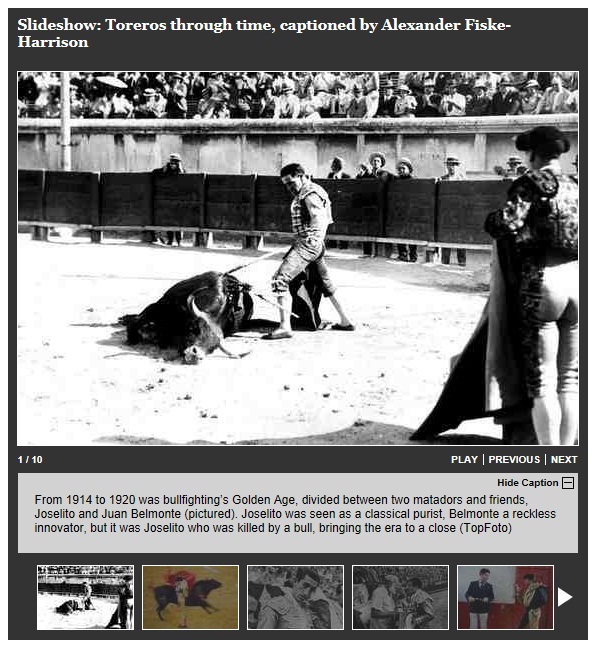
The Times: Toreros Through Time, captioned by Alexander Fiske-Harrison


Continue reading

Matador Juan José Padilla returns to the ring… and so do I

My friend, the legendary matador Juan José Padilla who is the first four chapters of my book Into The Arena, whose terrible goring last year cost him an eye as detailed here, is confirmed to return to the professional arena in Olivenza, Spain, on the final day of the feria there on Sunday, March 4th.

The matadors who are to accompany him are two of greatest working today. Morante de la Puebla, the Divine Cape, is an artistic genius and a childhood friend of Padillas. The second is José María Manzanares, son of the great matador of the same name, who put in a performace last year which stunned Spain and elevated him to “man of the moment”. Only Julián López – El Juli – and José Tomás also fight at this level.

They will be facing the best bulls in Spain, Núñez del Cuvillo, whose cattle are known for their ferocity and courage (as I have experienced myself). It was one of their bulls, fought by Manzanares, who was pardoned for bravery in Seville last year – the first pardon in that discerning ring in half a century.

I will be at Padilla’s side in training on the ranch – my own return to the ring with cattle – and in the callejón – the bullfighter’s alley – at the plaza de toros itself.

Alexander Fiske-Harrison

Juan José Padilla with a Miura bull, Pamplona 2011 (Photo: AFH personal collection)

Mad Bulls and Englishmen by Giles Coren in The Times

This article of Giles Coren’s was originally published in The Times magazine on Boxing Day ’09 where it is still available along with Dominic Elliot’s film of our day bullfighting here. All photos are by Nicolás Haro.

Alexander Fiske-Harrison, the English bullfighter, takes on a ‘vaquilla’ of the Saltillo breed. Inset: with Giles Coren, attending a bullfight in Seville.

Writers and travellers have long been drawn to the drama and romance of the bullfight. Giles Coren is no exception, so when he was contacted out of the blue by the younger brother of his dead best friend, now training to be a bullfighter in Spain, Giles was intrigued. Here he describes his journey into a unique culture of noblemen, peasants and swindlers, all driven by deadly serious dreams of death and glory

I am in a bullring. Not in the seats, in the ring. On the sand. From the relative safety of a wooden barrier with a small room behind it, built into the stone wall, I have seen four vaquillas, young cows, “caped” by one of Spain’s most famous matadors, the son of the first post-Franco prime minister of Spain, Adolfo Suárez Illana, and by Alexander Fiske-Harrison, the younger brother of my best friend at school, who died in an accident the year we left, three months before his 19th birthday. Continue reading

The unedited version of my article for the Daily Telegraph on why I shouldn’t win the Bookie Prize

My article about bullfighting and my book, Into The Arena, appeared in the Daily Telegraph yesterday (online here). However, it was edited to two-thirds of its original length, mainly to save money on photos it would seem. Here is the original.

Alexander Fiske-Harrison

Why I shouldn’t win the ‘Bookie’ Prize

Alexander Fiske-Harrison, on why his shortlisted book Into The Arena: The World Of The Spanish Bullfight should not win the William Hill Sports Book Of The Year Award 2011

A life and death matter: Alexander Fiske-Harrison (far right) running with the bulls in Pamplona, Spain Photo: Reuters /Joseba Etxaburu

When my publisher told me that my book was longlisted for a sports writing prize sponsored by William Hill – the Bookie Prize as it is known – I smiled a cynical smile. Controversy equals publicity, I thought, and this little gambit had a timely ring to it, given that it came less than a week after the Barcelona bullring had its last ever fight before a Catalonia wide ban on the activity came into force. Something often reported here as “Bullfighting Dies In Spain”, even though of the thousand bullfights a year, less than a dozen were held there.

In Spain itself bullfighting is written about in the cultural pages of the newspapers, not their sporting section and 2011 not only saw its regulation transferred from the Ministry of the Interior to that of Culture, but over the border in France it was placed on the list of the “cultural patrimonies” making it effectively unbannable. (French bullfights are mainly in the south, most notably in the restored Roman colisea of Arles and Nîmes.) Even Ernest Hemingway, the most famous writer on the subject in English wrote in Death In The Afternoon: “The bullfight is not a sport.”

Ernest Hemingway and the matador Antonio Ordóñez

So, whilst grateful for the nod, I didn’t think any more of it. However, when I found myself on the shortlist of just seven books, I wondered to myself what I would say if I received the prize and was then asked the inevitable question, “is it even a sport?” Continue reading

My book ‘Into The Arena’ shortlisted for the William Hill Sports Book Prize

It has just been announced that my book, Into The Arena: The World Of The Spanish Bullfight has been promoted from the longlist for the world’s richest sports writing prize, the William Hill Sports Book Of The Year Award 2011, onto the six-strong short list.

I should like to say that without the friendship and courage of the matadors of Spain, most particularly my Maestro Eduardo Dávila Miura and my friend Cayetano Rivera Ordóñez, this book would never have existed. However, the greatest thanks of all are owed to the first matador I met, the Cyclone from Jerez, Juan José Padilla, who is even now recuperating from a hideous near-fatal goring and preparing himself for further surgical intervention in Seville next week in the hope they can restore the sight to his left eye after the bull’s horn took it away (see earlier blogposts.) Continue reading

The matador Juan José Padilla, in his own words – #fuerzapadilla

Juan José Padilla with a Miura bull, Feria de Abril, Seville 2010 (Photo: Alexander Fiske-Harrison)

For those that missed the news story (here) Spain’s bravest matador, Juan José Padilla – a friend of mine and major character in my recent book Into The Arena – was terribly gored a fortnight ago. In this interview he speaks of his recovery. A translation of some of his words is below…

Alexander Fiske-Harrison

They know that this is my life and they know that this is my profession, and they know that I am going to fight, I will give my utmost to be able to face bulls again, because that is what makes me happy.

And because the bull has given me everything. The bull has given me magnificent triumphs, I have been the victor of the greatest fairs in Spain, and the fact that a bull is going to give me injuries does not meant that I am going to feel any bitterness towards him. I will return to face the bulls.

In the words of Adolfo Suárez Illana this morning, who is with him, “He is getting better little by little. But he is getting there…”

#fuerzapadilla

Juan José Padilla and I in the ring together in March ’09 (Photo: Paloma de Gaytan Ayala)