The Australian reviews my book: Death in the afternoon revisited by a beginner bullfighter

As an Australian citizen (dual-nationality with my British citizenship), I am very pleased to see that their best-selling national newspaper, The Australian has reviewed my book Into The Arena: The World Of The Spanish Bullfight in this weekend’s edition (online here: Death in the afternoon revisited by a beginner bullfighter | The …).

I think that the author, Matthew Clayfield, who refers heavily to Ernest Hemingway’s Death In The Afternoon as a strongancestral influence to my book has got it largely right – including in his criticisms.) Especially in his line on my ethical misgivings about bullfighting in the book:

While Fiske-Harrison eventually dismisses his qualms, it is difficult to read his final chapter, “La escotada” – the thrust of the matador’s sword – without getting a sense that his year with the bulls has only deepened their mystery. It certainly hasn’t put an end to his concerns. Or, one suspects, his searching for an answer.

I should add here, just to clarify, that despite press reports to the contrary, my talk at Blackwell’s Bookstore in Oxford has not been ‘threatened’ as such, and neither have I with regards to the talk. This was a miscommunication somewhere in the chain, as was the in-hindsight preposterous idea that the Thames Valley Police were aware of this and had failed to act.

I have myself received “death-threats” on this blog and elsewhere – although I have always found that phrase a little melodramatic, as I am neither dead nor feeling in the least threatened. Which is why I delete them, forget them and sleep easy at night. (Well, not quite: I dream, almost constantly, about bulls. My strangest – and most moving – dream about them opening chapter twenty of Into The Arena.)

Anyway, I will be talking at Blackwell’s at 7pm on Thursday, February 9th.

Alexander Fiske-Harrison

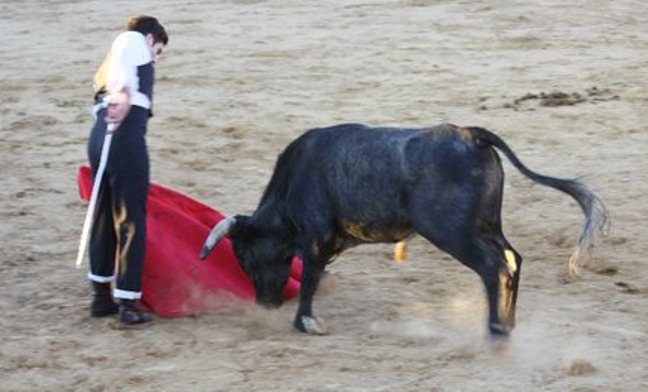
The photo of my one and only “bullfight” is enclosed below (Photo: Andy Cooke). A full discussion of the ethics – or lack of – in bullfighting is the next post in this blog.
Mad Bulls and Englishmen by Giles Coren in The Times

This article of Giles Coren’s was originally published in The Times magazine on Boxing Day ’09 where it is still available along with Dominic Elliot’s film of our day bullfighting here. All photos are by Nicolás Haro.

Alexander Fiske-Harrison, the English bullfighter, takes on a ‘vaquilla’ of the Saltillo breed. Inset: with Giles Coren, attending a bullfight in Seville.

Writers and travellers have long been drawn to the drama and romance of the bullfight. Giles Coren is no exception, so when he was contacted out of the blue by the younger brother of his dead best friend, now training to be a bullfighter in Spain, Giles was intrigued. Here he describes his journey into a unique culture of noblemen, peasants and swindlers, all driven by deadly serious dreams of death and glory

I am in a bullring. Not in the seats, in the ring. On the sand. From the relative safety of a wooden barrier with a small room behind it, built into the stone wall, I have seen four vaquillas, young cows, “caped” by one of Spain’s most famous matadors, the son of the first post-Franco prime minister of Spain, Adolfo Suárez Illana, and by Alexander Fiske-Harrison, the younger brother of my best friend at school, who died in an accident the year we left, three months before his 19th birthday. Continue reading

I didn’t win the Bookie Prize but as the latest Sunday Telegraph says, it’s “pure theatre” anyway…

FINALIST

Sadly, my book did not win the ‘Bookie Prize’ this year. That honour went to Ronald Reng’s A Life Too Short about the tragic suicide of his friend, Robert Enke, the German goalkeeper. Ronald gave a deeply moving impromptu speech, and then he, the champion cyclist David Millar (whose book Racing Through The Dark was also shortlisted) and I went for dinner. I would like to thank William Hill, Waterstones of Piccadilly, and all the other contestants (and my agent, publisher and girlfriend who were all present) for a great day. As I argued in my article in the Daily Telegraph on Saturday, I shouldn’t have won anyway. Here is the review their sister newspaper the Sunday Telegraph gave me the following day.

Alexander Fiske-Harrison

27.11.11

Books for Christmas

Sport books

Oliver Brown

INTO THE ARENA: The World of the Spanish Bullfight BY ALEXANDER FISKE-HARRISON Profile Books, £15.99

Bullfighting was banned in Catalonia last year and yet has continued to capture both the quintessence of Spain and the extremes of sporting heroism. It exerted a fascination early upon Alexander Fiske-Harrison, who watched his first bullfight as a 23-year-old philosophy student in Seville and embarked soon after on a quest to understand the spectacle in all its cultural complexity. This is no passive work, however: he undertakes months of training with one of the top matadors, Eduardo Dávila Miura, to steel himself for the final act of his own corrida de toros. Uneasy ethical dilemmas abound, not least how much suffering the animals are put through. But this remains a compelling read, unusual for its genre, exalting the bullfight as pure theatre.

The unedited version of my article for the Daily Telegraph on why I shouldn’t win the Bookie Prize

My article about bullfighting and my book, Into The Arena, appeared in the Daily Telegraph yesterday (online here). However, it was edited to two-thirds of its original length, mainly to save money on photos it would seem. Here is the original.

Alexander Fiske-Harrison

Why I shouldn’t win the ‘Bookie’ Prize

Alexander Fiske-Harrison, on why his shortlisted book Into The Arena: The World Of The Spanish Bullfight should not win the William Hill Sports Book Of The Year Award 2011

A life and death matter: Alexander Fiske-Harrison (far right) running with the bulls in Pamplona, Spain Photo: Reuters /Joseba Etxaburu

When my publisher told me that my book was longlisted for a sports writing prize sponsored by William Hill – the Bookie Prize as it is known – I smiled a cynical smile. Controversy equals publicity, I thought, and this little gambit had a timely ring to it, given that it came less than a week after the Barcelona bullring had its last ever fight before a Catalonia wide ban on the activity came into force. Something often reported here as “Bullfighting Dies In Spain”, even though of the thousand bullfights a year, less than a dozen were held there.

In Spain itself bullfighting is written about in the cultural pages of the newspapers, not their sporting section and 2011 not only saw its regulation transferred from the Ministry of the Interior to that of Culture, but over the border in France it was placed on the list of the “cultural patrimonies” making it effectively unbannable. (French bullfights are mainly in the south, most notably in the restored Roman colisea of Arles and Nîmes.) Even Ernest Hemingway, the most famous writer on the subject in English wrote in Death In The Afternoon: “The bullfight is not a sport.”

Ernest Hemingway and the matador Antonio Ordóñez

So, whilst grateful for the nod, I didn’t think any more of it. However, when I found myself on the shortlist of just seven books, I wondered to myself what I would say if I received the prize and was then asked the inevitable question, “is it even a sport?” Continue reading

My interview about Into The Arena on Sports Tonight Live

Below is a link to the podcast of the interview I gave about my view of bullfighting, from the stands and from the sand, to Neil Cole on Sports Tonight Live.

Sports Tonight Live: The Book Club with Alexander Fiske-Harrison

My book ‘Into The Arena’ shortlisted for the William Hill Sports Book Prize

It has just been announced that my book, Into The Arena: The World Of The Spanish Bullfight has been promoted from the longlist for the world’s richest sports writing prize, the William Hill Sports Book Of The Year Award 2011, onto the six-strong short list.

I should like to say that without the friendship and courage of the matadors of Spain, most particularly my Maestro Eduardo Dávila Miura and my friend Cayetano Rivera Ordóñez, this book would never have existed. However, the greatest thanks of all are owed to the first matador I met, the Cyclone from Jerez, Juan José Padilla, who is even now recuperating from a hideous near-fatal goring and preparing himself for further surgical intervention in Seville next week in the hope they can restore the sight to his left eye after the bull’s horn took it away (see earlier blogposts.) Continue reading

My “literary spat” with Mark Rowlands in the TLS (as reported in the Evening Standard)


Monday 24 October 2011

It’s wolf v bull as philosophers bare their teeth

Warring in blogland: Mark Rowlands and Alexander Fiske-Harrison

It’s the latest literary spat. Mark Rowlands, a British philosophy professor who spent a decade living with a wolf, gave a savage review to Alexander Fiske-Harrison’s book Into The Arena on the art of the matador in the Times Literary Supplement in September. Now Fiske-Harrison is as wounded as a bull lanced by a picador — and the men are locked in a battle of letters and blog posts against each other. Fiske-Harrison’s complaint is that Rowlands, who concerns himself with animal welfare, would be naturally indisposed to his love of bull-fighting, not to mention that Fiske-Harrison has previously given him a bad review. “Mark Rowlands is a proponent of vegetarianism and once tried to make his pet wolf into one, as described in The Philosopher and the Wolf,” says Fiske-Harrison. Professor Rowlands, who teaches at the University of Miami, had described Fiske-Harrison’s writing as being infected with “vainglory” and “startling arrogance” in his love of bull-fighting.The red rag in this feud was first waved two years when Fiske-Harrison reviewed Mark Rowlands’s wolf book for Prospect magazine. “If you combine misanthropy and lycophilia,” he wrote, “the resulting hybrid, lycanthropy, is indeed interesting but philosophically quite sterile.” Over to Rowlands. “I felt rather guilty that I was dispensing such a negative review,” he tells me. “I did, of course, inform the TLS of the fact that he had previously reviewed a book of mine. I resent the suggestion that my negative review was the result of personal animus … [it] was the result of the book not being very good.” Rowlands has also called Fiske-Harrison “thin-skinned”. The blog argument now runs to several thousands words, with still no victor in sight.

P.S. I suspect that Rowlands’ loathing of the book is more about my having fought a bull – see photo from my book above – than my ‘love’ of watching it. My aficion, or ‘love’, is actually what is in question throughout the book, something every other reviewer noted. As for the idea that a review could wound me – well, that’s just nice journalism I guess. My actual issues with Rowlands are quite clearly pointed out in our exchange in the letters’ page of the TLS here.

Alexander Fiske-Harrison

Juan José Padilla, matador, friend, my “Spanish brother”

I hear, courtesy of our mutual brother-in-arms Adolfo Suárez Illana (son of the founder of democratic Spain and its first president, Adolfo Suárez), that the matador Juan José Padilla is recovering following a long operation to try to repair the terrible damage wreaked on his face by a bull in Zaragoza on Friday evening. As the photo shows, the bull Marqués no. 8, from the breeder Ana Romero, pounced on Padilla as he tripped and fell during the act of the banderillas – Padilla being one of the few matadors in the modern era who places his own banderillas, rather than delegating it to his banderilleros. The bull, which weighed 508kg and was 5 years and 8 months old (only four months short of the upper age limit) entered its horn under the left hand side of his jaw and drove it up and out through his left eye socket. As the bull was drawn off him by the other toreros’ capes Padilla got to his feet saying “I can’t see, I can’t see” before collapsing into the arms of his assistants and being carried from the ring to the infirmary and from there to hospital. The bull’s horn severed the main facial nerve of the left side of Padilla’s face, which is now paralysed, and the optic nerve of the eye which seems unlikely to recover its sight. The bull was then killed by Miguel Abellán, who wept as he did so, having only recently recovered from a similarly bad goring himself.

Whilst researching my book, I came to know Padilla very well and he features in a half dozen chapters in my book, Into The Arena. He is a force of nature who dwarfs everything around him, as I am sure he will this terrible injury. The best description of him I have heard is that of my mother who met him with me at a bullfight in Cazalla de la Sierra in ’09. She said he was like Scaramouche, who in the novel’s opening line is described as “born with the gift of laughter and a sense that the world was mad, and that was his entire patrimony.” The photo below is from the tail end of one of our wild nights out, taken by my friend Nicolás Haro (as is the one above), with Padilla’s childhood friend, the great flamenco dancer Antonio ‘El Pipa’ in the foreground at his house. You can read the extract of that chapter of the book at The Pamplona Post here.

Suerte Maestro.

Alexander Fiske-Harrison

P.S. All of this has quite rightly taken precedence in my mind over my dispute with the philosopher Mark Rowlands in The Times Literary Supplement, which can be found here, and which I will follow up further soon. Needless to say, any man who can write, “Padilla is more likely to die trying to get to the arena than in it,” clearly hasn’t got the faintest idea what he is talking about, nor has the dignity to keep his ignorance to himself.

The Bullfight and the Ban (and the Spanish Economy)

El Cid in Seville on Saturday evening
(Photo: Alexander Fiske-Harrison)

The ban on formal Spanish-style bullfights, corridas de toros, in the autonomous region of Catalonia came into de facto effect last night with the final corrida in Barcelona’s great bullring, La Monumental. (The ban, voted for in the regional parliament in July 2010 actually begins in 2012, but the “season” is now over”.) At the time, I was in transit back from another, very different Spanish city, Seville. (Apologies to Fiona Govan at the Daily Telegraph for not available for comment as a result.)

I had flown out to Seville to fight – non-fatally – on a ranch nearby for the cameras of NBC Nightly News with Brian Williams in the US, before going to watch a corrida in the true heartland of bullfighting in Spain, it’s oldest major bullring, La Plaza de Toros de la Real Maestranza de Caballería de Sevilla (1749), then NBC was going to fly on to see 20,000 people pack into the century old Barcelona ring to watch Spain’s greatest matador, José Tomás, perform as the curtain fell on that part of the mundo taurino.

After NBC pulled out due to production problems, I took my girlfriend to the city I now regard as my second home after London and remained safely in the stands.

On Friday night, we saw a mediocre set of bulls of the second rank, fought with courage, determination and a lack of flair and technique by equally second-rank matadores. Given that we were sitting front row in seats generously donated by the bull-breeder Enrique Moreno de la Cova, it left a bad taste in my mouth. If the faena, the final part of each bull’s fight with the muleta or small red cape, has no art, then watching the picador drill his lance twice into each bull less than six feet in front of you can become the dominant visual memory. An evening out with that most garrulous of British aficionados, and the British Prince of Pamplona, Noel Chandler, did much to alleviate this.

Luckily, on Saturday night, we watched the Seville professional- as I think of him – El Cid fight his first bull with a blithe confidence which built up to a complicated brilliance using a sense of timing and grace of movement which I thought he had lost.

El Cid in Seville on Saturday evening
(Photo: Alexander Fiske-Harrison)

Continue reading

Bullfighting is an Art: My Talk at the Oxford & Cambridge Club

I delivered the following talk on the bulls to a packed dining room at the Oxford and Cambridge Club on Pall Mall, London yesterday. I wish I could remember the fascinating questions put afterwards, particularly the one by the philosopher Brendan McLaughlin bringing in schadenfreude and Nietzsche rather neatly. I sold copies of my book Into The Arena: The World Of The Spanish Bullfight afterwards. It can be found at most British bookshops, or purchased at a 50% discount at Amazon by clicking here, or purchased and downloaded even more cheaply as an eBook by clicking here (it includes both the black & white and the colour photos).

Alexander Fiske-Harrison

Like the undergraduate I would like to being this talk with a definition, this is from the Oxford English Dictionary:

Cruel, adjective

From the Middle English, Cruel. Also in French, Cruel, Spanish Cruel, Italian, Crudele, All from the Latin crūdēl-em – morally rough, cruel, from same root as crude.

Primary definition: Of persons: Disposed to inflict suffering; indifferent to or taking pleasure in another’s pain or distress; destitute of kindness or compassion; merciless, pitiless, hard-hearted.

First given use: 1297

Now let me move onto bullfighting.

Now, I can – and have given – various relative defences of bullfighting to Anglo-Saxon audiences (in which loose tribe I count myself), which can be found in detail in Chapter 7 of the book [and with vivid pictures in the transcript of my talk at the Edinburgh Festival – AFH]. I won’t repeat here the horrors of the abattoir, the utterly unnecessary and environmentally damaging habit of eating meat for adult humans, the fact that one fifth of Spain’s wilderness, the dehesa, is owned and maintained by the breeders of the fighting bulls which would surely become more standard farmland were the activity banned, nor the fact that the British don’t seem quite so squeamish about the brutal and real death of animals contained in the output of the BBC Natural History Unit.

Continue reading