The Untouchable – My Short Story Finalist for Le Prix International Hemingway

THE UNTOUCHABLE

(Originally published in French, translated from the original English enclosed below. En español aquí.)

I was told this story by an elderly Englishman who boarded the ‘Ciudad de Sevilla’ alongside me at the Port of Marseilles, en route to Rio de Janeiro in the Spring of 1940. His French was rusty and this had led to some confusion with the marseillais-speaking porters, so I assisted him and he thanked me in my own native Castillian, even though we had conversed in English up until that moment.

Seeing him dining alone that evening, I accepted his invitation to join his table. The rest of the ship’s passengers were refugees from Europe’s troubles, and that difference in itself gave us something in common.

He was clearly a man of private means and was journeying to Petrópolis to pay his respects at the funeral of the son of the old Emperor, whom he had known as a young man. I told him that I worked as a translator and had been sent by a publishing house to assist one of their authors, an Austrian, who had fled due to his religion and race and was seeking safe haven in Latin America.

We bonded over a shared love of history and storytelling and, as the wine flowed, he gained confidence and began to switch readily between my language and his, and I remarked that he must have spent some time in Spain.

This remark, innocently made, gave him pause, and I wondered if I had offended him or opened some old wound, and I apologised. He brushed my words aside and, having made some internal decision, began to tell me the story which I recount below, to the best of my ability and memory.

What shocked me at the time was not the story itself – fiction is at least half of my work – but the way that he told it. As I say, I cannot speak for its truth, although one wonders how an Englishman would know so accurately the inner workings and ritual of that closed, arcane and cruel world of ‘tauromachy’.

However, on his absolute sincerity I would bet my life: he believed every word he spoke. With each passing segment of memory his skin flushed and paled, his fingers trembled and steadied and the tendons of his hands and neck swelled and became distinct as though in a much younger man under great physical and emotional strain. This was not a performance, but a reliving of events both terrible and mystifying.

As a side note I should add that the ship docked at Barcelona the next day to take on a last group of passengers before heading out into the Atlantic. When I did not see the Englishman at dinner I enquired of the steward and was told he had unexpectedly disembarked in Spain. Whether he caught another ship or ever even made it to Brazil, I do not know.

*                      *                      *

I travelled through Spain in my twenties on a small inheritance. I had served in the Second Battle of Ypres, where I lost my innocence and the use of one leg, which explains the silver-headed cane which I carry to this day. Being no use in battle, and with the war between the various descendants of the Celts and the Saxons continuingly so bloodily in the north, I travelled south, to Madrid, and gained an interest in the more personal, less mechanised form of slaughter so wrongly called by my countrymen the bull-fight.

It was for that reason I saw a famous young toreador of the day with a bull named Barbero on the 27th of June 1917. It was the same day my brother succumbed to wounds received at Messines. Such were the times. That is also why I remember the date, although I should always remember that bullfight. Until, that is, I saw one better. I get ahead of myself, though. Suffice to say it was no coincidence that it was then that my passing interest turned to a fascination in that strange, formalised dance between man and beast that is la corrida.

I spoke with friends in the city, and they told me to head further south, and, from there, friends in Seville sent me out into the countryside so I could see from where those magnificent animals and valorous young men gain their instincts and their techniques.

I saw things in those days I had not thought possible. I have seen courage in the field: I have seen a regiment of men hold steady as half their number, comrades and friends, were snatched out of existence as though by the hand of some impatient deity, leaving behind a mist of pale redness and the sound of roaring thunder.

However, I had never seen a man, armed only with a piece of cloth, hypnotise a half of a ton of wild beast until it rests its horn against him like the Lady and the Unicorn in those tapestries which were also the products of Flanders but in a more civilised age.

As with the visionary and the zealot, at each new revelation my obsession grew.

It was around that time that I heard the story of a matador who was so nonchalant of death that the people who saw him said the bull that would kill him was not only weaned and eating grass but had probably already been loaded onto the truck bound for the plaza de toros that morning.

They had continued to say this about him for fifteen years.

The strangest thing of all about this fearless and nerveless man, besides his apparently charmed life, was the evolution of his character: at one point he had been the star of the bullfighting world, but that had changed. He had ceased fighting in the major bullrings or cultivating the visibility that such a profession requires. When he was young he had fought in Barcelona and Madrid and been seen in the finest restaurants of those great cities. Then he started only to fight in small, unknown towns, Tafalla in Navarre or Osuna in Andalusia – do you know them? No one does.

He even began signing his contracts under an assumed name so he would not appear on the posters announcing his bullfights. He stopped paying the customary bribe to the critics in the newspapers, and they duly ceased writing about him. Then, finally, he ceased appearing altogether.

However, among those with deep afición, true lovers of the taurine arts as I was seeking to become, his name was still one to conjure with, spoken with passion in those hidden bars near bullrings with their dark-wood walls and cigar-smoke air.

His name was José Luis Castro Martín, but he was known more simply as ‘The Untouchable’.

To read on, please click here…
An artist returns to the bulls – David Yarrow in Miura II

BULLISH by David Yarrow (2024)

(Para leer esta publicación en español, haga clic aquí.)

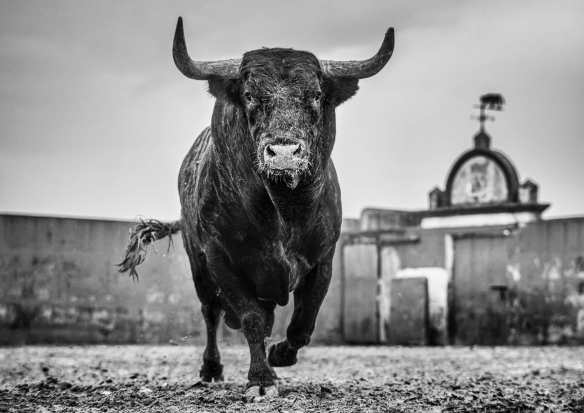
When the great fine art photographer David Yarrow contacted me to help him capture an image of a Spanish fighting bull, I contacted my friend, mentor, colleague and the greatest ambassador el mundo de los toros, ‘the world of the bulls’, could ever ask for, matador Eduardo Dávila Miura. We then took David to the most famous fighting bull-breeding ranch in the world, Zahariche, outside Seville, which is owned run by Eduardo’s uncles, Eduardo and Antonio Miura, and introduced him to the 8-year-old, two thirds of a tonne semental, or breeding sire, bull Pañolito, who has never been fought and never will be.

David Yarrow and Alexander Fiske-Harrison in the ring with the bull Pañolito at Finca Zahariche, Ganadería Miura, outside Seville in 2024 (Photo: David Richard Dunwoody)

No animals were harmed in the taking of this photo, only humans (I am still walking with a stick after breaking my ankle in that ring.) You can read all about it in my earlier post here, with a selection of photos by the rest of our team, including three-time British Champion Jockey and two-time Grand National winner Richard Dunwoody – who took the photo above – and professional polo player and horse-breeder – and semi-finalist in the British Ladies Open Polo at Cowdray Park last year – Klarina Pichler.

EL TORO by David Yarrow (2024)

After the massive success of the release of limited edition, signed and certified prints of that image, El Toro, he has gone on to release another photo, which is my own personal favourite from that day, Bullish. (Click on links in-title to purchase from the Maddox Gallery in UK or US.)

In my own mind, I titled El Toro ‘The Threat’, and Bullish ‘The Hero’. And it is the latter which will soon be hanging on my own wall. That is if they deliver the 5 foot 7 inch wide version. If it is the 7 foot 10 inch print – and that’s not even the largest – it will have hang in the office of City stockbrokers Fiske PLC on loan and I’ll visit it during my monthly board meetings.

It is a suitable venue, given that the bull and the bear are the historical symbolic representations of optimism and pessimism in the stock market. Of course, David knows this all too well, having worked in the markets himself, and is why he named the picture as he did. In his own words:

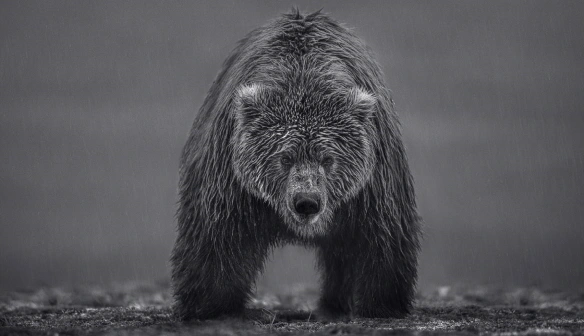
Three years ago, I took a picture of an imposing mother bear in a rainstorm in Alaska. The image grabbed the eye and held it because the bear was emphatically in a face-off with me and she cut a formidable presence. It looked like my sparring partner would win any battle and therefore I captioned the photograph Bearish.

BEARISH by David Yarrow (2021)

Early in 2024, I travelled to Seville to photograph the famous bulls of the Miura ranch. They are the most dangerous and revered lineage of fighting bulls in the world. It was not an assignment for the timid, as the behind-the-scenes footage shows. Most of my photographs of this bull failed to convey the immediate sense of threat as this emotion is only evoked by a head on charge, which tends to be challenging to photograph. In a full-on encounter, common sense and self-preservation should instinctively take control to the detriment of the filming.


But in this split second, I felt secure enough to give the camera half a second more. That’s it – half a second. But that was all I needed. Before I entered the arena, I had no preconception of my lens choice or my shooting position because I had no idea what to expect from these bulls. I certainly didn’t expect to so intensely process the trade-off between risk and reward. It was the purest of iterative processes.


The bull has great stature and looks to be a King amongst Kings. He conveys total confidence in himself, as well as an ability to manage the current situation. It was time to marry up the picture Bearish, with a new picture Bullish. ~ David Yarrow

For all enquiries, contact alexander@thelastarena.com

An artist comes to the bulls – David Yarrow in Miura

(En español aquí)

When the legendary fine art photographer David Yarrow calls you answer. Not least when he says he wants to extend his famed art photography of wild things to the animal that most closely resembles the wild ancestor of all modern cattle (Bos taurus), the aurochs (Bos primigenius primigenius.)

David’s up close and personal shots of the beasts of the wilderness, reproduced on the internet ad infinitum, but in actuality produced as vast, wall-sized prints of the highest quality, hair-fine resolution, sell for tens – sometimes hundreds – of thousands of pounds, euros and dollars.

CHARGE by David Yarrow (2013)

Cara Delevingne with lion for Tag Heuer #dontcrackunderpressure campaign by David Yarrow (2018)

The Spanish toro de lidia, aka toro bravo, ‘brave bull’, comes in the top ten genetically for relatedness to the ancestral aurochs, and six of the others in the top ten are its Spanish cousins (including the berrendas who feature later.) However, the toro bravo is the closest in phenotype – anatomy, morphology and behaviour – by far.

The Aurochs from Vig, whose skeleton is in the National Museum of Denmark, weighed almost 1000 kg (2,200 lbs), and its shoulder height was almost 2 metres (6 feet 6 inches.)

You can see the relatedness of the toro de ‘Lidia’ to a British fossil of aurochs, in this summary for Rewilding Europe of the paper ‘Genetic origin, admixture and population history of aurochs (Bos primigenius) and primitive European cattle‘, published in the journal Heredity in 2016.

Having received my brief, I knew exactly where to go: the one breeding ranch, founded in 1847, which is famed for the cattle that most closely match the vast size of the aurochs of all strains of toros bravos and whose extraordinary ‘feral’ (I mean that in the biologist’s sense of the word) aggression most matches the aurochs’ wild character. It is the family name which conjures most fear among matadors. As Ernest Hemingway put it in his 1932 classic, Death In The Afternoon:

There are certain strains of bulls in which the ability to learn rapidly in the ring is highly developed. These bulls must be fought and killed as rapidly as possible with the minimum of exposure by the man, for they learn more rapidly than the fight ordinarily progresses and become exaggeratedly difficult to work with and kill. Bulls of this sort are the old caste of fighting bulls raised by the sons of Don Eduardo Miura of Sevilla… which made them the curse of all bullfighters.

A study by the University of Complutense in Madrid, published as ‘Ancestral matrilineages and mitochondrial DNA diversity of the Lidia cattle breed‘ in the journal Animal Genetics in 2008 showed how among the toros bravos which all show “a certain degree of primitivism”, the Miuras stand alone as a breed-within-a-breed.

That’ primitivism’ is the reason why Ferruccio Lamborghini, formerly a friend and customer of Enzo Ferrari, took the bull as his logo to contrast with the ´prancing pony´, and why the world’s first supercar was launched under the name Lamborghini Miura in 1967.

As you can see below, Ferruccio personally took it to Spain and drove it to show it to old Eduardo Miura, father of the present owners, brothers Eduardo and Antonio. Several more models from that marque also took their name from individual Miura bulls afterward: from the Islero in 1968 to the Murciélago in 2001.

Autumn 1968. Finca Zahariche in Lora del Río, Spain. Standing, in a black suit, Ferruccio Lamborghini, next to Eduardo Miura, patriarch of the famous family of fighting bull breeders. The year before, the legendary car began to be sold, the Lamborghini Miura, the first supercar in history.

Continue reading

The Last Matador for GQ (unedited)

Padilla at home (Photo Zed Nelson/GQ/Condé Nast 2012)

It was the last bullfight of the Spanish season, held, as it has been for centuries, in the 250-year-old plaza de toros in Zaragoza in north-eastern Spain.

Juan José Padilla, a 38-year-old matador from Andalusia in the south, was fighting the fourth bull of six (he’d also fought the first.)

The bull, ‘Marqués’, was a 508kg (1,120lb) toro bravo born 5 years and 8 months previously on the ranch of Ana Romero, also in Andalusia. Before entering this ring it had lived wild, ranched from horseback, and had never before seen a man on the ground.

Padilla passing a bull with the magenta and gold two-handed capote, ‘cape’ (Photo: Alexander Fiske-Harrison)

Padilla was midway through the second of the three acts of the spectacle. He had already caped the bull with the large, two-handed magenta and gold cape, the capote, then the picador had done his dirty work with the lance from horseback, tiring the bull and damaging its neck muscles to bring its head down.

Now Padilla, rather than delegate to his team as other matadors do, was placing the banderillas himself, the multi-coloured sticks with their barbed steel heads. He had put in two pairs and was on the third. He ran at the bull with a banderilla in either hand, it responded with a charge, Padilla leapt into the air, it reared, he placed his sticks in its shoulders and landed.

Juan José Padilla ‘places’ the banderillas (Credit: WENN US / Alamy Stock Photo)

Running backwards from the charging bull, his eyes were focused on the horns coming at him in an action he had performed tens of thousands of times before. However, this time his right foot came down slightly off centre and in the path of his left, foot hit ankle, and then he was down.

In a breath the bull was on him and its horn took Padilla under his left ear, cracking the skull there, destroying the audial nerve, and then driving into the jaw at its joint. It smashed up through both sets of molars and ripped through muscle and skin before exploding his cheek bone as surely as a rifle bullet, stopping only as it came out through the socket of his left eye – from behind – taking his eyeball out with it, shattering his nose and then ripping clean out of the side of his head.

There is an image I will never lose, much as I wish I could. It is of a man standing with half his face held in his right hand. Cheek, jaw and eyeball, like so much meat, resting in his palm as he walked towards his team uncomprehending, and they, with looks of absolute horror, grabbed his arms and rushed him to the infirmary of the ring.

The second worst image

And yet here, in the amongst the carnage inflicted on a human body by a half ton of enraged animal, is the key to Juan José Padilla. The clue is in the phrase “stood up.”

Soccer players are stretchered off the field from a tap to the ankle. Boxers go down from a padded glove. This was more than half a ton of muscle, focused into a pointed tip that ploughed through his skull like a sword through snow. And the man got up and walked.

Then came coma and intensive care and surgery after surgery. Continue reading

An Essay On Bullfighting


the-last-arena-logo

José Tomás by Carlos Cazalis from his forthcoming book Sangre de Reyes, 'Blood Of

José Tomás by Carlos Cazalis from his book Sangre de Reyes, ‘Blood Of Kings’

When I first went to my first bullfight 25 years ago, I was 23 and was sure I would hate it. I was a passionate animal lover and had been a keen amateur naturalist since childhood, a member of the WWF (which I remain to this day) & Greenpeace, a former zoology undergraduate student at the University of Oxford, and was at the time a philosophy postgraduate at the London School of Economics and Political Science. (I am currently doing postgraduate work at  King’s College, London, this time in applied neuroscience.)

It should be obvious that this is not an auspicious CV for a future aficionado a los toros.

As expected, what I saw contained many moments of brutality and blood but I was surprised also to find I could see beyond them and feel moments of breathless thrill as well.

What genuinely shocked me, though, was that I could also perceive intermittently, and only with one of the bullfighters present that day, a form of beauty that was entirely novel to me.

In my moral confusion, I decided to research this alien thing, reading what I could in English – Ernest Hemingway, Kenneth Tynan, Barnaby Conrad – and going when possible to see a corrida, a ‘bullfight’, on my annual visits to Spain. Each time I went with a little more understanding and a little less aversion. Some would argue I became more sensitive to the aesthetics, others that I had become more inured to the ethics (or lack thereof.) I wouldn’t like to say either way.

into-the-arena-cover

Into The Arena: The World Of The Spanish Bullfight was published by Profile Books in 2011 and shortlisted for the William Hill Sports Book Of The Year Award – the oldest and richest sports writing prize in the world – the same year.

Following my essay on the subject for Prospect magazine, ‘A Noble Death‘, in 2008 I was commissioned to write a book and moved to Spain for two years. Among other researches, I trained as a bullfighter to the level of matador de novillos-toros, facing endless cattle from old, heavy and wise to young, light and fast. I ended by killing a single animal in the ring, a novillo, a three-year-old bull weighing around a third of a ton.

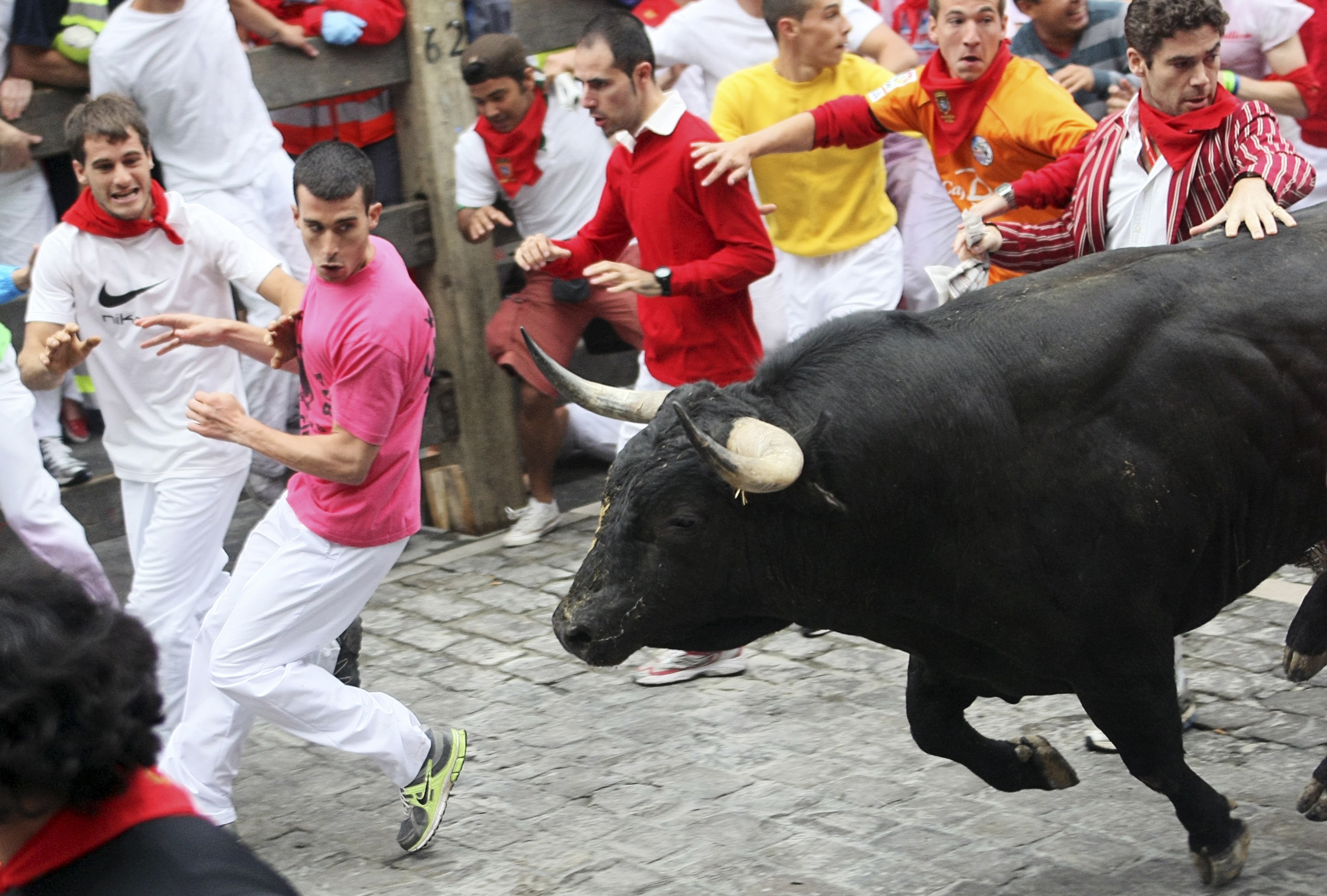
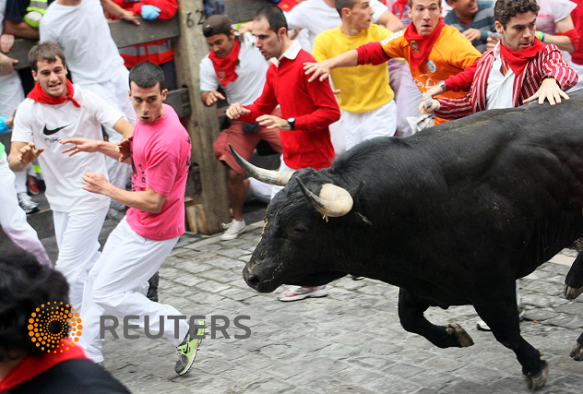
As part of the research, I also participated in the encierros, ‘bull-runs’, of Pamplona and ran with fear and ignorance among the masses of drunken foreigners and adrenaline seekers who fill those streets.

Unlike those visitors, I returned, and ended up running in towns across Spain, away from the tourist trail and among those born to this bloodless and less ritualised, more pagan practice. This led to my second book on los toros – as editor and primary author – with chapters by the Mayor of Pamplona, along with John Hemingway – grandson of Ernest – Beatrice Welles – daughter of Orson – and many others.

The Bulls Of Pamplona, edited by AFH and co-authored with a foreword by the Mayor of Pamplona and co-authored by John Hemingway, Ernest’s grandson, Beatrice Welles, Orson’s daughter and many others.

This makes me singular in my afición in English-speaking countries but in Spain – or Portugal, France, Mexico, Colombia, Peru, Ecuador, Venezuela – the picture is very different.

Alexander Fiske-Harrison running with the Torrestrella bulls of Álvaro Domecq - striped jacket - in Pamplona (Photo: Joseba Etxaburu - Reuters)

Alexander Fiske-Harrison running with the Torrestrella bulls of Álvaro Domecq – striped jacket – in Pamplona (Photo: Joseba Etxaburu – Reuters)

According to the annual figures on asuntos taurinos, ‘taurine matters’, published by Spain’s Ministry of Culture, the bulls are on the way back for the first time since the world economy collapsed in 2008.

When I first came to Spain to research in 2007 for Prospect magazine there were 3,691 major public bullfights that year, including corridas, of which there were 953, alongside novilladas with novices, and rejoneo with horseback bullfighters.

Following the financial crisis of historic proportions the next year, there was a precipitous drop in numbers, not only for bullfighting but all expensive live spectacles such as theatre and opera. This drop evened out, averaging at a 6% annual fall until I began researching my second book in 2015, when the fall in corridas was 1% per annum.

However, after COVID-19, the number of bullfights of all kinds in total in 2022 was up 8% on 2019 at 1,546 and the number of full corridas up 18% at 412. Continue reading

Miura: “Many bulls for Pamplona will end up in the anonymity of a slaughterhouse”

To celebrate the tenth anniversary of my own first visit to Zahariche, the legendary ranch of my friends the Miura family – the most famous breeders of Spanish fighting bulls in history – and in this difficult time for all taurinos, I thought I would translate this interview with Don Eduardo Miura in the Spanish newspaper ABC.

Alexander Fiske-Harrison

Miura: «Muchos toros de Pamplona acabarán en el anonimato de un matadero»

The mythical cattle from the ranch of Zahariche, saint and symbol of Pamplona, ​​close each year the Feria de San Fermín

Rosario Pérez
Madrid
22/04/2020

A dark silence ran through the world of bullfighting at the suspension of the Fiesta of the fury in red and white: not bull-runs nor bullfights, nothing. The cancellation of the Feria del Toro enlarges even further the shadow of the crisis in the world of bull-breeding.

“This season is a ruin,” is the unanimous voice. Although the cartels were not yet known – the Bullfighting Commission suspended the contracting of the bullfighters in March when they first heard the sounds about the State of Emergency – the Casa de la Misericordia had already decided on the ranches in December, nine bullfights and one novice bullfight, sixty bulls will stay in the countryside: Pincha, Capea, La Palmosilla, Núñez del Cuvillo, Victoriano del Río, Jandilla, Fuente Ymbro, Cebada Gago, José Escolar and Miura.

Miuras – Eduardo Miura, AFH, Antonio Miura, and the matador Eduardo Dávila Miura in the finca ‘Zahariche’ in 2010 (Photo: Lucy Gould)

And now in one of the scenes where usually the main part of the money is paid to the ranches, and then their very best bulls are sent to the Corrals of Gas in the City, yet another setback is delivered to this most affected sector of the economy, where there is no income and everything is expenses:

“Animals must be cared for and fed daily,” says Eduardo Miura. The ranch of ‘Zahariche’, saint and symbol of Pamplona, ​​was going to sent yet another perfect group of bulls for the Sanfermines on July 14.”

“I imagined it would not be celebrated this year but this is a very cruel blow. We have been there for fifty years without missing a single one, except during the riots of ’78. This coronavirus is crushing us; in addition to health, it is going to have a very negative impact on global tourism and the economy. ”

AFH trains with a young Miura in Zahariche in 2010 (Photo AFH personal collection)

The Fiesta of Pamplona was one of the eight bullfights that the Miura had lined up for 2020, around fifty bulls whose final time “may be the slaughterhouse”, without the honors of the bullring.

“We have raised them with the greatest care to be dealt with in rings like Seville or Pamplona, ​​and now the destiny of many may be to be sacrificed in the anonymity of a slaughterhouse. It is a real shame.”

AFH and Juan José Padilla in the ring together (AFH personal collection)

Miura, the brand of bull with which the matador Juan José Padilla was crowned the eternal hero in San Fermín, had prepared for Pamplona bulls from Cuatreños to Cinqueños [Four- to five-years-old, no bull of six years or older may enter the ring by Spanish law – AFH] but he knows that not even all four-year-olds will be able to contend in 2021 either:

“There will be an excess of bulls out in the fields, prices will drop, expenses will continue … And I do not expect much help from a government that is not very friendly to the activity to which I have dedicated myself.”

The Casa de la Misericordia of Pamplona plans to give preference to the livestock contracted for this year at the next fair [in 2021], but even so “the economic damage is going to be very heavy, and each one will have to get out of this crisis as best they can.”

AFH, first ever bull-run – with Miuras in Pamplona – circled right – July 12th, 2009 (Photo AFH personal collection)


Xander’s Blog: Confinement In The Time Of Coronavirus – My article in the Daily Telegraph


For the original article, available to subscribers only, please click here.

DAILY TELEGRAPH

Here in Spain there is martial law in all but name – surely the British wouldn’t put up with it

Alexander Fiske-Harrison

20th March 2020

It was when they taped off the children’s playground on the Plaza de la Constitución, as though it were a crime scene, that we knew the rumours were true.

All that Saturday the streets had been empty of people save the town’s ex-pat population as the Spanish government debated at every level – local, provincial and national – about what would put on ‘lockdown’ and how. I came down from my balcony to investigate as the local police pinned a notice to the swings, reading “Proclamation: Preventative Measures for the Protection of Citizens against the Coronavirus”, written in the name of the Mayor, and followed by a list of closures ranging from the municipal library to the 12th-century Moorish castle which stands guard over our Andalusian hilltop town.

Knowing that more was sure to come we stayed at Bar Pastor until closing time. The next morning we woke up to find the police sealing that bar, and all the others. It had begun.

Click here to read more

The Thrill Is Gone…


El Norte de Castilla

‘The North Of Castile’

VERSIÓN EN INGLÉS – PARA LA VERSIÓN ORIGINAL ESPAÑOLA HAGA CLIC AQUÍ

The Joy Of The Thrill

Alexander Fiske-Harrison

Monday, September 9th, 2019

VERSIÓN EN INGLÉS – PARA LA VERSIÓN ORIGINAL ESPAÑOLA HAGA CLIC AQUÍ

Lungs burning, vision fuzzing, heart thumping and hands shaking, I stood watching and chatting with my companions in the street, Josechu Lopez and David Garcia, as the last bull moved up the street last Tuesday, in the antepenultimate encierro of the oldest feria of bull-running in the world, and the last time I expect to find myself sharing the asphalt with my favourite animal ever again.

It is not that I have lost my love for the bull or my affection for encierros, ‘bull-runs’: my admiration for this meeting place for man and beast is entirely undiminished. Nor is it the decrepitude of old age or excesses of an indulgent lifestyle that are pulling me out as I enter my mid-40s: I could still clock a three-and-three-quarter hour marathon in Mont Saint-Michel in France last year, and did my finest taurine runs ever the year before that in such rarified places as Funes and Falces.

Midnight Run – Alexander Fiske-Harrison, far right, running on the horns of a bull in a nocturnal encierro in Funes in Navarre in 2017

No, ten years after my first ever encierro – with Miuras, in San Fermin – I have had to admit that my personal experience of running alongside, and occasionally in front of, such animals has ceased to deliver a pleasure that outweighs the ultimate risk. It is not that, to quote the great B. B. King, “the thrill is gone”, but that the joy in that thrill has. Continue reading

The Great Fighting Bulls Of Pamplona

The Breeding of the Toro Bravo

The author running with a prototypical bull of Torrestrella, a cross of the encastes, ‘breeds’, of Juan Pedro Domecq and Núñez, in Pamplona in 2011. (Touching the bulls is illegal. However, as can be seen below, the author was balancing before slipping between this bull and his brother behind him.)

I was recently commissioned by Running Of The Bulls, Inc. – the United States’ largest tour operator to Pamplona for its annual Fiesta de San Fermín – to provide some information for their clients on the bulls themselves.

I was asked for a light, introductory, Hall of Fame of Bulls in Pamplona. However, since I also work with the industry body the Fundación del Toro de Lidia, ‘Foundation of the Fighting Bull’, I took this article more seriously than they expected. As a result, by the time I was halfway through writing I was already several thousand words over my limit…

The full written version is here, minus a series of specially filmed interviews I did for them around the world which are available only on their site, www.runningofthebulls.com.

In it I discuss about a dozen ganaderías, ranches that breed bulls registered under Spanish law as being of the fighting bull ‘race’.

However, there are many, many more. According to the Ministry of Culture’s latest figures, published Spring 2018, there are 1,329 ganaderas de reses de lidia, ‘breeders of fighting cattle’, in their registry.

These supplied the past season’s 1,553 bullfights of all varieties. These include novilladas with novice matadors, rejoneo from horseback and full corridas in which 1,2 or 3 full matadors face 6 full-sized toros bravos, ‘brave bulls’, and various combinations of these types of event.

(These combinations can lead to media confusion. Although there were only 387 pure corridas last year, there were a further 370 events in which at least one matador faced a toro bravo as part of the event.)

These were serviced by the 10,959 licensed bullfighting professionals in Spain, 825 of them being matadors.

And this is all alongside the 17,920 popular festivals involving cattle such as the encierros, ‘bull-runs’, for which Pamplona is famed.

It is a big thing, this mundo de los toros, ‘world of the bulls’. Continue reading