The Last Matador for GQ (unedited)

Padilla at home (Photo Zed Nelson/GQ/Condé Nast 2012)

It was the last bullfight of the Spanish season, held, as it has been for centuries, in the 250-year-old plaza de toros in Zaragoza in north-eastern Spain.

Juan José Padilla, a 38-year-old matador from Andalusia in the south, was fighting the fourth bull of six (he’d also fought the first.)

The bull, ‘Marqués’, was a 508kg (1,120lb) toro bravo born 5 years and 8 months previously on the ranch of Ana Romero, also in Andalusia. Before entering this ring it had lived wild, ranched from horseback, and had never before seen a man on the ground.

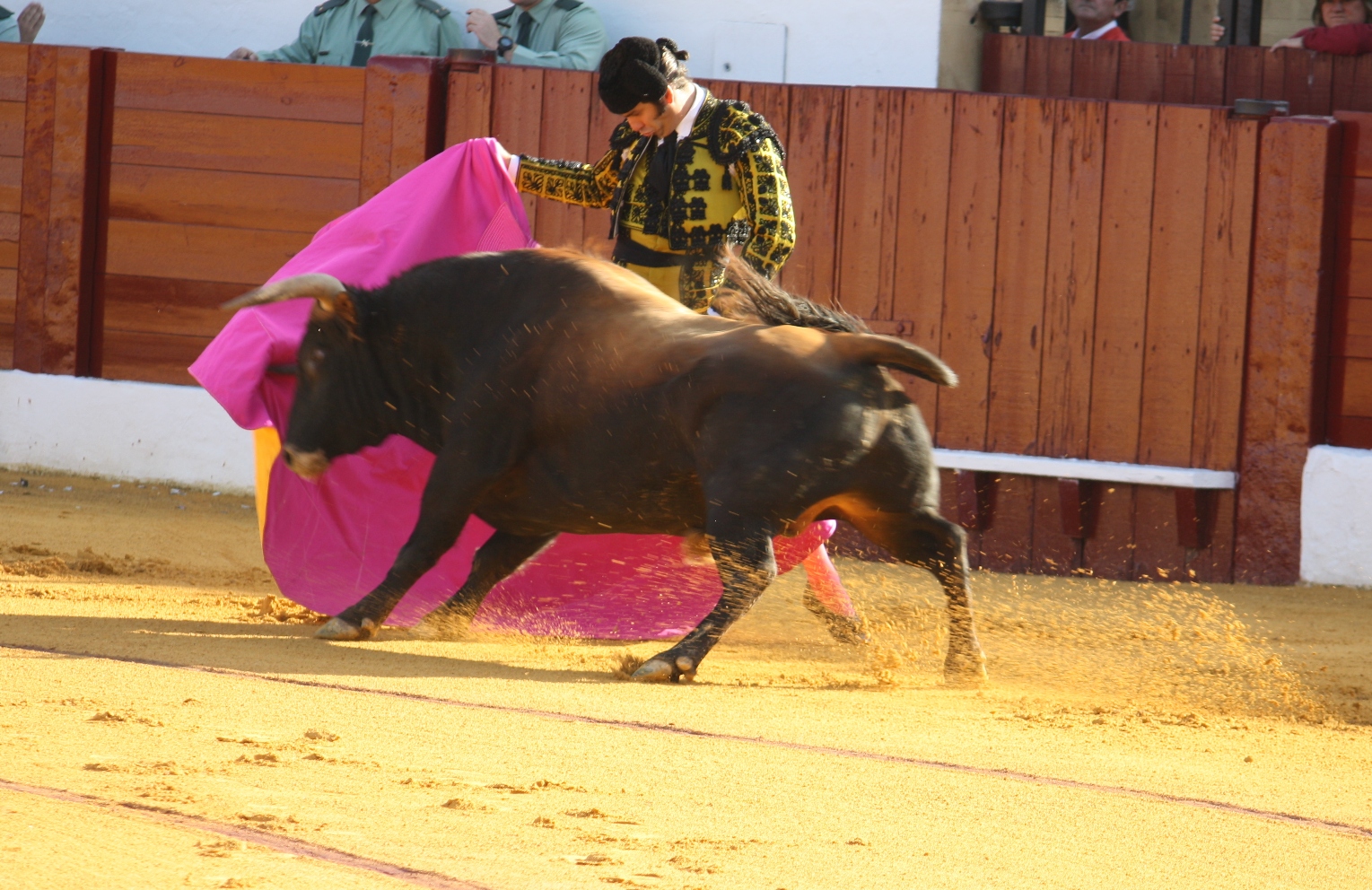
Padilla passing a bull with the magenta and gold two-handed capote, ‘cape’ (Photo: Alexander Fiske-Harrison)

Padilla was midway through the second of the three acts of the spectacle. He had already caped the bull with the large, two-handed magenta and gold cape, the capote, then the picador had done his dirty work with the lance from horseback, tiring the bull and damaging its neck muscles to bring its head down.

Now Padilla, rather than delegate to his team as other matadors do, was placing the banderillas himself, the multi-coloured sticks with their barbed steel heads. He had put in two pairs and was on the third. He ran at the bull with a banderilla in either hand, it responded with a charge, Padilla leapt into the air, it reared, he placed his sticks in its shoulders and landed.

Juan José Padilla ‘places’ the banderillas (Credit: WENN US / Alamy Stock Photo)

Running backwards from the charging bull, his eyes were focused on the horns coming at him in an action he had performed tens of thousands of times before. However, this time his right foot came down slightly off centre and in the path of his left, foot hit ankle, and then he was down.

In a breath the bull was on him and its horn took Padilla under his left ear, cracking the skull there, destroying the audial nerve, and then driving into the jaw at its joint. It smashed up through both sets of molars and ripped through muscle and skin before exploding his cheek bone as surely as a rifle bullet, stopping only as it came out through the socket of his left eye – from behind – taking his eyeball out with it, shattering his nose and then ripping clean out of the side of his head.

There is an image I will never lose, much as I wish I could. It is of a man standing with half his face held in his right hand. Cheek, jaw and eyeball, like so much meat, resting in his palm as he walked towards his team uncomprehending, and they, with looks of absolute horror, grabbed his arms and rushed him to the infirmary of the ring.

The second worst image

And yet here, in the amongst the carnage inflicted on a human body by a half ton of enraged animal, is the key to Juan José Padilla. The clue is in the phrase “stood up.”

Soccer players are stretchered off the field from a tap to the ankle. Boxers go down from a padded glove. This was more than half a ton of muscle, focused into a pointed tip that ploughed through his skull like a sword through snow. And the man got up and walked.

Then came coma and intensive care and surgery after surgery. Continue reading

Perhaps bullfighting is not a moral wrong: My talk at the Edinburgh International Book Festival

Yesterday evening I immensely enjoyed giving a talk to the sold out audience at the 500-seat Scottish Power Theatre at the Edinburgh International Book Festival on my award-winning book Into The Arena: The World Of The Spanish Bulllfight. It was followed by a discussion with the chair, Al Senter, and the Q&A session with the audience that (along with brief personal chats with about half of those present who came to have their books signed by me in the London Review of Books tent afterwards.) The questions were all well-informed and interesting, not least because, as many of the audience members said to me in person, I’d answered most of the more controversial questions in my opening talk. Here is the transcript of what I said:

* * *

I was going to read from my book, but it seems that the most important topic in the United Kingdom in the 21st Century, indeed in the English-speaking world – when discussing bullfighting – are the ethical issues surrounding the injuring and killing of animals as part of a public spectacle. So I want to address these head on.

As a liberal – in the classical, John Suart Mill sense – it is not my intention, or my place, to tell people whether or not they should approve of or enjoy bullfighting anymore than it is whether they should approve of or enjoy opera. However, when people seek to ban an art form from existing, so that other people may not enjoy it, whatever claims have been made by other people who have never witnessed it, then certain questions have to be raised.

Whatever the motivations behind the ban on bullfighting on Catalonia – and there have been accusations of underhand dealings, thumbing of noses at Madrid to gain votes, which has some circumstantial evidence for it as the popular Catalan regional hobby of attaching burning tar balls and fireworks onto bulls’ horns and letting them into the streets is unaffected by the legislation – anyway, the stated reason is the ethics, or rather lack of ethics, of bullfighting. So, that is what I should like to discuss here.

However, before I can do that, I have to dispel some myths that have long surrounded the bullfight, pieces of propaganda that have been propagated by the anti-bullfight lobby such as CAS International, the League Against Cruel Sports and PETA.

The one I most often hear is the complaint that the matador faces a broken down and destroyed animal. Take a close look at this bull in these photos and tell me how broken down it looks.

Morante de la Puebla performs a ‘veronica’ (Photo: Author)

Continue reading

Book Out Now.

The book which grew out of this blog, Into The Arena: The World Of The Spanish Bullfight is out now at all major British bookstores. Click here to purchase at Amazon.

The first review cane out in yesterday’s the Daily Mailclick here to read it. Positive, and surprisingly balanced for that newspaper, what I enjoyed most was that the print copy claimed to have a photograph of the author. When I looked, what I found instead was a photograph of the spectularly famous matador, and face of Armani Spain, Cayetano Rivera Ordóñez. (When I told him this, all he could do was laugh.)

Alexander Fiske-Harrison

My interview with Cayetano Rivera Ordóñez in ‘The Times’.

Cayetano Rivera Ordoñez (Photo: Nicolás Haro)

Published in the magazine of yesterday’s edition of the Sunday Times is my interview with the extremely simpatico and gifted matador, Cayetano Rivera Ordóñez. On the day of his corrida in Sanlucar de Barrameda, my photographer Nicolás Haro and I went to meet him in his hotel where we spoke for a couple of hours from which these words are extracted.

A Life in the Day: The lord of the bullring

The matador Cayetano Rivera Ordóñez, 32, on his love-hate relationship with the bull

Alexander Fiske-Harrison
Published: 26 July 200

I usually arrive in a town the night before the fight. The day I fight, I don’t put on the alarm clock. It is important not to be tired. Depending on the time, I either get breakfast or I have an early lunch. I cannot eat for four or five hours before the fight, in case I have to have surgery. Matadors have to deal with those little matters. Usually I don’t go out from the hotel room. I’m in my own world, concentrating for the afternoon. I lie back, relax, talk to friends, watch some TV, listen to some music: flamenco, rock’n’roll, depending on how I feel.

When I am training at my family’s house in Ronda, near Malaga, I usually wake up around 9. I go to the gym for a couple of hours, then I practise my moves without the bull at home, what we call toreo de salon, for two hours. We also spend a long time thinking about the bull, because you have to read it: its movements, its speed, the height of its horns when it charges. The bull tells you what you are able to do and what you shouldn’t try, and you have to improvise on this in real time. Continue reading