The Last Matador for GQ (unedited)

Padilla at home (Photo Zed Nelson/GQ/Condé Nast 2012)

It was the last bullfight of the Spanish season, held, as it has been for centuries, in the 250-year-old plaza de toros in Zaragoza in north-eastern Spain.

Juan José Padilla, a 38-year-old matador from Andalusia in the south, was fighting the fourth bull of six (he’d also fought the first.)

The bull, ‘Marqués’, was a 508kg (1,120lb) toro bravo born 5 years and 8 months previously on the ranch of Ana Romero, also in Andalusia. Before entering this ring it had lived wild, ranched from horseback, and had never before seen a man on the ground.

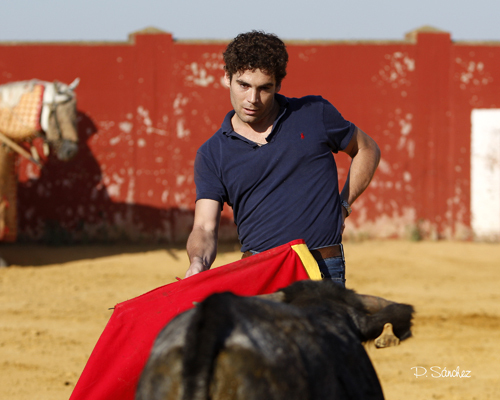
Padilla passing a bull with the magenta and gold two-handed capote, ‘cape’ (Photo: Alexander Fiske-Harrison)

Padilla was midway through the second of the three acts of the spectacle. He had already caped the bull with the large, two-handed magenta and gold cape, the capote, then the picador had done his dirty work with the lance from horseback, tiring the bull and damaging its neck muscles to bring its head down.

Now Padilla, rather than delegate to his team as other matadors do, was placing the banderillas himself, the multi-coloured sticks with their barbed steel heads. He had put in two pairs and was on the third. He ran at the bull with a banderilla in either hand, it responded with a charge, Padilla leapt into the air, it reared, he placed his sticks in its shoulders and landed.

Juan José Padilla ‘places’ the banderillas (Credit: WENN US / Alamy Stock Photo)

Running backwards from the charging bull, his eyes were focused on the horns coming at him in an action he had performed tens of thousands of times before. However, this time his right foot came down slightly off centre and in the path of his left, foot hit ankle, and then he was down.

In a breath the bull was on him and its horn took Padilla under his left ear, cracking the skull there, destroying the audial nerve, and then driving into the jaw at its joint. It smashed up through both sets of molars and ripped through muscle and skin before exploding his cheek bone as surely as a rifle bullet, stopping only as it came out through the socket of his left eye – from behind – taking his eyeball out with it, shattering his nose and then ripping clean out of the side of his head.

There is an image I will never lose, much as I wish I could. It is of a man standing with half his face held in his right hand. Cheek, jaw and eyeball, like so much meat, resting in his palm as he walked towards his team uncomprehending, and they, with looks of absolute horror, grabbed his arms and rushed him to the infirmary of the ring.

The second worst image

And yet here, in the amongst the carnage inflicted on a human body by a half ton of enraged animal, is the key to Juan José Padilla. The clue is in the phrase “stood up.”

Soccer players are stretchered off the field from a tap to the ankle. Boxers go down from a padded glove. This was more than half a ton of muscle, focused into a pointed tip that ploughed through his skull like a sword through snow. And the man got up and walked.

Then came coma and intensive care and surgery after surgery. Continue reading
An Essay On Bullfighting


the-last-arena-logo

José Tomás by Carlos Cazalis from his forthcoming book Sangre de Reyes, 'Blood Of

José Tomás by Carlos Cazalis from his book Sangre de Reyes, ‘Blood Of Kings’

When I first went to my first bullfight 25 years ago, I was 23 and was sure I would hate it. I was a passionate animal lover and had been a keen amateur naturalist since childhood, a member of the WWF (which I remain to this day) & Greenpeace, a former zoology undergraduate student at the University of Oxford, and was at the time a philosophy postgraduate at the London School of Economics and Political Science. (I am currently doing postgraduate work at  King’s College, London, this time in applied neuroscience.)

It should be obvious that this is not an auspicious CV for a future aficionado a los toros.

As expected, what I saw contained many moments of brutality and blood but I was surprised also to find I could see beyond them and feel moments of breathless thrill as well.

What genuinely shocked me, though, was that I could also perceive intermittently, and only with one of the bullfighters present that day, a form of beauty that was entirely novel to me.

In my moral confusion, I decided to research this alien thing, reading what I could in English – Ernest Hemingway, Kenneth Tynan, Barnaby Conrad – and going when possible to see a corrida, a ‘bullfight’, on my annual visits to Spain. Each time I went with a little more understanding and a little less aversion. Some would argue I became more sensitive to the aesthetics, others that I had become more inured to the ethics (or lack thereof.) I wouldn’t like to say either way.

into-the-arena-cover

Into The Arena: The World Of The Spanish Bullfight was published by Profile Books in 2011 and shortlisted for the William Hill Sports Book Of The Year Award – the oldest and richest sports writing prize in the world – the same year.

Following my essay on the subject for Prospect magazine, ‘A Noble Death‘, in 2008 I was commissioned to write a book and moved to Spain for two years. Among other researches, I trained as a bullfighter to the level of matador de novillos-toros, facing endless cattle from old, heavy and wise to young, light and fast. I ended by killing a single animal in the ring, a novillo, a three-year-old bull weighing around a third of a ton.

As part of the research, I also participated in the encierros, ‘bull-runs’, of Pamplona and ran with fear and ignorance among the masses of drunken foreigners and adrenaline seekers who fill those streets.

Unlike those visitors, I returned, and ended up running in towns across Spain, away from the tourist trail and among those born to this bloodless and less ritualised, more pagan practice. This led to my second book on los toros – as editor and primary author – with chapters by the Mayor of Pamplona, along with John Hemingway – grandson of Ernest – Beatrice Welles – daughter of Orson – and many others.

The Bulls Of Pamplona, edited by AFH and co-authored with a foreword by the Mayor of Pamplona and co-authored by John Hemingway, Ernest’s grandson, Beatrice Welles, Orson’s daughter and many others.

This makes me singular in my afición in English-speaking countries but in Spain – or Portugal, France, Mexico, Colombia, Peru, Ecuador, Venezuela – the picture is very different.

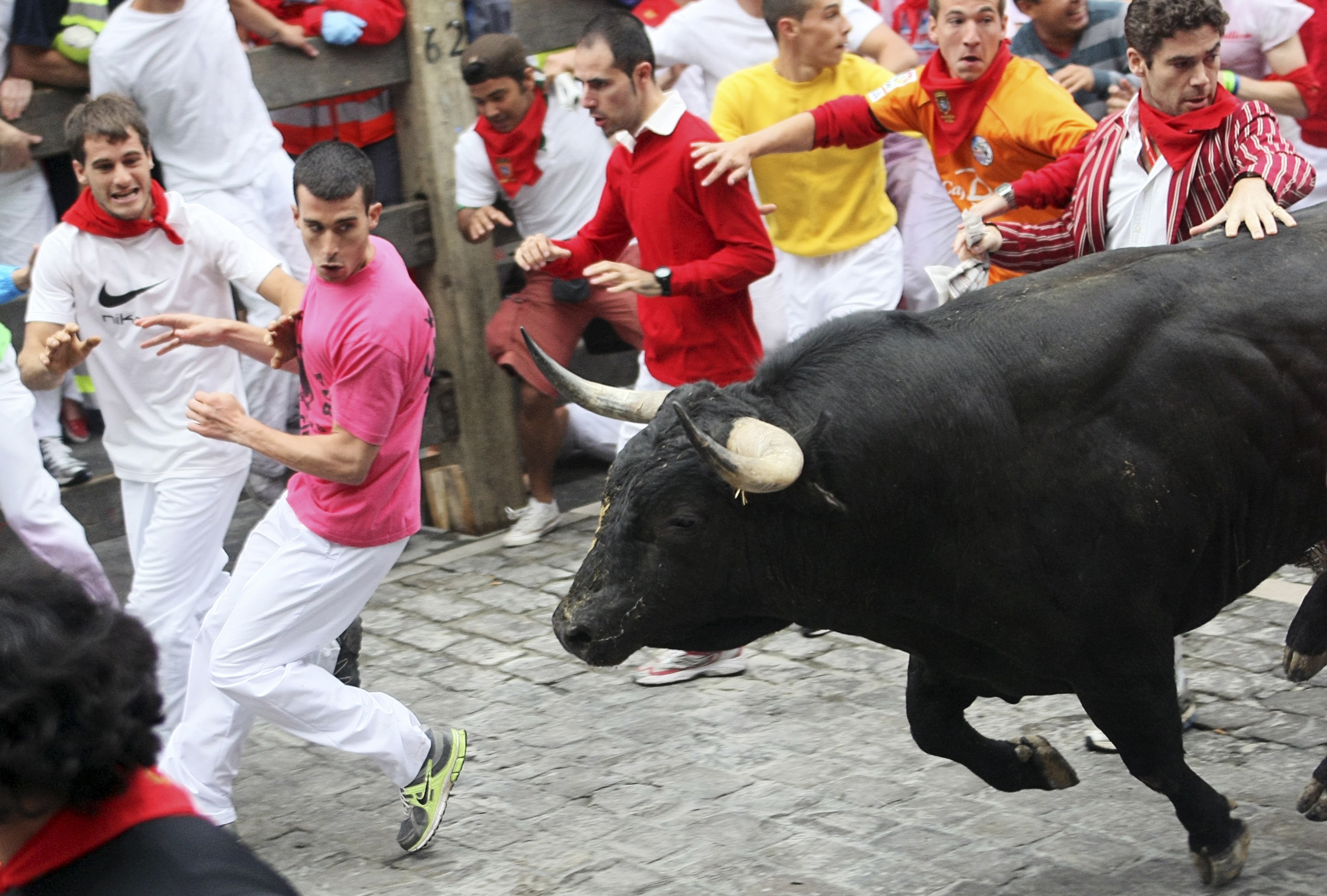
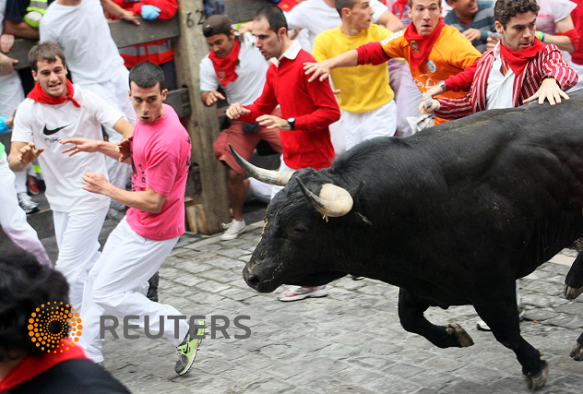
Alexander Fiske-Harrison running with the Torrestrella bulls of Álvaro Domecq - striped jacket - in Pamplona (Photo: Joseba Etxaburu - Reuters)

Alexander Fiske-Harrison running with the Torrestrella bulls of Álvaro Domecq – striped jacket – in Pamplona (Photo: Joseba Etxaburu – Reuters)

According to the annual figures on asuntos taurinos, ‘taurine matters’, published by Spain’s Ministry of Culture, the bulls are on the way back for the first time since the world economy collapsed in 2008.

When I first came to Spain to research in 2007 for Prospect magazine there were 3,691 major public bullfights that year, including corridas, of which there were 953, alongside novilladas with novices, and rejoneo with horseback bullfighters.

Following the financial crisis of historic proportions the next year, there was a precipitous drop in numbers, not only for bullfighting but all expensive live spectacles such as theatre and opera. This drop evened out, averaging at a 6% annual fall until I began researching my second book in 2015, when the fall in corridas was 1% per annum.

However, after COVID-19, the number of bullfights of all kinds in total in 2022 was up 8% on 2019 at 1,546 and the number of full corridas up 18% at 412. Continue reading

Miura: “Many bulls for Pamplona will end up in the anonymity of a slaughterhouse”

To celebrate the tenth anniversary of my own first visit to Zahariche, the legendary ranch of my friends the Miura family – the most famous breeders of Spanish fighting bulls in history – and in this difficult time for all taurinos, I thought I would translate this interview with Don Eduardo Miura in the Spanish newspaper ABC.

Alexander Fiske-Harrison

Miura: «Muchos toros de Pamplona acabarán en el anonimato de un matadero»

The mythical cattle from the ranch of Zahariche, saint and symbol of Pamplona, ​​close each year the Feria de San Fermín

Rosario Pérez
Madrid
22/04/2020

A dark silence ran through the world of bullfighting at the suspension of the Fiesta of the fury in red and white: not bull-runs nor bullfights, nothing. The cancellation of the Feria del Toro enlarges even further the shadow of the crisis in the world of bull-breeding.

“This season is a ruin,” is the unanimous voice. Although the cartels were not yet known – the Bullfighting Commission suspended the contracting of the bullfighters in March when they first heard the sounds about the State of Emergency – the Casa de la Misericordia had already decided on the ranches in December, nine bullfights and one novice bullfight, sixty bulls will stay in the countryside: Pincha, Capea, La Palmosilla, Núñez del Cuvillo, Victoriano del Río, Jandilla, Fuente Ymbro, Cebada Gago, José Escolar and Miura.

Miuras – Eduardo Miura, AFH, Antonio Miura, and the matador Eduardo Dávila Miura in the finca ‘Zahariche’ in 2010 (Photo: Lucy Gould)

And now in one of the scenes where usually the main part of the money is paid to the ranches, and then their very best bulls are sent to the Corrals of Gas in the City, yet another setback is delivered to this most affected sector of the economy, where there is no income and everything is expenses:

“Animals must be cared for and fed daily,” says Eduardo Miura. The ranch of ‘Zahariche’, saint and symbol of Pamplona, ​​was going to sent yet another perfect group of bulls for the Sanfermines on July 14.”

“I imagined it would not be celebrated this year but this is a very cruel blow. We have been there for fifty years without missing a single one, except during the riots of ’78. This coronavirus is crushing us; in addition to health, it is going to have a very negative impact on global tourism and the economy. ”

AFH trains with a young Miura in Zahariche in 2010 (Photo AFH personal collection)

The Fiesta of Pamplona was one of the eight bullfights that the Miura had lined up for 2020, around fifty bulls whose final time “may be the slaughterhouse”, without the honors of the bullring.

“We have raised them with the greatest care to be dealt with in rings like Seville or Pamplona, ​​and now the destiny of many may be to be sacrificed in the anonymity of a slaughterhouse. It is a real shame.”

AFH and Juan José Padilla in the ring together (AFH personal collection)

Miura, the brand of bull with which the matador Juan José Padilla was crowned the eternal hero in San Fermín, had prepared for Pamplona bulls from Cuatreños to Cinqueños [Four- to five-years-old, no bull of six years or older may enter the ring by Spanish law – AFH] but he knows that not even all four-year-olds will be able to contend in 2021 either:

“There will be an excess of bulls out in the fields, prices will drop, expenses will continue … And I do not expect much help from a government that is not very friendly to the activity to which I have dedicated myself.”

The Casa de la Misericordia of Pamplona plans to give preference to the livestock contracted for this year at the next fair [in 2021], but even so “the economic damage is going to be very heavy, and each one will have to get out of this crisis as best they can.”

AFH, first ever bull-run – with Miuras in Pamplona – circled right – July 12th, 2009 (Photo AFH personal collection)


The Great Fighting Bulls Of Pamplona

The Breeding of the Toro Bravo

The author running with a prototypical bull of Torrestrella, a cross of the encastes, ‘breeds’, of Juan Pedro Domecq and Núñez, in Pamplona in 2011. (Touching the bulls is illegal. However, as can be seen below, the author was balancing before slipping between this bull and his brother behind him.)

I was recently commissioned by Running Of The Bulls, Inc. – the United States’ largest tour operator to Pamplona for its annual Fiesta de San Fermín – to provide some information for their clients on the bulls themselves.
I was asked for a light, introductory, Hall of Fame of Bulls in Pamplona. However, since I also work with the industry body the Fundación del Toro de Lidia, ‘Foundation of the Fighting Bull’, I took this article more seriously than they expected. As a result, by the time I was halfway through writing I was already several thousand words over my limit…

The full written version is here, minus a series of specially filmed interviews I did for them around the world which are available only on their site, www.runningofthebulls.com.

In it I discuss about a dozen ganaderías, ranches that breed bulls registered under Spanish law as being of the fighting bull ‘race’.

However, there are many, many more. According to the Ministry of Culture’s latest figures, published Spring 2018, there are 1,329 ganaderas de reses de lidia, ‘breeders of fighting cattle’, in their registry.

These supplied the past season’s 1,553 bullfights of all varieties. These include novilladas with novice matadors, rejoneo from horseback and full corridas in which 1,2 or 3 full matadors face 6 full-sized toros bravos, ‘brave bulls’, and various combinations of these types of event.

(These combinations can lead to media confusion. Although there were only 387 pure corridas last year, there were a further 370 events in which at least one matador faced a toro bravo as part of the event.)

These were serviced by the 10,959 licensed bullfighting professionals in Spain, 825 of them being matadors.

And this is all alongside the 17,920 popular festivals involving cattle such as the encierros, ‘bull-runs’, for which Pamplona is famed.

It is a big thing, this mundo de los toros, ‘world of the bulls’. Continue reading

For The Love Of ‘Toreo’ – article in ‘Boisdale Life’ on bullfighting

Boisdale Life

FOR THE LOVE OF TOREO

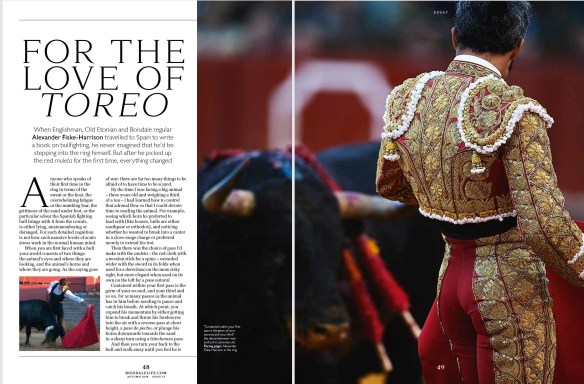
When Englishman, Old Etonian and Boisdale regular Alexander Fiske-Harrison travelled to Spain to write  a book on bullfighting, he never imagined that he’d be stepping into the ring himself. But after he picked up  the red muleta for the first time, everything changed

People speak of their first time in the ring in terms of the sweat or the heat, the overwhelming fatigue or the numbing fear, the grittiness of the sand under foot, or the particular odour the Spanish fighting bull brings with it from the corrals. They are all either lying, misremembering or deranged. For such detailed cognition is not how massive levels of acute stress work in the normal human mind.

When you are first faced with a bull your world consists of two things: the animal’s eyes and where they are looking, and the animal’s horns and where they are going. As the saying goes of war: there are far too many things to be afraid of to have time to be scared.

By the time I was facing a large bull – three years old and weighing a third of a ton – I had learned how to control that adrenal flow so that I could devote time to reading the animal. For example, seeing which horn he preferred to lead with (like boxers, bulls are either southpaw or orthodox), and noticing whether he wanted to break into a gallop in a close-range charge or preferred merely to lengthen his stride at a trot. Then there was the choice of pass I’d make with the muleta – the red cloth with a wooden stick for a spine – extended wider with the sword in its folds when used for a derechazo in the right hand, or on its own on the more risky, but more elegant, left for a pase natural.

Continue reading

Iván Fandiño: We Who Are About To Die Salute You…

Death closes all: but something ere the end,
Some work of noble note, may yet be done,
Not unbecoming men that strove with Gods.

(from Alfred, Lord Tennyson’s ‘Ulysses’)

The 36-year-old Basque matador Iván Fandiño was killed by a bull in the ring yesterday in Aire-Sur-L’Adour, near Mont de Marsan, in the Nouvelle-Aquitaine region of southwestern France.

The hierro, ‘iron’ or brand, of the ranch of Baltasar Ibán along with its colours.

The bull, Provechito No. 53, was born in March 2013 in El Escorial in the province of Madrid, on the well-known as respect ranch of Baltasar Ibán – founded 1920 – whose herd is of the Contreras bloodline – whose origin is the historic Murubé line – with a touch of Domecq – whose origin is the historic Parladé line.

It was the third of six bulls fought that evening, and was actually being fought by the matador Juan del Álamo when Fandiño stepped in to perform a quite upon it – a sequence of artistic manoeuvres with cape done after the bull has faced the mounted picador with his lance.

This is not an uncommon occurrence in the centuries-old scripted sequence of a corrida. The corrida is not a sport, nor a fight (even though I use that English verb as “torear” has no proper translation) – nor thought of, discussed or reviewed in the papers as such. It is a tragic spectacle culminating in a ritual sacrifice.

Fandiño had already been awarded an ear from his own bull, the first of the evening as most senior matador – he became a full matador in 2005 in Bilbao (he was the only Basque matador at the time of his death) – and clearly thought this bull special enough that he could do something to entertain, impress or move the audience with it.

July 11, 2013-Pamplona, Spain- Matador Iván Fandiño does a pase de pecho with a bull from the ranch of Torrestrella of Álvaro Domecq (Photo © Jim Hollander / EPA)

Continue reading

An Essay On Bullfighting


the-last-arena-logo

José Tomás by Carlos Cazalis from his forthcoming book Sangre de Reyes, 'Blood Of

José Tomás by Carlos Cazalis from his forthcoming book Sangre de Reyes, ‘Blood Of Kings’

When I first went to a bullfight 17 years ago, I was 23 and was sure I would hate it. I was a passionate animal lover and had been a keen amateur naturalist since childhood, WWF & Greenpeace member and zoology undergraduate. Not an auspicious CV for a future aficionado de los toros.

As expected, what I saw contained many moments of brutality and blood  but I was surprised also to find I could see beyond them to feel moments of breathlessness thrill as well. What genuinely shocked me, though, was that I could also perceive intermittently, and only with one of the bullfighters present, a kind of beauty that was entirely new to me.

In my moral confusion, I decided to research this alien thing, reading what I could in English – mainly Ernest Hemingway and Barnaby Conrad – and going when possible to see a corrida, a ‘bullfight’, on my irregular visits to Spain. Each time I went with a little more understanding and a little less aversion. Some would argue I became more sensitive to the aesthetics, others that I had become more inured to the ethics (or lack thereof.) I wouldn’t like to say either way.

into-the-arena-coverIn 2008 I was commissioned to write a book on the subject and I moved to Seville for two years and among other researches I trained as a bullfighter to the level of matador de novillos-toros – a novice level matador de toros bravos – ending by killing a single animal in the ring, a novillo, a three-year-old bull weighing around a third of a ton. (Into The Arena: The World Of The Spanish Bullfight was published by Profile Books in 2011 and shortlisted for the William Hill Sports Book Of The Year Award the same year.)

As part of the research, I also attended the encierros, ‘bull-runs’, of Pamplona and ran with fear and ignorance among the masses of drunken foreigners and adrenaline seekers. Unlike those visitors, I returned, and ended up running in towns across Spain, away from the tourist trail and among those born to this bloodless and less formal, more pagan practice. I ran with the bulls from San Sebastián de los Reyes in the suburbs of Madrid, to Falces, where you hurtle pell-mell down a goat-path, bordered by a sheer drop, in the foothills of Navarran Pyrenees. From Tafalla, also in Navarre, which resembles Pamplona in the 1920s to Cuéllar in Old Castille, which hosts the most ancient encierros in Spain.

(The book I edited and co-authored with the Mayor of Pamplona, Ernest Hemingway’s grandson, Orson Welles’s daughter and the finest bull-runners including the late Julen Madina, Jokin Zuasti and Reuters & EPA photographer Jim Hollander, The Bulls Of Pamplona (And Beyond), was published by Mephisto Press in 2017, available online here.)

I may be something of an oddity in my afición in English-speaking countries – although there is a Club Taurino of London as there is of New York – but in Spain (or Portugal, France, Mexico, Colombia, Peru, Ecuador, Venezuela) the picture is very different.

Alexander Fiske-Harrison running with the Torrestrella bulls of Álvaro Domecq - striped jacket - in Pamplona (Photo: Joseba Etxaburu - Reuters)

Alexander Fiske-Harrison running with the Torrestrella bulls of Álvaro Domecq – striped jacket – in Pamplona (Photo: Joseba Etxaburu – Reuters)

According to the annual figures on asuntos taurinos, ‘taurine matters’, published by Spain’s Ministry of Culture, the bulls are on the way back for the first time since the world economy collapsed in 2008.

The number of full-fledged corridas in 2015 stabilised at 394, down only 1% since 2014 compared with that year’s drop of 7% on the year before and 10% before that.

There were even large increases in some regions – Andalusia, Aragon, Murcia, the two Castiles and the Basque Country – and it seems that Madrid was the real fall, perhaps a reflection of the strange political stirrings going on in the capital.

The number of bullfights in the broader sense of the word – including novilladas for novices and rejoneo for horseback toreros etc., – 80% of which occur in Andalusia, Madrid and the two Castiles,  had fallen by 7% to 1,736, but this after a slight increase the year before.

Far more importantly in a country where subsidies distort the market, the number of people actually attending bullfights in 2015 was up to 3.7 million, an increase of more than a third of a million since 2011 when my book came out. Back, in fact, to pre-financial crisis levels.

This is alongside some 6.4 million having watched bullfighting on the television to which it had only returned in 2015 (and half a million more on the internet.) Continue reading

Love of animals or hatred of man?

the-last-arena-logo

El País, Spain's equivalent of The Guardian (The Guardian ran the story here.)

El País, Spain’s equivalent of The Guardian (The Guardian ran the story here.)

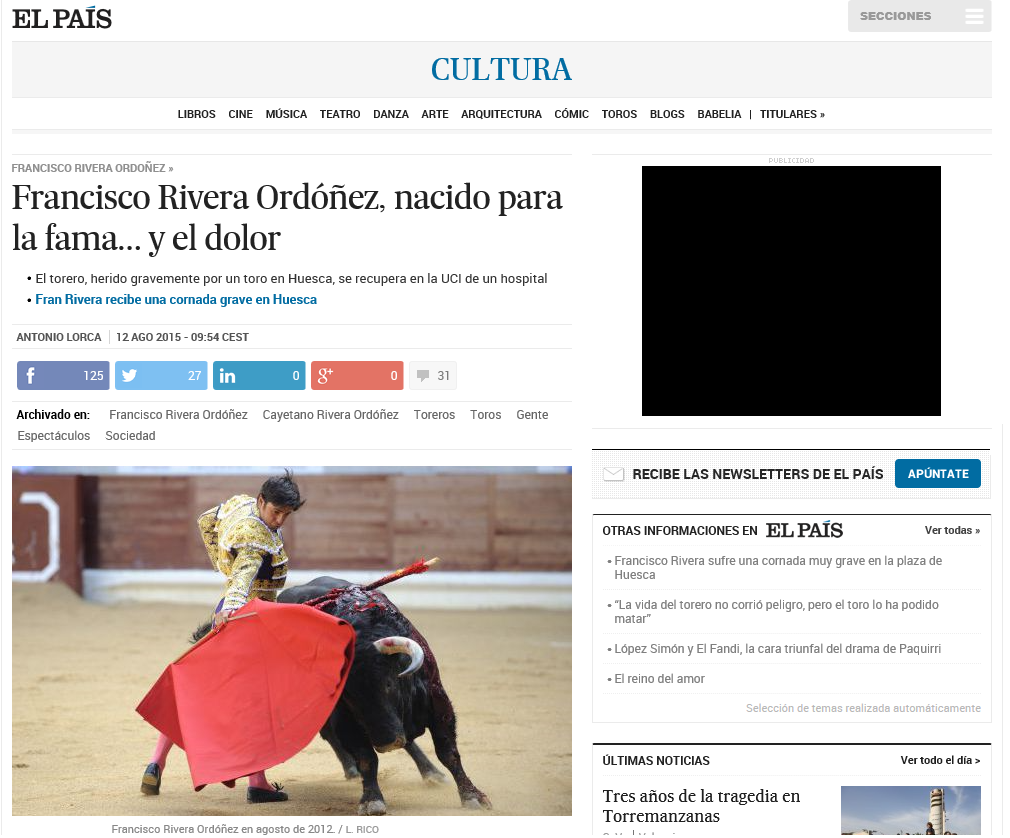
Francisco Rivera Ordóñez, born to fame… and to pain

This is the headline of the article by Antonio Lorca, bullfighting critic, in the culture section of El País, Spain’s left of centre national newspaper. Francisco is, along with his brother the matador Cayetano, heir to the greatest dynasty in the history of bullfighting.

Their father was Francisco Rivera Peréz, ‘Paquirri’, killed by a bull in 1984, a death made all the more famous since it was televised, as were his final moments on the surgeon’s table, telling the panicking medical staff that it didn’t matter, to remain calm. The effect of this death on his youngest son, my friend the matador Cayetano, I quoted in my previous post. I am sure his older brother Francisco felt similarly.

How Cayetano feels today I dare not ask: Francisco, who had also taken his father’s nom de guerre Paquirri, was gored by a bull in Huesca in Aragon in north-eastern Spain, a horn entering his abdominal cavity to a depth of 25cm – or a foot – hitting everything from his spine to his aorta in its visceral trajectory. As an admirer who has always found him charm itself in person, I wish him a swift and complete recovery.

In fact, let me rephrase that, as a human being of good conscience, I wish him a swift and complete recovery. Even were I to think the method of killing cattle used in the bullrings of Spain morally inferior to that in our British or American slaughterhouses I would not wish my fellow man anything else.

Yes, the bullfight – as we wrongly translated the word corrida – is a twenty-minute long staged ‘combat’ from the bull’s perspective (it is a dance from the man’s hence it is reviewed as such in the culture section) and some people might think this is worse than queuing for hours with the stench of death in the abattoir, even despite the average fighting bull dying at 5-years-old after living wild in forests while the average meat cow is reared in a corral or pen and died at 18 months, but that arguable ethical stance wouldn’t make me wish death on the practitioners of the art and craft of toreo. I eat cattle on the whim of their flavour, not from any need. This tells me everything about their actual moral status. N.B. All of the carcases end up in the food chain.

Francisco is carried wounded from the ring. Although not toreando, 'fighting', that day, the matador Juan José Padilla ran in unarmed to help save his injured friend. He was my first teacher in the ring, and I wrote the sotry of his comeback after he lost his eye for GQ here.

El Mundo, Spain’s equivalent of The Times. (My interview with Francisco’s brother Cayetano for the Sunday Times magazine is here. The man with an eyepatch carrying him is my friend the matador Juan José Padilla. My account of his comeback after losing his eye to a bull is in GQ magazine here.

Police asked to act against ‘death threats to Fran Rivera on Twitter

However, in some cases an apparent – and loudly asserted – love of animals is actually a device to justify and conceal a deep hatred of humanity, especially of any variations or differences in it, anything that disagrees with your world view: the mask of overt and virtuous love soon slips to reveal skull of snarling, spitting hate beneath. Such as we see in the headline above. Much the same, I suspect, was true in the case of the unfortunate old lion, who people insist on calling Cecil as though he would have come if called, who was illegally shot in Zimbabwe. (I wrote about it in some detail on my personal blog here.) Continue reading

The Cult Of The Bull

20130612-010502.jpg

As the 2013 season draws to a close, I have just received my copy of Olé! Capturing the Passion of Bullfighters and Aficionados in the 21st Century, which is filled with chapters and photos by some the foremost among the English-speaking faithful in the Spanish ‘Cult Of The Bull’, brought together and edited by Hal Marcovitz. (Available at Amazon in the US here, and the UK here.)

There are also wonderful photographs, alongside those by Jim (who is responsible for the stunning cover), from my dear friend from Seville, Nicolás Haro, shortlisted contestant for the internationally presitigious Photo España prize.

(Nicolás also took the black and white photos in my own William Hill Sports Book of the Year shortlisted Into The Arena: The World Of The Spanish Bullfight.)

His work on horses is being exhibited in an exhibition in Seville on December 3rd (for which I have literally just filed the ‘foreword’ to the catalogue.)

Photo Espana Nicolas Haro

I should add a mention of my review of the complete letters of Hemingway, from the period 1923-1925, when his interest in bullfighting and Spain first developed, for The Spectator, online here.

However, it is not my own writing I should like to promote in this blog post, but that of the other writers in Olé!, some of whom I have not exactly seen eye-to-eye with over the years.

Continue reading