For The Love Of ‘Toreo’ – article in ‘Boisdale Life’ on bullfighting

Boisdale Life

FOR THE LOVE OF TOREO

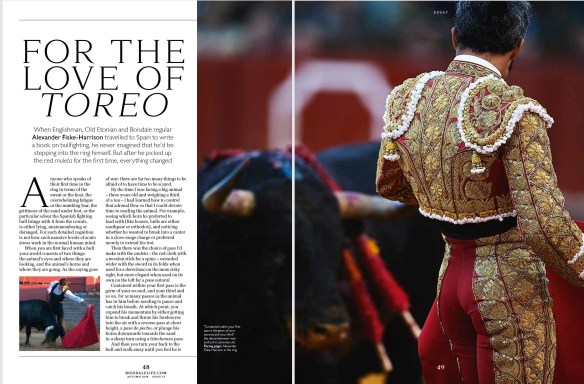
When Englishman, Old Etonian and Boisdale regular Alexander Fiske-Harrison travelled to Spain to write  a book on bullfighting, he never imagined that he’d be stepping into the ring himself. But after he picked up  the red muleta for the first time, everything changed

People speak of their first time in the ring in terms of the sweat or the heat, the overwhelming fatigue or the numbing fear, the grittiness of the sand under foot, or the particular odour the Spanish fighting bull brings with it from the corrals. They are all either lying, misremembering or deranged. For such detailed cognition is not how massive levels of acute stress work in the normal human mind.

When you are first faced with a bull your world consists of two things: the animal’s eyes and where they are looking, and the animal’s horns and where they are going. As the saying goes of war: there are far too many things to be afraid of to have time to be scared.

By the time I was facing a large bull – three years old and weighing a third of a ton – I had learned how to control that adrenal flow so that I could devote time to reading the animal. For example, seeing which horn he preferred to lead with (like boxers, bulls are either southpaw or orthodox), and noticing whether he wanted to break into a gallop in a close-range charge or preferred merely to lengthen his stride at a trot. Then there was the choice of pass I’d make with the muleta – the red cloth with a wooden stick for a spine – extended wider with the sword in its folds when used for a derechazo in the right hand, or on its own on the more risky, but more elegant, left for a pase natural.

Continue reading

Iván Fandiño: We Who Are About To Die Salute You…

Death closes all: but something ere the end,
Some work of noble note, may yet be done,
Not unbecoming men that strove with Gods.

(from Alfred, Lord Tennyson’s ‘Ulysses’)

The 36-year-old Basque matador Iván Fandiño was killed by a bull in the ring yesterday in Aire-Sur-L’Adour, near Mont de Marsan, in the Nouvelle-Aquitaine region of southwestern France.

The hierro, ‘iron’ or brand, of the ranch of Baltasar Ibán along with its colours.

The bull, Provechito No. 53, was born in March 2013 in El Escorial in the province of Madrid, on the well-known as respect ranch of Baltasar Ibán – founded 1920 – whose herd is of the Contreras bloodline – whose origin is the historic Murubé line – with a touch of Domecq – whose origin is the historic Parladé line.

It was the third of six bulls fought that evening, and was actually being fought by the matador Juan del Álamo when Fandiño stepped in to perform a quite upon it – a sequence of artistic manoeuvres with cape done after the bull has faced the mounted picador with his lance.

This is not an uncommon occurrence in the centuries-old scripted sequence of a corrida. The corrida is not a sport, nor a fight (even though I use that English verb as “torear” has no proper translation) – nor thought of, discussed or reviewed in the papers as such. It is a tragic spectacle culminating in a ritual sacrifice.

Fandiño had already been awarded an ear from his own bull, the first of the evening as most senior matador – he became a full matador in 2005 in Bilbao (he was the only Basque matador at the time of his death) – and clearly thought this bull special enough that he could do something to entertain, impress or move the audience with it.

July 11, 2013-Pamplona, Spain- Matador Iván Fandiño does a pase de pecho with a bull from the ranch of Torrestrella of Álvaro Domecq (Photo © Jim Hollander / EPA)

Continue reading

An Essay On Bullfighting


the-last-arena-logo

José Tomás by Carlos Cazalis from his forthcoming book Sangre de Reyes, 'Blood Of

José Tomás by Carlos Cazalis from his forthcoming book Sangre de Reyes, ‘Blood Of Kings’

When I first went to a bullfight 17 years ago, I was 23 and was sure I would hate it. I was a passionate animal lover and had been a keen amateur naturalist since childhood, WWF & Greenpeace member and zoology undergraduate. Not an auspicious CV for a future aficionado de los toros.

As expected, what I saw contained many moments of brutality and blood  but I was surprised also to find I could see beyond them to feel moments of breathlessness thrill as well. What genuinely shocked me, though, was that I could also perceive intermittently, and only with one of the bullfighters present, a kind of beauty that was entirely new to me.

In my moral confusion, I decided to research this alien thing, reading what I could in English – mainly Ernest Hemingway and Barnaby Conrad – and going when possible to see a corrida, a ‘bullfight’, on my irregular visits to Spain. Each time I went with a little more understanding and a little less aversion. Some would argue I became more sensitive to the aesthetics, others that I had become more inured to the ethics (or lack thereof.) I wouldn’t like to say either way.

into-the-arena-coverIn 2008 I was commissioned to write a book on the subject and I moved to Seville for two years and among other researches I trained as a bullfighter to the level of matador de novillos-toros – a novice level matador de toros bravos – ending by killing a single animal in the ring, a novillo, a three-year-old bull weighing around a third of a ton. (Into The Arena: The World Of The Spanish Bullfight was published by Profile Books in 2011 and shortlisted for the William Hill Sports Book Of The Year Award the same year.)

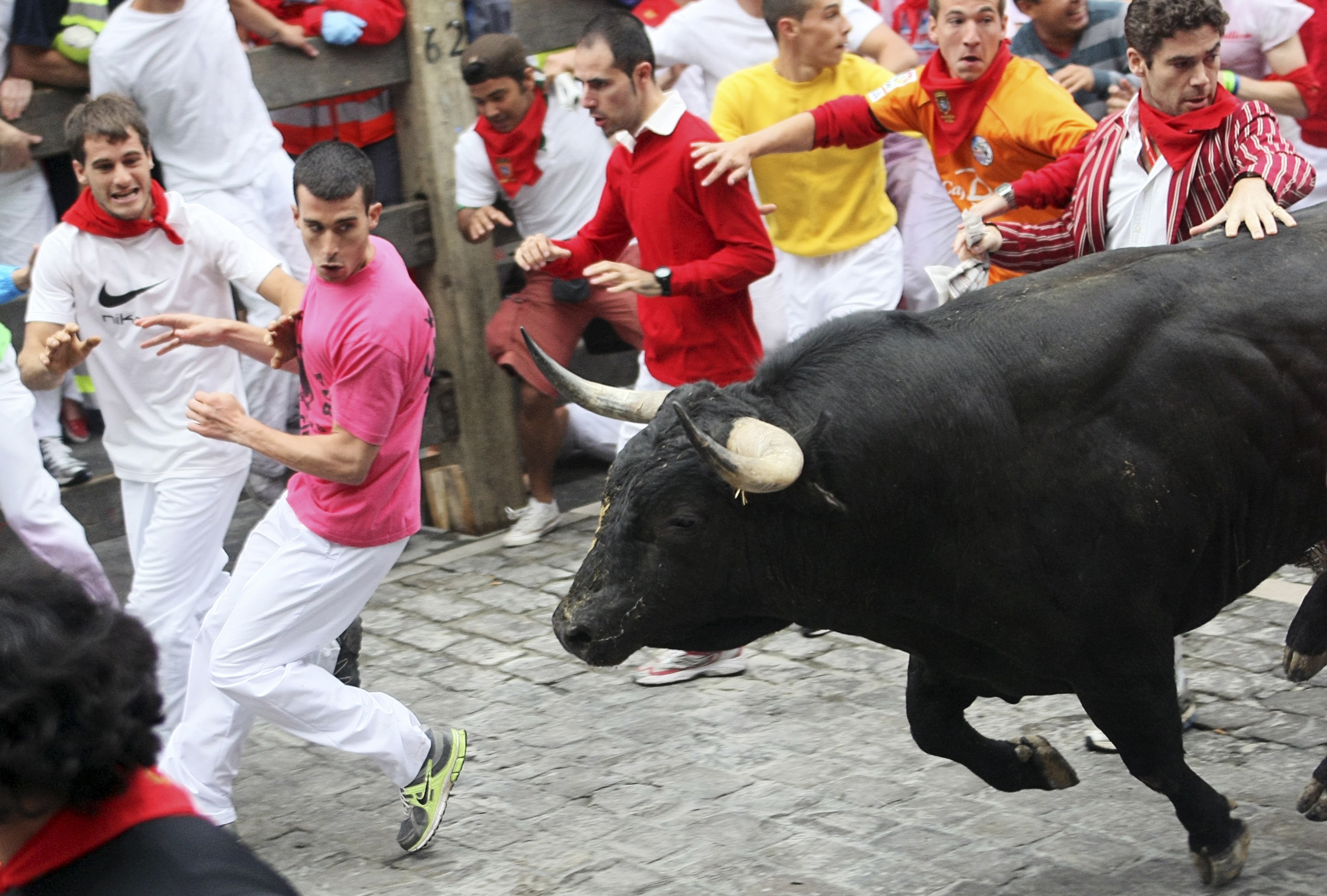
As part of the research, I also attended the encierros, ‘bull-runs’, of Pamplona and ran with fear and ignorance among the masses of drunken foreigners and adrenaline seekers. Unlike those visitors, I returned, and ended up running in towns across Spain, away from the tourist trail and among those born to this bloodless and less formal, more pagan practice. I ran with the bulls from San Sebastián de los Reyes in the suburbs of Madrid, to Falces, where you hurtle pell-mell down a goat-path, bordered by a sheer drop, in the foothills of Navarran Pyrenees. From Tafalla, also in Navarre, which resembles Pamplona in the 1920s to Cuéllar in Old Castille, which hosts the most ancient encierros in Spain.

(The book I edited and co-authored with the Mayor of Pamplona, Ernest Hemingway’s grandson, Orson Welles’s daughter and the finest bull-runners including the late Julen Madina, Jokin Zuasti and Reuters & EPA photographer Jim Hollander, The Bulls Of Pamplona (And Beyond), was published by Mephisto Press in 2017, available online here.)

I may be something of an oddity in my afición in English-speaking countries – although there is a Club Taurino of London as there is of New York – but in Spain (or Portugal, France, Mexico, Colombia, Peru, Ecuador, Venezuela) the picture is very different.

Alexander Fiske-Harrison running with the Torrestrella bulls of Álvaro Domecq - striped jacket - in Pamplona (Photo: Joseba Etxaburu - Reuters)

Alexander Fiske-Harrison running with the Torrestrella bulls of Álvaro Domecq – striped jacket – in Pamplona (Photo: Joseba Etxaburu – Reuters)

According to the annual figures on asuntos taurinos, ‘taurine matters’, published by Spain’s Ministry of Culture, the bulls are on the way back for the first time since the world economy collapsed in 2008.

The number of full-fledged corridas in 2015 stabilised at 394, down only 1% since 2014 compared with that year’s drop of 7% on the year before and 10% before that.

There were even large increases in some regions – Andalusia, Aragon, Murcia, the two Castiles and the Basque Country – and it seems that Madrid was the real fall, perhaps a reflection of the strange political stirrings going on in the capital.

The number of bullfights in the broader sense of the word – including novilladas for novices and rejoneo for horseback toreros etc., – 80% of which occur in Andalusia, Madrid and the two Castiles,  had fallen by 7% to 1,736, but this after a slight increase the year before.

Far more importantly in a country where subsidies distort the market, the number of people actually attending bullfights in 2015 was up to 3.7 million, an increase of more than a third of a million since 2011 when my book came out. Back, in fact, to pre-financial crisis levels.

This is alongside some 6.4 million having watched bullfighting on the television to which it had only returned in 2015 (and half a million more on the internet.) Continue reading

Noel Chandler, Prince of Pamplona: A Tribute

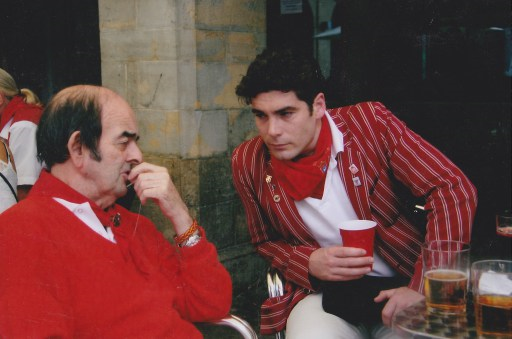
Noel Chandler and Alexander Fiske-Harrison, Pamplona, July 2013 (Photo: David Penton)

Noel Chandler and Alexander Fiske-Harrison, Pamplona, July 2013 (Photo: David Penton)

It seems it is my season for tributes to dead friends: I lost a near-sister on September 14th, and a true friend one month later on October 14th. Noel Chandler, though, was a few weeks shy of his 80th birthday, where Antonia Francis died just before her 40th. There is quite a difference.

The Spanish newspapers have been suitably effusive – for example his Pamplona local Diario de Navarra headlined with Welshman Noel Chandler dies, illustrious visitor to the feria of San Fermín’. However, they all seem to have propagated certain errors, starting with his age. Noel died at 79 not 76.

For that reason among others I am pleased not only to include my own memories of Noel, interspersed with a little journalistic research (about, for example, his service in the army), but also an interview he did with the secretary of the Club Taurino of London, David Penton, for their magazine La Divisa in 2013 which I suggested someone should do before it was all forgotten. However, nothing will ever capture the man in full. As even David noted when he forwarded the piece:

I promised to send you… the Lunch with Noel article which you prompted me to do. I hope you think it does him justice. Sadly he asked me to take a number of things out – mostly related to his generosity.

I’ll raise a glass to that.

AFH

Noel John Chandler

On his way to the great encierro (Photo: Jim Hollander, 1981)

On his way to the great encierro (Photo: Jim Hollander, 1981)

15 November 1935, Newport, Wales – 14 October 2015, Madrid Spain

B.A. (Hons.) Law, University of Bristol, 1958.

Lieutenant, Middlesex Regiment (Duke of Cambridge’s Own), 1961.

Managing Director, ICL Singapore Pte Ltd. 1994.

After the corrida on the final day of my first feria de San Fermín –  July 14th, 2009 – a few hours before pobre de mí– when I was… (ahem)… tired and emotional having run with bulls that morning and drunk whatever was handed to me during the day until I had seen them killed very badly that evening, I bumped into a pretty young woman called Ivy Mix – a good name for such a famous bartender – who led me to a bar called Al Capone where in the doorway was standing Noel Chandler.

I had heard of Noel, of course, but in my research for my book Into The Arena: The World Of The Spanish Bullfight I had courteously avoided British and American aficionados as I did not want to inherit non-native prejudices or to see Spain second-hand. (The only reason I had gone to Pamplona was because my first teacher of toreo, Juan José Padilla said he would run with me and his bulls.)

Miss Mix introduced me to Noel saying I was writing a book on the world of the bulls. Noel looked into my eyes – which were a little blurry on the third day of my first Pamplona fiesta – through his own  – which were… well, he was ten days into his forty-eighth fiesta – and said:

“What the fuck do you know about bulls?” Continue reading

My article ‘See you soon, Cuéllar’ in El Norte de Castilla

El Norte de Castilla 2014 header

Yesterday’s newspaper

Yesterday, the Spanish regional newspaper El Norte de Castilla – ‘The North of Castile’ – published my third annual ‘thankyou-note’ article about the town of Cuéllar (original Spanish here), in Castile and Leon for its generosity during its feria – my favourite – and its incredible bull-runs. I cannot recommend the town enough to visitors and tourists – especially during the feria, where the bull-runs are as spectacular to watch as they are to participate in (as I have written before for the Financial Times.) The best place to stay is the Hotel Mesón San Francisco (click here to book), and other details of the town are in the article below. It is an hour and a half’s drive from Madrid, or a twenty minute fast train to Segovia and forty minute taxi ride… AFH

El Norte de Castilla 2014

As it appeared in the paper…

See you soon, Cuéllar

Opinion

“I have run in many bull-runs, but my favourite is, without doubt, the one in Cuéllar»

Alexander Fiske-Harrison | Segovia

For three years now I have come to the heart of Old Castile for the Fair of Our Lady of the Rosary of Cuéllar, and each year before, like a polite but unfamiliar guest, I would write a thank you letter as is the custom of we English. (2012, 2013) Now that I feel know Cuéllar a little better, even if not each of its inhabitants personally, and I can address you less formally, as real friends are allowed to do. And yet there are still so many thanks to be given, and not just from myself in England but also from my other friends whom came from around the ‘Anglo-Saxon’ world this year: from Australia and from Scotland, from Canada and from Wales, even from Australia (you have had celts from Ireland in your Irish pub since before I first came.) And of course,  your great sculptor of, historian of and runner of encierros, Dyango Velasco.

(From outside the Saxon world we also brought a crazy Viking from Sweden – who ran with your bulls despite an aneurysm in his leg – and an even crazier Mexican, who never normally runs, except he found himself lost in the forest among the bulls – the blind leading the lame among the lethal.)

We all of us wish to thank Mariano de Frutos, his daughter Elisa and her husband Ruben Salamanca at the Hotel Mesón San Francisco, which was our headquarters in much the same way Hotel Quintana in Pamplona was once that of Ernest Hemingway and his friends – it is also the hotel of the bullfighters, some of whom I still know – and gardens on calle San Francisco are like the outside tables of the Café Iruña, attended with divinely inspired patience by Enrique and Cristina. However, we also ventured beyond our querencia – ‘lair’ – there, to your peñas, beginning on the afternoon of the Pregón with Bill’s presenting his new novel – with me as translator – at El Pañuelo at the invitation of its president Valentin Quevedo on its fiftieth anniversary for CyLTV and various assembled journalists. There is also always Dyango’s peña el Orinal, and the even nameless poker club of Luis Quevedo and his wife Soco since their son Alberto’s Bodega La Carchena has closed. In the words of our poet Tennyson, “though much is taken, much abides.” So instead we went to the flamenco of the Café Theatre Oremus of Marcos Gómez and the taurine bar Paralex of Miguel Ángel Cobos who has more carteles than your town hall, but no bull’s head (yet.)

Alexander Fiske-Harrison, Larry Belcher and Dyango Veslaco in Café Oremvs (Photo: Mónica Rico)

Alexander Fiske-Harrison, Larry Belcher and Dyango Veslaco in Café Oremvs (Photo: Mónica Rico)

Continue reading

My Kingdom for a Horse

Nicolás Haro's brother, Kinchu, Burghie Westmorland and Alexander (Photo: Mercedes Aguilar Camacho)

Nicolás’s brother, Kinchu, Burghie Westmorland & Alexander Fiske-Harrison (Photo: Mercedes Aguilar Camacho)

Seville, Spain: Nicolás Haro’s exhibition at SICAB – Salón Internacional del Caballo de Pura Raza Española, ‘international salon of the thoroughbred horses of Spain’ – of his photos was a huge success. I only hope that our idea of turning this into a book, with his photos accompanied by my words – some of them are already in my foreword to his exhibition catalogue here – becomes a reality. Then, I can also embark on my book on wolves and humans and continue my on-going coverage of man’s relationship with the rest of the Animal Kingdom. Nicolás’s interview in the Spanish national newspaper, ABC, is below. Here’s some of what he has to say in English…

—What do you remember of Alexander Fiske[-Harrison]?
— He became a friend and has participated with an article in the catalogue of ‘équema’. So has José Antonio Sánchez Cousteau (jockey and writer) with another interesting article.

—But Fiske lived here in Sevilla and wanted to be a bullfighter. Did he ever tread the sand of a bullring?

– (Laughs) I believe so. Yes, he got to tread the sand. And he killed a bull. Nothing less than a Saltillo [an old and famously tricky and dangerous breed of Spanish fighting bull]

Nicolas y yo en ABC sobre caballos

Continue reading

All The Pretty Horses by Nicolás Haro

As they salt the roads for ice and the mercury falls below par, it is time for a last venture to Seville of 2013 for my friend and colleague Nicolás Haro’s exhibition of photography of the psychological and behavioural ties between humans and horses.
Packed and back on the road...

Packed and back on the road…

Nicolás took the contemporary black and white images which illustrated my book Into The Arena: The World Of The Spanish Bullfight (Profile Books, London, 2011, finalist, William Hill Sports Book of the Year 2011.)

Since I contributed the introduction to the exhibition’s catalogue, it was nice to have an excuse to flee the chill. As for why it belongs on a blog about bullfighting, well… I’ll start with Nicolas’s words and then mine (in the English original.)

Alexander Fiske-Harrison

image

Dear Friends,

By virtue of my relationship with various bull breeders, I take the liberty of addressing myself to you, to inform you that, during the week of SICAB, Salon Internacional de Caballos de Pura Raza Española, which I understand that you or your associates will be attending, I will be inaugurating an exhibition centred on the figure of the horse, with all of its emotional vitality.This exhibition is produced with the support of the ganadería Estirpe Cárdenas, The Real Maestranza de Caballería de Sevilla, and Bodegas Infantes de Orleáns y Borbón.

To this end I attach an invitation to the exhibition, which I trust will be of interest to you. I will be delighted to meet you personally at stand number 2164/2165, where the exhibition will be held. On Wednesday evening I am pleased to invite you to a cup of sherry from 7:30 on; the exhibition will be open throughout the week.

I look forward to seeing you there.

Best regards,

Nicolás Haro Fernández de Córdoba

http://www.nicolasharo.com

image

The horse: Our last love…

Of all the major animals that man has taken into his home, the horse was the last.

The first was the wolf, which not only gave us the dog, but changed us forever. How different the tribe which had to risk its braves facing the bison and mammoth with spears, to the one which could merely wound with a few well-placed arrows and then unleash the pack to bring the beast down many miles distant.

However, after that ally, all the animals we brought into the house – cattle, sheep, goats, chickens – were much briefer and less honoured guests whose short lives ended in our stomachs.

Not so, the horse. If anything, he lifted man out of such base and basic interests. A horse gave a man a metre more height, twenty kilometres per hour more speed, and 400 kilos more muscle. He made a man into more than he was before, which is why the first men on horses, probably nomadic Asian tribes, when seen by those who could not ride such as the first Minoan Greeks, gave rise to the myth of the ‘centaur’, half man, half horse.

The centaur also represented the deep and ever-present connection which must be present between horse and rider. Cattle can be herded and need not have their bestial nature altered, only diminished: the minotaur merely blundered around the labyrinth of Crete, while the combination of man and wolf -the lycanthrope or werewolf – was more savage still. However, in classical tradition, Chiron, a centaur was tutor and mentor to Theseus, Achilles, Jason and Perseus.

Away from myth, horses made men into more than they were because of their role in war, from which the original notions of nobility were derived. Caballero in Castilian, Chevalier in French, Cavalier in English, all mean both horseman and someone who is more than a common man. A knight was defined by his horse, both literally – he must possess one – and abstractly, the code he followed, that of chivalry, owes its etymology to the horse as well.

Horses, literally and figuratively, raised man up. However, what of the animal itself? Although the horse assisted man’s warlike nature, man himself could not live in a state of war with an animal that had to bear him into battle. The oldest breed of horse, the four and a half millenia Arabian – whose blood flows so strongly in both the pure race of Spain and thoroughbred of England – had to live within the tent with his Bedouin masters, which, in an animal so large, required one of intelligence, sensitivity, physical control and grace and the ability to understand his master and, most of all, to make himself understood. Hundreds of kilos of undemonstrative terror or anger cannot long live happily in the house of human beings. The most communicative, intuitive and attuned to the human psyche would have been selected for, just as much as the courageous and the strong, the tireless and the obedient.

It is this vital psychic kinship between man and animal that the photos of my friend and colleague Nicolás have so elegantly captured, a kinship which I myself was brought up to feel and have witnessed in Nicolás in his dealings with horses as well as the art he has made from them. His images contain so many of the emotions we share: pride, fear, playfulness, despair, resignation and power. They are a reminder although the centaur – like the unicorn and the pegasus – may not exist: we have much to learn from pondering the very real ethological and psychological origins of these ideas.

Copyright Alexander Fiske-Harrison December 2012

The Cult Of The Bull

20130612-010502.jpg

As the 2013 season draws to a close, I have just received my copy of Olé! Capturing the Passion of Bullfighters and Aficionados in the 21st Century, which is filled with chapters and photos by some the foremost among the English-speaking faithful in the Spanish ‘Cult Of The Bull’, brought together and edited by Hal Marcovitz. (Available at Amazon in the US here, and the UK here.)

There are also wonderful photographs, alongside those by Jim (who is responsible for the stunning cover), from my dear friend from Seville, Nicolás Haro, shortlisted contestant for the internationally presitigious Photo España prize.

(Nicolás also took the black and white photos in my own William Hill Sports Book of the Year shortlisted Into The Arena: The World Of The Spanish Bullfight.)

His work on horses is being exhibited in an exhibition in Seville on December 3rd (for which I have literally just filed the ‘foreword’ to the catalogue.)

Photo Espana Nicolas Haro

I should add a mention of my review of the complete letters of Hemingway, from the period 1923-1925, when his interest in bullfighting and Spain first developed, for The Spectator, online here.

However, it is not my own writing I should like to promote in this blog post, but that of the other writers in Olé!, some of whom I have not exactly seen eye-to-eye with over the years.

Continue reading

Seville: I have not deserted her

Charlas Taurinas en Cuellar

I have been getting busy undoing the damage of Pamplona – barely a good run among five, injuries from that one, a habit of craving cognac at 8.05 a.m. – and began a regime of training for the infinitely more serious, and ancient, encierros, ‘bull-runs’, of Cuéllar in Old Castile which as I described in the travel section of the Financial Times (link here) (for which I am receiving my prize as stated – with odd spelling – in the above poster, along with my friend Nicolás Haro who took the photographs for the article.) I may be making my way out of the world of the bulls – as I’ve written here – but there’s still time for one last perfect run, one last job, one last score…

The-American-Spectator-LogoMeanwhile, my writing on the topic still trickles out, publication lags being what they are, this time in ‘The Great American Bar Room’ series in The American Spectator, which is finally available online here. It tells the story of an morning, afternoon, evening and night spent drinking with the great one-eyed matador, my old friend Juan José Padilla (before he lost his eye. How he lost his eye, and came back to bullfighting without it, I wrote up for GQ magazine hast year here.) SCN_0004
Reading that account of my time in Spain, at the very beginning my journey that I recounted in my William Hill Sports Book of the Year shortlisted Into The Arena: The World Of The Spanish Bullfight (details here), I realise again how much I owe to Andalusia in general, and particular to the city of Seville which gave me everything. Which is why, in its hour of need, I was particularly glad that my rewrite of one of the bestselling guide books in the world, the Wallpaper* magazine City Guide, published by Phaidon Press, has just come out.

These guides have sold well over a million copies. So when I was asked to “update” their Seville edition – replacing about half of the original text- I thought it would be an excellent chance to repay old friends, This is in no way dishonest, nor a conflict of interest: these friends simply are my friends because their establishments are the best in town. Sadly, they do not always fit the aesthetics of ‘urbane sophistication’ that Wallpaper* demands for its photographically-based pages. So they are mainly mentioned in the text. However, their is no simply no denying that if you go to Seville and want an apartment, you should go to my friend Kinchu’s apartments at Almansa 11 (they did get a photo, p.20, website here.)

Wallpaper cover

If you want a cheap hotel, stay at the Hotel Adriano by the bullring (from here on in, click on names for websites). If more expensive but traditional, Hotel Las Casas de la Judería (p.22-23) in the Barrio Santa Cruz of which my friend the Duke of Segorbe still holds a part. If boutique, Hotel Corral del Rey (p.30) belonging to the Scott brothers. And if old school grandeur, the Hotel Alfonso XIII (p.24-25) where we had such a great party in June…

The nicest restaurant near the bullring is that owned by Horacio, after whom it takes its name (and one of the few to speak English) on calle Antonio Diaz. Around the corner on calle Arfe is the most authentic of the small bars in town, Casa Matías which often has flamenco – sometimes sung by the moustachioed Matías himself – in the afternoons (the true flamenco, the cante jondo, the deep song, rather than the dance spectacle which tourists crave.) For the best old school atmosphere with your tapas, go round the corner again to Hijos de E. Morales on calle García de Vinuesa. For the finest ham, the jamón ibérico pata negra, go to Bar Las Teresas in Barrio Santa Cruz on calle de Santa Teresa, or for more modern tapas, Vinería San Telmo, owned by the charming Juan Manuel Tarquini on paseo Catalina de Ribera, also in that quarter. (These all feature on p.48 of the guide. None require bookings.)

Finally, for the true heart of Seville, go to La Maestranza, the great plaza de toros of Seville, where corridas de toros – it is not a bull-fight, nor is it a sport, as I argue throughout this blog – are held in the mini feria of Saint Michael on the last weekend of September, with the best young novice matadors on the Friday evening (27th) and some of the finest matadors on the Saturday and the very best on the Sunday. (For anything from matador’s swords to wallets made of toro bravo leather – go to the torero’s tailor, Pedro Algaba on calle Adriano, part of the Maestranza building itself – on p.70 of the guide.)

And there is so much else to see in Seville: every building of historic beauty fragranced by the iconic orange trees that line the streets; and the vast fallen bull of the cathedral in the baking sun, with its belltower, La Giralda – once the minaret of the Moorish mosque – standing matador-proud on the skyline; the art galleries and museums, the exquisite Moorish gardens of the Alcazar palace and the eclectic botany of the original Empire on which the sun did not set in the Park of Maria Luisa… and the beautiful river Guadalquivir carving through it all.

Alexander Fiske-Harrison