Vocento: “A Gentleman In The Ring”

(Versión original en español aquí.)

A couple of weeks ago the eleven newspapers of the Vocento Group in Spain – El Correo, El Diario Vasco, El Diario Montañés, La Verdad, Ideal, Hoy, Sur, La Rioja, El Norte de Castilla, El Comercio, La Voz de Cádiz, Las Provincias – ran the following interview with me. The only exception was ABC which ran this one a few weeks before.

Alexander Fiske-Harrison

A Gentleman In The Ring

by Francisco Apaolaza

Having crossed through a dimensional portal, suddenly he appears in the bull-run of Cuéllar (Segovia), in an out-and-out race with Spanish fighting bulls, a copy of the Financial Times rolled up in his hand. With each stride, Alexander Fiske-Harrison, English gentleman, writer, actor and reporter for the British press spans the huge distance between his world of the cultural and economic elite of London and the bull-run of Cuéllar with its dust, hooves, horns and shoe leather. This is the story of how one man crossed through the door of these parallel universes and then relayed it in the first person to the most anciest newspaper in the City.

Now, perhaps, the Financial Times will give a respite to the workhorse of Spanish debt and point instead to Spain’s oldest bull-run. Perhaps the best part of the story is the signature on the article. Fiske-Harrison is not the type of tourist who cannot distinguish a cart-ox from a fighting bull, but is an amateur bullfighter whose curious journey began many years ago while search of new cultures and strong sensations. What he found was very far from his life in a grand English family – a line of bankers – with its studies at Oxford, its games of rugby, horses, shooting and the exclusive red and white athletics blazer of Eton College, where Prince William and David Cameron also studied. Continue reading

Alexander Fiske-Harrison in ‘ABC’: “Many foreigners would not spend a cent in Spain without the bulls.”

The Spanish national newspaper ABC ran the following interview with me last week (with photos by Nicolás Haro).

The online version is available here. The beginning translates in a way you would only find in Spain:

Alexander Fiske-Harrison at his book launch in Seville (ABC)

Alexander Fiske-Harrison: “Many foreigners would not spend a cent in Spain without the bulls.”

Interview by Anna Grau

A British Gentleman passionate about the Fiesta, he is an amateur matador (the “bullfighter-philosopher” they call him) and has published a book on the art of bullfighting.

To Alexander Fiske-Harrison in his own country, which is the UK, some call him the “bullfighter-philosopher.” While others send him death threats, since he has gone from being active supporter of animal rights and a student of philosophy and piology in London and Oxford to being a matador in Spain. He is the author of Into the Arena (Profile Books), treatise on Spanish bullfighting for non-believers and foreigners. Many of which, he notes, come to our country intensely attracted to the fiesta nacional… and would swiftly back from where they came if this disappeared.

How to ask this man what he thinks of bullfighting ban in Barcelona? “Since then, the only money I’ve spent there has been to take a taxi from the airport to the train station to go to run with the bulls in Pamplona, a city that invests 4 million Euros each year in the Feria de San Fermín, and gets in return 60 million Euros from tourism.” Clear cut. Continue reading

The Spectator: A Good Run by Alexander Fiske-Harrison

My article from The Spectator, written largely on the breakfast tables of Pamplona, half cut on vanilla and cognac, having just run with the bulls.

AFH

A good run

14 July 2012

Why I risk my life among the bulls of Pamplona

I have just finished running — with a thousand like-minded souls from around the world — down a half-mile of medieval city streets while being pursued by a half-dozen half-ton wild Spanish fighting bulls. They were accompanied by an equal number of three-quarter-ton galloping oxen, but we didn’t worry about them: they know the course as well as anyone and keep the bulls in a herd. This is good, because when fighting bulls are on their own they become the beast of solitary splendour and ferocity you may see in bullrings across Spain, France, Portugal, Mexico and much of Latin America. However, every second week in July, during the festival of Saint Fermín, they are run together as a herd from the corrals to the bullring. Continue reading

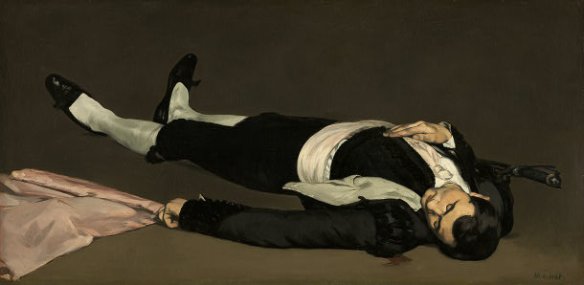
533 professional bullfighters killed in the ring since 1700

The Dead Toreador by Edouard Manet (c.1864)

Given the large number of people who have wandered to this blog in search of answers about the so-called ‘conversion’ photograph of Álvaro Munera from bullfighter to animal rights activist – which is actually not of him at all – I thought that I would set another record straight that has been bothering me for a while.

When the philosopher of animal rights, Mark Rowlands, was mistakenly commissioned by The Times Literary Supplement to review my book Into The Arena: The World Of The Spanish Bullfight, one of the multitude of mistakes he made, both logical and empirical, was his statement that there have been only fifty-two bullfighters killed or fatally injured in the ring since 1700.

(Ironically, he also said that my friend and former teacher, the matador Juan José Padilla, was more likely to die on the way to the bullring than within it. This was published eight days before Padilla had the side of his face destroyed, skull multiply fractured, and eye removed from behind, as the other recent posts on this blog show.)

Juan José Padilla teaches me the ‘banderillas’ at his home in ’09 (Photo: Nicolás Haro)

However, since I had never been macabre enough to try to add up the exact number of bullfighters killed in the ring, I did not have a statistic to hand to counter his general claim. I did, however, know the origin of Rowlands’ statement.

The American author on bullfighting Barnaby Conrad wrote in The People’s Almanac, No.2, Issue 2 (1978):

While hundreds of bullfighters have died in the arena, of the approximately 325 major matadors since 1700, only 52 have been killed in the arena.

I picked Rowlands up on his misleading misquotation in our exchange on the letters’ page of the TLS here (along with a few of his many other errors.) In his reply, he seemed not to have even understood that he was misquoting someone else’s statistic:

I say fifty-two in the last 300 years, Fiske-Harrison says (vaguely) “hundreds”… Fiske-Harrison’s language gives a false impression of the dangers to bullfighters.

Personally, I suspect that his intial error was actually to go on Google and take the first result he could find – Wikipedia – and, when challenged, he realised that this is absolutely no excuse for a tenured professor writing in a respected literary magazine which at one time took its reviews from the likes of T. S. Eliot, Virginia Woolf and Henry James.

Whilst I still do not know exactly how many bullfighters have died in the past three hundred years, I do now know what the minimum number is: it is 533.

That, by the way, is just the professionals notable enough to report on. The figure does not include amateurs killed in plazas and on ranches. And we can safely assume – looking that the documentary history of Spain and Latin America in the past three hundred years – that there were plenty of professionals whose deaths went unreported, especially in pre–antibiotic era when death would have come later from gangrene, tentanus and the other terrible routes which Hemingway described with such grim accuracy in Death In The Afternoon However, I think that speculating on figures without evidence is an excuse for bad scholarship.

In terms of evidence, every one of these 533 is described in detail in a four volume Spanish work entitled “Victims of Bullfighting.” All four volumes are available online here, and the numbers easily verifiable via the contents’ pages even for non-Spanish speakers.

http://www.fiestabrava.es/pdfs/MVT-1.pdf
http://www.fiestabrava.es/pdfs/BVT-1.pdf
http://www.fiestabrava.es/pdfs/PVT-1.pdf
http://www.fiestabrava.es/pdfs/NVT-2-1.pdf

Alexander Fiske-Harrison

GQ magazine on the comeback of the bravest bullfighter in Spain: Juan José Padilla

My British GQ article on the comeback of the now one-eyed bullfighter Juan José Padilla is online here. The US edition of GQ sent there own author to interview him afterwards, which was silly, as she hadn’t the first idea about bullfighting – whereas I’ve been doing it since 2009 – nor Padilla and his place in that world – whereas as I had the man as my first teacher. The photo below is of the two of us during one of those lessons. We were both very different men then. He had two eyes…

Fiske-Harrison and Padilla training with a young fighting bull in 2009.

By coincidence, Claire Danes, the beautiful actress on the cover of the issue on which the article appeared is a dear friend whom I thanked in the acknowledgments to the book that came out of those two years in Spain Into The Arena: The World Of The Spanish Bullfight in the first five chapters of which Padilla is so central. So I must thank her once again in the acknowledgments to this article, this time for providing such glamorous packaging.

Padilla is a man of great dignity, aesthetically and internally, but he isn’t exactly pretty. And, as Zed Nelon’s wonderful spread which opens the physical edition of the article shows, he ain’t no cover girl. The photo is in his house, which we went to the day before his comeback ‘fight.’

Please note, should you read the article, that, GQ holds the view, in common with many other publications, that when you pay a writer for his words, you have also bought the right to put words in his mouth.

I, personally, could not write a phrase like “my dread boiled.” (What I actually wrote was “I was worried.”) My dread just doesn’t boil (anymore).

Nor could I have written that the Spanish financial bailout was £80m. I used to work for the Financial Times and know a million from a billion.

Nor did I write the paragraph below, which appeared twice, once as a pull quote. I don’t even really agree with it.

Just so you know. (Bullfighters do not compare bull’s horns to “a Louboutin stilleto”. Ever.)

Anyway, much of the article is mine, and all of Padilla’s words are his own, which on their own would make it worth reading. However, if you come across something in the article that feels wrong, then it probably is, and probably didn’t come from me.

Anyway, if you want to know Padilla’s whole story, and much, much more, read my book Into The Arena: The World Of The Spanish Bullfight. You can purchase it as an eBook via GQ on their website where it tops their recommendation list here. (It was also shortlisted for the William Hill Sports Book of the Year Award, “the world’s richest sports’ writing prize”.)

If you live outside the UK or want it as a physcial book, other options are here.

Alexander Fiske-Harrison

Bullfighting and the Gallup Polls: “Lies, damned lies, and statistics.”

I was recently interviewed on the BBC and one of the people also interviewed, a representative from People for the Ethical Treatment of Animals (PETA), brought up an opinion poll “by Gallup” in 2006, which said that 72% of the people in Spain were “against bullfighting.”

Now, putting to one side the fact that PETA’s claim was not true – the poll actually said that 72% said they had “no interest” in bullfighting – this got me thinking. There was another “Gallup poll” I read about from four years before which said that 69% of Spanish people polled had no interest, and the most recent one, from 2008, gave the same figure. These are big swings: millions of people.

So I looked into it further, and what I found was fascinating. Continue reading

Perhaps bullfighting is not a moral wrong: My talk at the Edinburgh International Book Festival

Yesterday evening I immensely enjoyed giving a talk to the sold out audience at the 500-seat Scottish Power Theatre at the Edinburgh International Book Festival on my award-winning book Into The Arena: The World Of The Spanish Bulllfight. It was followed by a discussion with the chair, Al Senter, and the Q&A session with the audience that (along with brief personal chats with about half of those present who came to have their books signed by me in the London Review of Books tent afterwards.) The questions were all well-informed and interesting, not least because, as many of the audience members said to me in person, I’d answered most of the more controversial questions in my opening talk. Here is the transcript of what I said:

* * *

I was going to read from my book, but it seems that the most important topic in the United Kingdom in the 21st Century, indeed in the English-speaking world – when discussing bullfighting – are the ethical issues surrounding the injuring and killing of animals as part of a public spectacle. So I want to address these head on.

As a liberal – in the classical, John Suart Mill sense – it is not my intention, or my place, to tell people whether or not they should approve of or enjoy bullfighting anymore than it is whether they should approve of or enjoy opera. However, when people seek to ban an art form from existing, so that other people may not enjoy it, whatever claims have been made by other people who have never witnessed it, then certain questions have to be raised.

Whatever the motivations behind the ban on bullfighting on Catalonia – and there have been accusations of underhand dealings, thumbing of noses at Madrid to gain votes, which has some circumstantial evidence for it as the popular Catalan regional hobby of attaching burning tar balls and fireworks onto bulls’ horns and letting them into the streets is unaffected by the legislation – anyway, the stated reason is the ethics, or rather lack of ethics, of bullfighting. So, that is what I should like to discuss here.

However, before I can do that, I have to dispel some myths that have long surrounded the bullfight, pieces of propaganda that have been propagated by the anti-bullfight lobby such as CAS International, the League Against Cruel Sports and PETA.

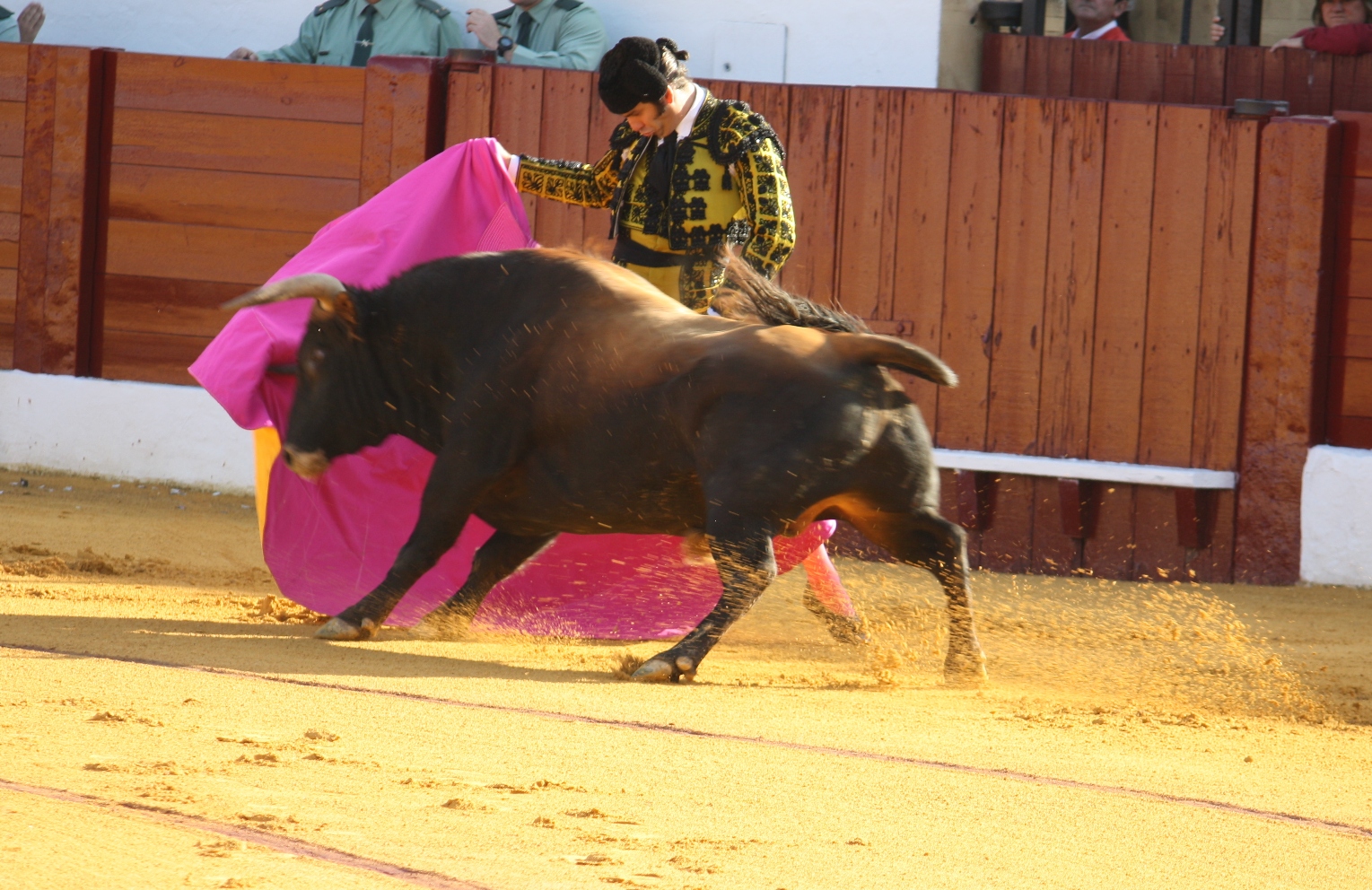
The one I most often hear is the complaint that the matador faces a broken down and destroyed animal. Take a close look at this bull in these photos and tell me how broken down it looks.

Morante de la Puebla performs a ‘veronica’ (Photo: Author)

Continue reading

‘World’s Scariest Animal Attacks’ on Channel 5* (UK) & Discovery Channel (USA)

It is nice to see that the inteview I filmed at my favourite tapas bar in London, Capote y Toros on the Old Brompton Road, was broadcast again as narration for the fighting bull segment in ‘World’s Scariest Animal Attacks’ on both sides of the Atlantic last night.

If you missed it in the UK, on Channel 5* at 9pm BST last night, you can watch it again here. If you missed in the US at 10pm EDT last night on the Discovery Channel as part of ‘Shark Week’ (when is it not Shark Week on Discovery?), it can be seen again today, August 16th, at 12 am & 2:00 pm, and then again on Aug 18th at 11 am.

Alexander Fiske-Harrison is the expert witness on the toro bravo – Spanish fighting bull – segment of ‘World Scariest Animal Attacks’, first broadcast in the Spring on Channel 5 in the UK, re-broadcast on the Discovery Channel in the US…
In 2010, a fighting bull went on the rampage through the crowded audience at a bullring in Tafalla in north-eastern Spain. The event was not a bullfight, though, but a spectacle of acrobatic bull-leaping, in which the bull normally leaves the ring unharmed to be used again. However, this time, things ended very differently, and very badly, for the people in the audience and the bull…

Mentorn TV

You can read more about Alexander Fiske-Harrison’s account of his two years in Spain, Into The Arena: The World Of The Spanish Bullfight here, where there are also links to purchase or download from Amazon, iTunes etc.

The famous ‘conversion’ photo of the ‘matador’ Álvaro Múnera is…

Fraud

…actually of the real matador Francisco Javier Sánchez Vara, while the words associated with it were actually written by Antonio Gala Velasco in the Spanish newspaper El País. Read the full story on my updated blog post hereAlexander Fiske-Harrison

The Barcelona Ban on Bullfighting: Two Years on…

Two years after the regional parliament in Barcelona voted to ban the corrida de toros, known in English as bullfighting – although not other forms of ‘playing with bulls’ – throughout Catalonia, it looks increasingly like this will piece of legislation will be overthrown by the federal government in Madrid when they, following France, make the corrida a matter of protected cultural interest.

It is interesting to review the arguments on both sides in this matter, and, despite asking me – who am avowedly anti-ban not least because I am politically a liberal – to write the foreword, the most balanced book produced on the subject remains the series of interviews with animal rights groups, bullfighters, politicians and journalists by Cat Tosko. Just take a look at the contents list below. I also enclose my foreword in full.

Alexander Fiske-Harrison
 
The book is available as a paperback or eBook for £5 at Amazon UK here, or Amazon US for $8 here.


The Bull and The Ban

Interviews from both sides of the debate on the controversy surrounding bullfighting, its recent ban in the autonomous community of Catalonia and its future in Spain, the rest of Europe and the Americas…

Contents:

Foreword by Alexander Fiske-Harrison – author of Into The Arena: The World Of The Spanish Bullfight.

Introduction by the interviewer, Catherine Tosko – documentary filmmaker and former Animal Rights activist.

The Interviews

Alfred Bosch: Catalan MP & Coalition Leader, Catalan Parliament

Antoni Strubell i Trueta: Catalan MP & Author

Rampova: Catalan artist

Marilén Barceló: Catalan Psychologist, Bullfighting aficionada

Bob Rule: British aficionado, member: Club Taurino of London

Miguel Perea: Spanish bullfighter (picador)

Emilio Bolaños Arrabal: Spanish bullfighter (banderillero)

Fernando Cámara Castro: Spanish bullfighting teacher (ex-matador)

Francisco Rivera Ordóñez: Spanish bullfighter (matador)

Frank Evans: British bullfighter (matador)

Alexander Fiske-Harrison: British author & bullfighter (aficionado practicó)

Gaspar Jiménez Fortes: Spanish bullring manager

Equanimal: Spanish Animal Rights lobby group

Graham Bell: British Animal Rights activist

Jason Webster: British writer: author of Duende: In Search of Flamenco and the novel Or The Bull Kills You…

Foreword

In this book you will find the entire range of views on bullfighting represented in a series of interviews – from those who are completely against it to those who are completely for it – backed by the strongest arguments they can give. And although in my own interview I give the views I have come to hold after two years in Spain researching my own book on the subject – namely against any form of ban, but with grave misgivings about the cruelty of the activity – I have actually inhabited each position given at different times along the way.

Continue reading